




For decades, Kerala’s public healthcare system has stood as a source of collective pride for the State. It was woven into the Malayali imagination as proof that a small State, with limited wealth and resources, could build an unparalleled humane public system and ensure healthcare delivery.
The proof is in the pudding. During the Nipah outbreak and later during the COVID-19 pandemic, this confidence reached an extraordinary peak under the stewardship of the then Health Minister K.K. Shailaja. Kerala’s Health Department became synonymous with clarity, preparedness, scientific communication, and administrative decisiveness. The daily evening press address of Chief Minister Pinarayi Vijayan during the pandemic became the hallmark of State reassurance and the Left Democratic Front (LDF) government led by Vijayan rode to power for a second term with a thumping majority in 2021 on the back of this success.
That success, however, could not be repeated nor the momentum kept alive during the second term.
The more Kerala’s reputation grew during the pandemic years the harsher was the scrutiny that followed, when the public health system appeared to weaken in the post-pandemic phase. In a State like Kerala, which is politically literate, media-sensitive, and deeply networked through local communities, expatriate families, and civil society, governance failures are rarely evaluated in isolation. They accumulate socially, emotionally, and conversationally long before they manifest electorally.
By the time of the May 2026 Assembly election, healthcare had evolved from a policy sector issue into a metaphor for a broader perception of the second LDF government’s incompetence.
Change in leadership
A major factor in this perception was the leadership transition in the health department. The appointment of Veena George as the Minister in the second term turned out to be politically risky. Firstly, Veena George did not come into office with substantial experience in healthcare, public health systems, epidemiology, hospital governance, or crisis management. Neither did she accumulate any experience in administration or policy making.
Her only claim to fame remained her media experience as a reporter and anchor. Therefore, her knowledge and experience in healthcare remained close to that of an average mediaperson. In Kerala, where public discourse on health is unusually sophisticated and citizens routinely engage with questions of policy, institutional quality, and welfare delivery, this absence of domain familiarity became politically consequential.
Veena George’s comparison with Shailaja persisted relentlessly and came to haunt the Left Front as the election came closer. Fairly or unfairly, Veena George had inherited not merely a Ministry but an expectation shaped by one of the most celebrated public health performances in contemporary India.
Under Shailaja, the planning, execution, and communication during a major crisis had instilled great confidence among citizens. Veena George’s tenure, however, was characterised by uncertainty and defensiveness.
The discontent sharpened as it became conspicuous in routine healthcare delivery, the everyday functioning that directly shapes citizens’ lives. Reports of medicine shortages in government hospitals began surfacing from multiple districts. Patients complained that prescriptions issued in public hospitals could not be fully procured at hospital pharmacies, forcing them to purchase medicines privately. Intermittent shortages were reported in essential consumables, reagents, and surgical supplies.

Health officials setting up a temporary COVID-19 antigen detection test lab at Palakkad on August 5, 2020.
| Photo Credit:
K.K. MUSTAFAH
For a State that had long celebrated its public healthcare system, such experiences carried symbolic weight. Kerala’s voters were not comparing themselves merely to weaker-performing States, they were comparing their government to Kerala’s own past standards.
Criticism of priorities
Another criticism that steadily gained traction was the perception that the government prioritised visible infrastructure over systemic strengthening. New hospital buildings, specialty blocks, and inaugurations became frequent markers of official publicity. Yet many doctors, health workers, and commentators argued that physical expansion was not matched by adequate recruitment, specialist appointments, biomedical maintenance systems, supply-chain resilience, or operational planning.
Over Rs.10,000 crore of Kerala Infrastructure Investment Fund Board (KIIFB) funds were spent over the past 10 years on new buildings and facilities. The criticism gradually condensed into a politically damaging phrase: new buildings, old problems.
For instance, in late June 2025, Dr Haris Chirackal, then the head of the urology department at Thiruvananthapuram Government Medical College, sparked a major controversy by publicly whistle-blowing on systemic equipment shortages affecting patient care. He shared a viral social media post expressing his anguish over being forced to postpone elective surgeries at the last minute owing to a lack of critical equipment and basic accessories. The Directorate of Medical Education (DME) issued a show-cause notice to him, alleging that he violated government conduct rules and defamed the Health department by airing his grievances publicly instead of utilising official channels.
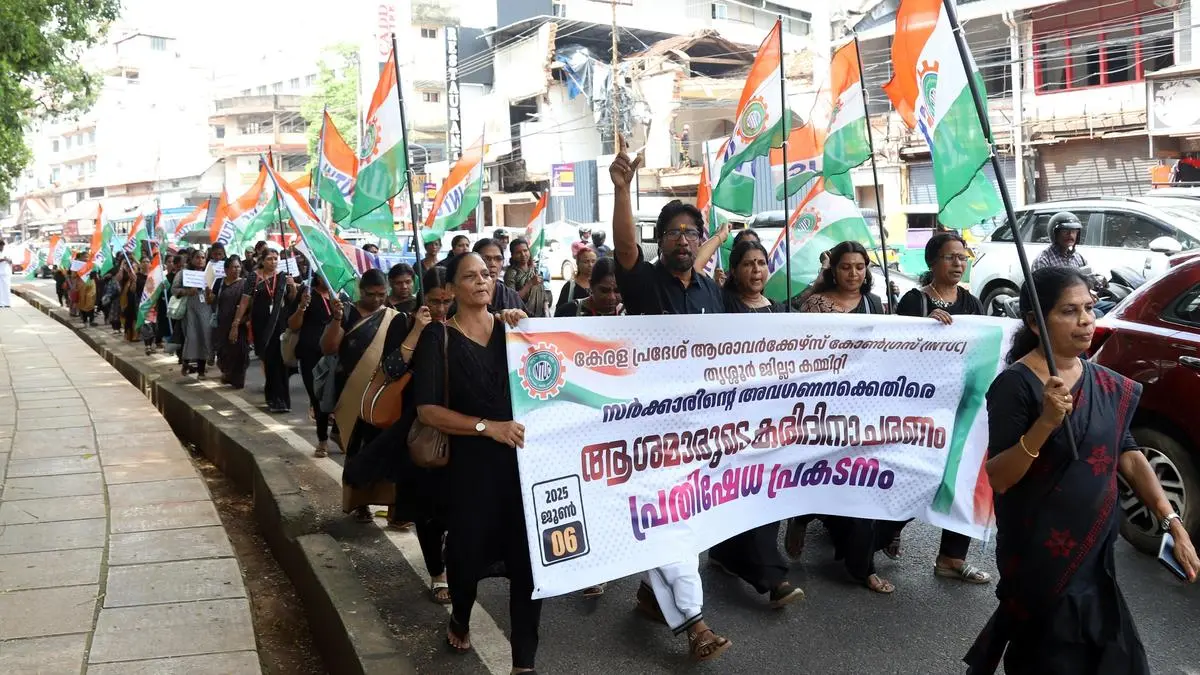
Simultaneously, the prolonged agitation by Accredited Social Health Activist (ASHA) workers became one of the most emotionally resonant controversies of the second term. During the pandemic, ASHA workers had been celebrated as frontline heroes who carried healthcare into villages, households, and vulnerable communities. But in the years that followed, dissatisfaction grew over low honorariums, delayed payments, inadequate incentives, and the government’s reluctance to seriously engage with their demands.
In Kerala’s political culture, grassroots workers are not invisible labour. They are embedded within neighbourhoods, self-help groups, and local political networks. Their frustrations travel quickly through society. When ASHA workers publicly protested, many voters did not see it as an isolated labour dispute. They saw a contradiction between the government’s rhetoric and its treatment of frontline health workers.
The dissatisfaction was not confined to ASHA workers alone. Nurses, temporary staff, lower-tier employees, and sections of doctors increasingly voiced concerns regarding workload, burnout, staffing shortages, delayed appointments, and institutional pressures. This created the impression that the health system was becoming overstretched without corresponding administrative responsiveness.
Middle-class anxieties
In the meanwhile, middle-class anxieties also intensified. Increasingly, families who ideologically supported welfare-oriented public healthcare felt compelled to seek treatment in private hospitals due to overcrowding, long waiting times, delayed diagnostics, or lack of confidence in availability of medicines and specialists in government hospitals.
This was politically significant because Kerala’s middle class has historically been one of the strongest social validators of the State’s public health achievements. Once sections of this constituency began expressing doubt, the narrative of decline spread rapidly.
The surge in private hospitals and the government indirectly endorsing them did not help the discontent. Equally worrying, people without health insurance were unable to approach private hospitals.
Compounding this was the issue of financial stress within the healthcare ecosystem. Delays in payments to suppliers, procurement inefficiencies, and pressures linked to welfare-linked schemes fed into a broader public conversation about the State government’s fiscal difficulties. This was despite the State’s investment in health and family welfare increasing from Rs.5,000-6,000 crore a year in 2015-16 to Rs.14,079.96 crore in 2025-26, one of the fastest rises in the country.
In Kerala’s politically aware society, budgetary strain is rarely understood as an abstract macroeconomic issue; citizens interpret it through lived institutional experiences such as unavailable medicines, delayed services, postponed recruitment, and administrative slowdowns.
Squandering COVID-era goodwill
Perhaps the deepest criticism of the second LDF government’s approach to health was that it failed to convert pandemic goodwill into long-term structural reform. Kerala had earned enormous global attention during the pandemic, creating expectations that the State would use that momentum to modernise disease surveillance, strengthen primary care, further improve geriatric and mental health systems, expand staffing, and build resilient logistics. Critics began to increasingly argue that a historic opportunity had been lost in the second term.
The prolonged failure to bring an All India Institute Of Medical Sciences (AIIMS) to the State also became politically damaging. Critics argued that while Kerala frequently accused the Centre of neglect, it too contributed to the delay by failing to build consensus around a suitable site and by not moving swiftly enough to secure a land parcel that met all requirements without dispute.
In public perception, the debate gradually shifted from whether the Centre was denying Kerala the AIIMS to why a State renowned for administrative competence had still not succeeded in securing the spot for one.
Equally damaging was the government’s communication style during criticism. Rather than openly acknowledging gaps and engaging with concerns, the administration was often perceived as defensive. In Kerala, where political debate is vigorous and public trust depends heavily on transparency, the defensiveness amplified criticism rather than containing it.
Ultimately, healthcare became more than a sectoral issue. It became symbolic of what many voters saw as the broader condition of the government’s second term: centralisation of authority, administrative exhaustion, slower responsiveness, weakening grassroots connection, and diminishing energy for reform after an exceptionally strong first term.
This does not mean healthcare alone determined the 2026 electoral outcome. Kerala’s elections are shaped by overlapping forces such as unemployment, inflation, welfare delivery, anti-incumbency, religious and caste dynamics, fiscal pressures, and shifting social coalitions. But healthcare carried unusual political weight because it touched nearly every household, every class, and every region and religion.
In Kerala, healthcare is more than a public service; it is part of the State’s social contract with its citizens. When that system appeared to falter, voters did not merely see shortages of medicines, delayed appointments, or administrative lapses. They saw signs of a government losing its grip on one of its most fundamental responsibilities.
By the time of the 2026 election, many voters seemed to conclude that the second LDF government had not merely underperformed, it had allowed one of Kerala’s proudest post-Independence achievements to lose its sense of reliability, purpose, and public trust.
Ameer Shahul is the author of the bestselling book Vaccine Nation: How Immunisation Shaped India (Macmillan, 2025). His forthcoming title, The Silent Syndicate: Who Prices Your Health (Hachette, 2026), explores the changing dynamics of India’s healthcare ecosystem.
Also Read | Kerala struggles, stretched to the limit
Also Read | Kerala: The closest call in a generation