





It begins with an email.
In response to questions about Pakistan’s compliance with global terror financing standards, the Financial Action Task Force (FATF) Media Team wrote: “Pakistan is not a member of the FATF… you may wish to contact the Asia/Pacific Group on Money Laundering APG directly.”
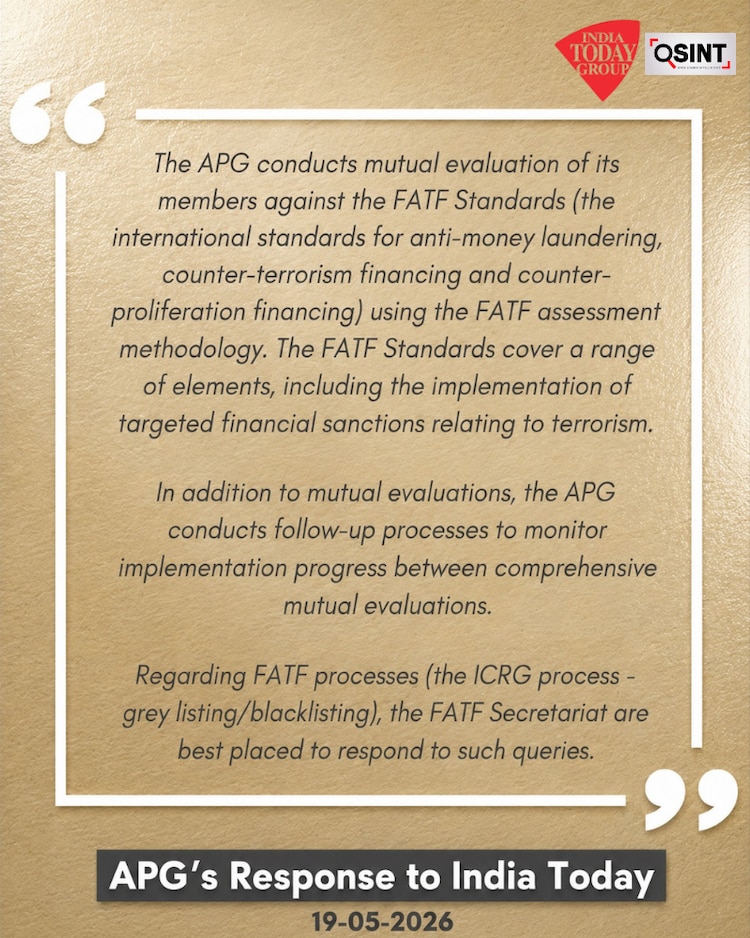
The APG, contacted separately — and more than once — responded: “Regarding FATF processes — the ICRG (International Co-operation Review Group) process, grey listing/blacklisting — the FATF Secretariat are best placed to respond to such queries.”
A final email was sent to the FATF with both responses attached, the loop laid out plainly, the questions specific and on the record. It has not been answered.
Between those emails, in a compound in Bahawalpur that this reporter has tracked since 2015, the domes of Jaish-e-Mohammed’s headquarters are going back up.
The Moment the Watchdogs Stood Down
In October 2022, the Financial Action Task Force removed Pakistan from its grey list — the formal register of countries under enhanced monitoring for deficiencies in combating money laundering and terror financing. The announcement from Paris was accompanied by the customary language of cautious optimism: Pakistan had addressed the required action items, the process had worked, the framework had held.
Within weeks, Jaish-e-Mohammed began raising money more openly.
This reporter documented that shift in December 2022. A UN-sanctioned, Pakistan-banned terrorist organisation — whose founder Masood Azhar remains one of the most designated individuals in the world — had gone into overdrive collecting funds almost immediately after the international financial pressure on Islamabad was lifted. The timing was not incidental. Working undercover, the India Today team had managed to speak with a JeM operative from Peshawar named Imran who was collecting funds for building new mosques. “We are doing it in Peshawar and all over Pakistan”, the operative said.
The story was published. No international body responded. No mechanism was triggered.
The Expansion Nobody Noticed
By early 2025, the silence had become structural.
In March of that year, satellite imagery obtained by this reporter showed that JeM’s headquarters in Bahawalpur — a sprawling compound in Pakistan’s Punjab province — had undergone significant physical expansion. Satellite imagery analysis showed that the Jamia Masjid Subhan Allah had doubled in size to over 18 acres, nearly twice its original footprint since its construction in 2011-12. More significantly, the pace of construction had accelerated in late 2022, which coincided with Pakistan’s removal from the Grey List as per Damien Symon, an independent geo-intelligence researcher at the Intel Lab.
The compound sits in a city that has long been identified in international terrorism assessments as a hub of militant infrastructure.
Pakistan was, at this point, not merely off the grey list. It was, by the formal reckoning of the global AML/CFT framework, a cooperating jurisdiction. Its compliance had been assessed. Its progress had been documented. It had been, in the language of the system, whitelisted.
The headline of this reporter’s March 2025 story: Exclusive: Terror Outfit Jaish’s Headquarters Expands in Whitelisted Pakistan.
No international body responded. No mechanism was triggered.
Pahalgam, Operation Sindoor, and the Rubble That Wasn’t the End
On April 22, 2025, terrorists killed 26 people, mostly tourists, in Pahalgam, Jammu and Kashmir. It was attributed to The Resistance Front, a shadow outfit linked to Pakistan based terror networks supported by its military.
On May 7, 2026, India launched Operation Sindoor — a series of precision strikes targeting terror infrastructure across Pakistan and Pakistan-occupied Kashmir. Among the sites struck was Bahawalpur. The headquarters this reporter had documented expanding through satellite imagery over three years was hit.
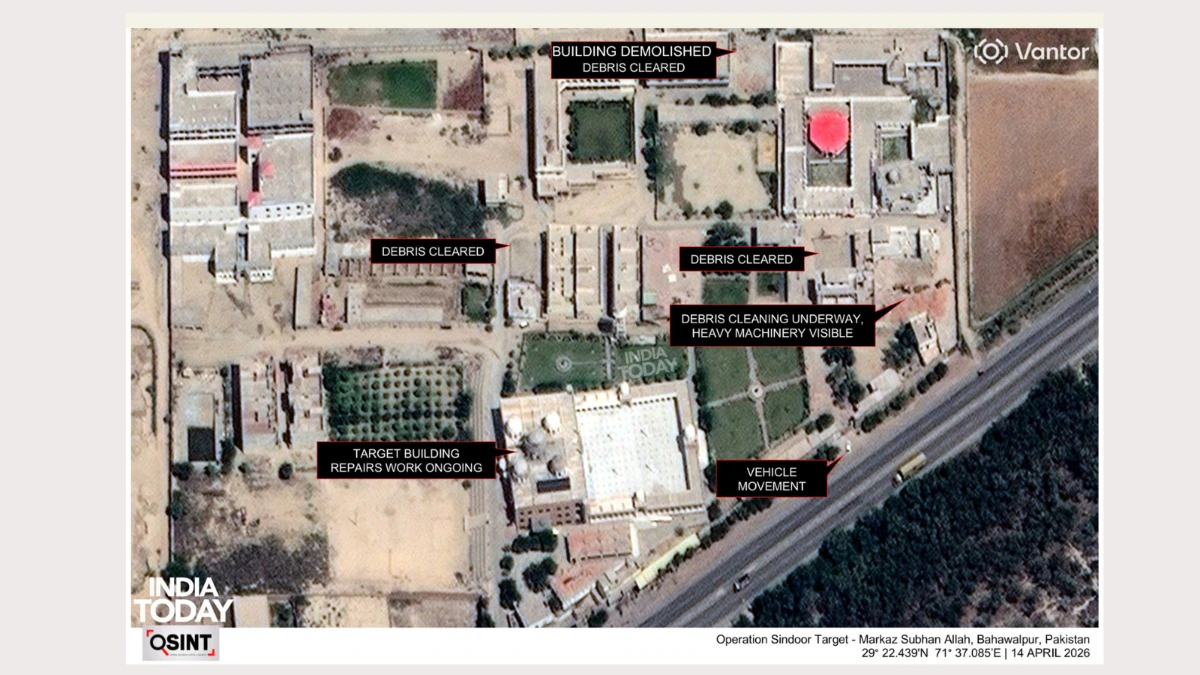
Within days, satellite images told a new story. The domes above Subhan Allah, which had sustained visible damage, now appeared restored, suggesting a push to return the facility to operational status. Additional activity was also evident at the complex, where debris from other impacted structures were being cleared. Heavy machinery was observed on site, continuing debris removal nearly a year after the strike.
The compound was not abandoned. It was not dismantled. It was being rebuilt.
This reporter published the findings on May 6, 2026. And then went looking for someone to be accountable for all of it.
The Loop
The question put to the Financial Action Task Force (FATF) was straightforward: given that Pakistan is subject to FATF Standards through the APG, and given documented evidence of active terror infrastructure in a country that has been removed from the grey list, what mechanisms exist to act on that evidence?
FATF’s response arrived promptly:
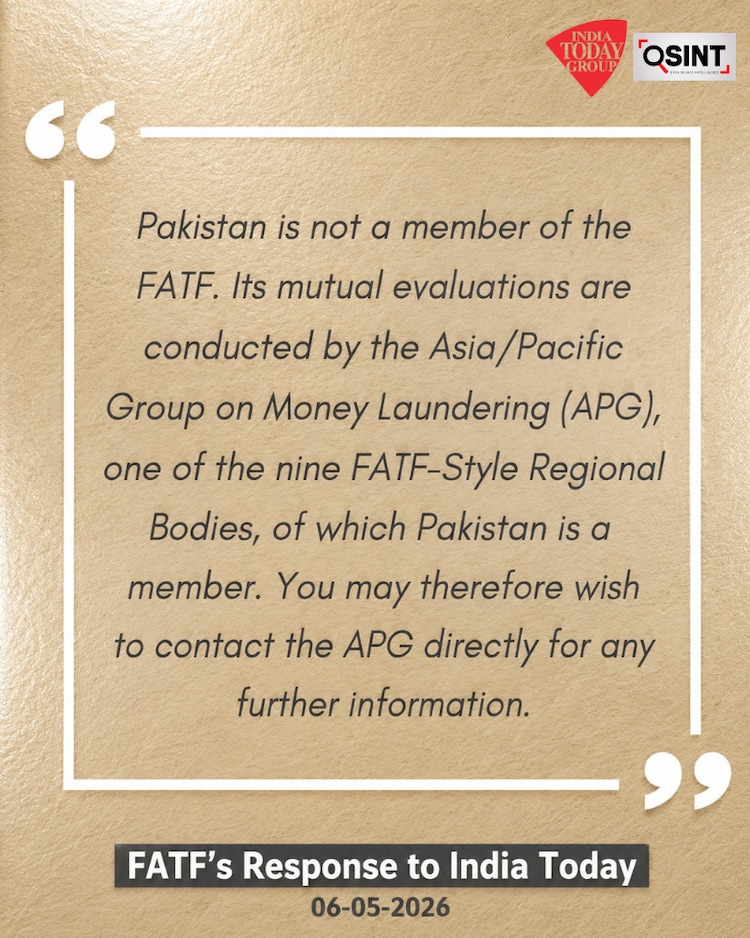
“Pakistan is not a member of the FATF. Its mutual evaluations are conducted by the Asia/Pacific Group on Money Laundering (APG), one of the nine FATFStyle Regional Bodies, of which Pakistan is a member. You may therefore wish to contact the APG directly for any further information.”
The APG was contacted. And then contacted again. Its response, when it came, was careful:
“The APG conducts mutual evaluation of its members against the FATF Standards (the international standards for anti-money laundering, counter-terrorism financing and counter-proliferation financing) using the FATF assessment methodology. The FATF Standards cover a range of elements, including the implementation of targeted financial sanctions relating to terrorism. In addition to mutual evaluations, the APG conducts follow-up processes to monitor implementation progress between comprehensive mutual evaluations. Regarding FATF processes (the ICRG process – grey listing/blacklisting), the FATF Secretariat are best placed to respond to such queries.”
Read it once, and it sounds like a responsible division of labour. Read it again — alongside the FATF’s response — and something else emerges.
The FATF says it does not evaluate Pakistan. The APG says it does evaluate Pakistan, but that decisions on grey listing and blacklisting belong to FATF’s ICRG process. The APG evaluates. The FATF lists. Between those two functions — between the body that generates the findings and the body that is supposed to act on them — there is, apparently, no automatic mechanism. No mandatory referral. No trigger.
There is clearly a structural gap that has been operating in plain sight, exploited quietly, for years.
The Questions That Were Never Answered
Armed with both responses, this reporter returned to the FATF with three specific questions on May 20:
First: what is the precise procedural mechanism by which APG findings — including evidence of inadequate implementation of targeted financial sanctions — are referred to the ICRG?
Second: since Pakistan’s removal from the grey list in October 2022, has any APG follow-up report or finding on Pakistan been brought before any FATF body, working group, or plenary? If yes, what was the outcome?
Third: satellite imagery and published reporting has documented the expansion and active rebuilding of JeM’s headquarters in Bahawalpur during the period Pakistan has been off the grey list. In the absence of FATF membership covering Pakistan, who within the international AML/CFT framework holds accountability for outcomes of this nature?
The FATF has not responded.
That silence is, in its own way, an answer. Not a malicious one, perhaps. Not a calculated one. But an answer nonetheless — to the question of whether anyone, in any institution, in any city with a mandate over this, is prepared to say: this is our responsibility, and we failed it.
What the Domes in Bahawalpur Mean
There is a particular kind of institutional failure that does not announce itself. It arrives instead as a series of reasonable-sounding deflections, each one technically accurate, each one pointing elsewhere. FATF to APG. APG to FATF. Evaluation without listing. Listing without evaluation. Standards without enforcement. Enforcement without accountability.
The domes in Bahawalpur are a physical record of that failure. They went up while Pakistan was whitelisted. They came down under Indian airstrikes. They are going up again.
The system that was supposed to prevent this has not responded to the last email sent to it. The last email was not a hostile one. It contained, plainly and without editorialising, the words of the two institutions themselves — sent back to them as a question.
The question was: if not you, then who?
It has not been answered.
– Ends