

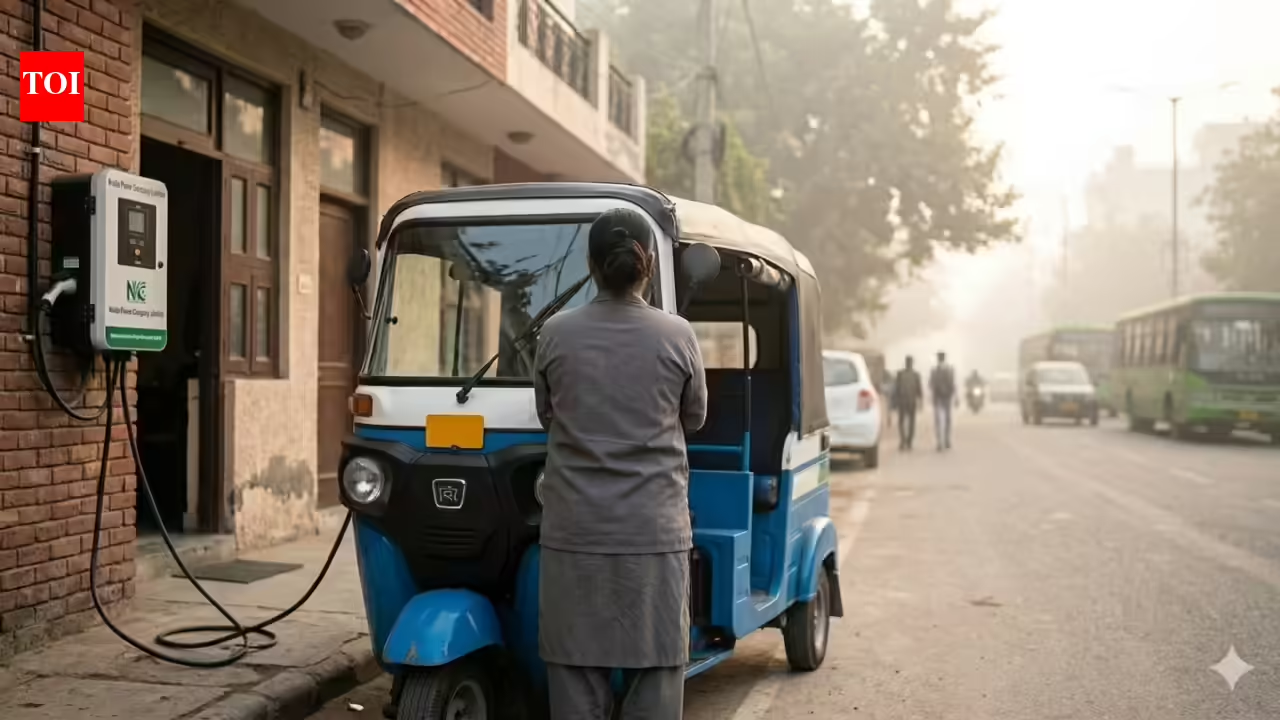
New Delhi : Every morning, before Delhi’s roads fill with office-goers, school buses and delivery vans, Mamta waits patiently at her home in Burari. Just outside, her electric auto-rickshaw remains plugged into a charging point. For nearly three-and-a-half hours, she watches the battery indicator inch upward before she can begin work.A few years ago, her mornings looked very different.Until 2022, she worked at a repair shop, earning modest wages and wondering if she would ever own a vehicle of her own. Then Delhi’s electric vehicle policy push opened a small window of opportunity. Women were encouraged to enter the sector through dedicated permits and incentives for electric autos.Mamta borrowed money and invested nearly Rs 4.5 lakh, including interest costs, in an e-auto. “Khud kamao, khud rakho, par bachta kuch nahi (you earn on your own, but there is hardly any saving),” she said.
How e-autos stack up against CNG counterparts
Today, drivers like Mamta sit at the centre of what could become one of the biggest transformations in Delhi’s public transport system since the city’s shift from diesel and petrol to CNG more than two decades ago.Under Delhi’s draft EV Policy 2.0, registration of new internal combustion engine three-wheelers, including CNG autos, will be prohibited from Jan 1, 2027. Existing vehicles will continue to operate subject to permit conditions, but future growth of the sector is expected to be entirely electric. The proposal reflects Delhi’s broader push towards cleaner mobility as the city battles chronic air pollution while also seeking to reduce dependence on fossil fuels.Yet, conversations with drivers already operating EVs reveal that while the transition is underway, significant gaps remain.For Mamta, the economics broadly favour electric mobility: “Electricity costs are lower than CNG, which saw hiked prices this year.”However, her household electricity connection had to be upgraded from 2 kW to 4 kW to support charging. After four years of operation, battery performance has started declining and charging stops are becoming more frequent.The bigger challenge is infrastructure. “There is no proper charging facility in Burari. So, I don’t plan my route. Trips to central and south Delhi are manageable, but I refuse passengers to border areas.”Finding a charging station is a pain point, finding someone to repair the vehicle is another. “Recently, the accelerator malfunctioned near Sarojini Nagar. No roadside mechanic wanted to touch it. I had to call a mechanic from my area,” she said. The auto remained parked for hours, taking away a day’s earnings.
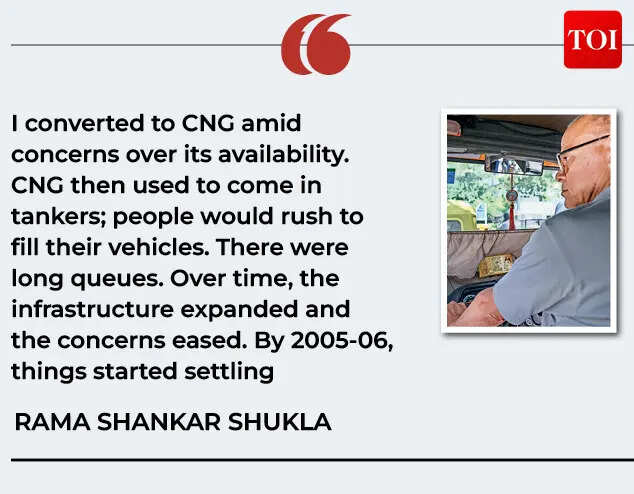
Rama Shankar Shukla shifted to CNG amid concerns over its availability
Mamta’s experience highlights a question policymakers will increasingly confront: Can charging and service infrastructure grow at the same pace as vehicle adoption? Auto driver Rama Shankar Shukla remembers the uncertainty surrounding the landmark transition to CNG in the early 2000s. “I switched amid fears over whether there would be enough CNG,” he recalled. “Back then, CNG would come in tankers and people would rush to fill their vehicles. There were long queues.”Over time, the infrastructure expanded and concerns eased. “By 200506, things started settling.”
Permit & regulatory hurdles
Infrastructure worries aside, drivers also face growing competition from app-based services and bike taxis. Regulatory hurdles add another layer of difficulty. Shukla points to permitrelated issues that often require repeated visits to govt offices. “There’s a mistake in the spelling of my name on Aadhaar because of which every time I go for permit renewal, I end up paying Rs 10,000 to touts,” he said.Delhi transport department data suggests the shift has begun unevenly. Electric auto-rickshaw registrations increased from just 55 in 2021 to 1,097 in 2022, and further to 1,426 in 2024, before effectively stalling over the past year.The reason is not demand alone. Senior transport department officials said fresh registrations have remained frozen because of the city’s permit cap. Delhi has a ceiling of about one lakh auto-rickshaw permits, a limit linked to court directions aimed at controlling pollution and managing vehicle numbers. Thus, even as govt prepares to mandate electric autos for future registrations, virtually none have been registered in the past one-and-a-half years.Transport minister Pankaj Singh said the situation will change once the new EV policy is notified, and 40,000-50,000 ageing autos would be replaced by electric over time. Govt is also examining legal options to increase the overall permit cap, potentially allowing more e-autos to enter the market, he said.Auto unions argue this issue requires urgent resolution. Rajendra Soni, general secretary, Delhi Auto Rickshaw Sangh, said the permit ceiling has become a major bottleneck. “Delhi’s population has increased significantly, but the permit ceiling is the same, due to which new e-auto registrations haven’t been happening for more than a year,” he said.The contradiction is hard to miss. Even as Delhi is set to ban new CNG auto registrations, the pipeline for new e-autos remains constrained by permit limitations.
Charging & cost challenges
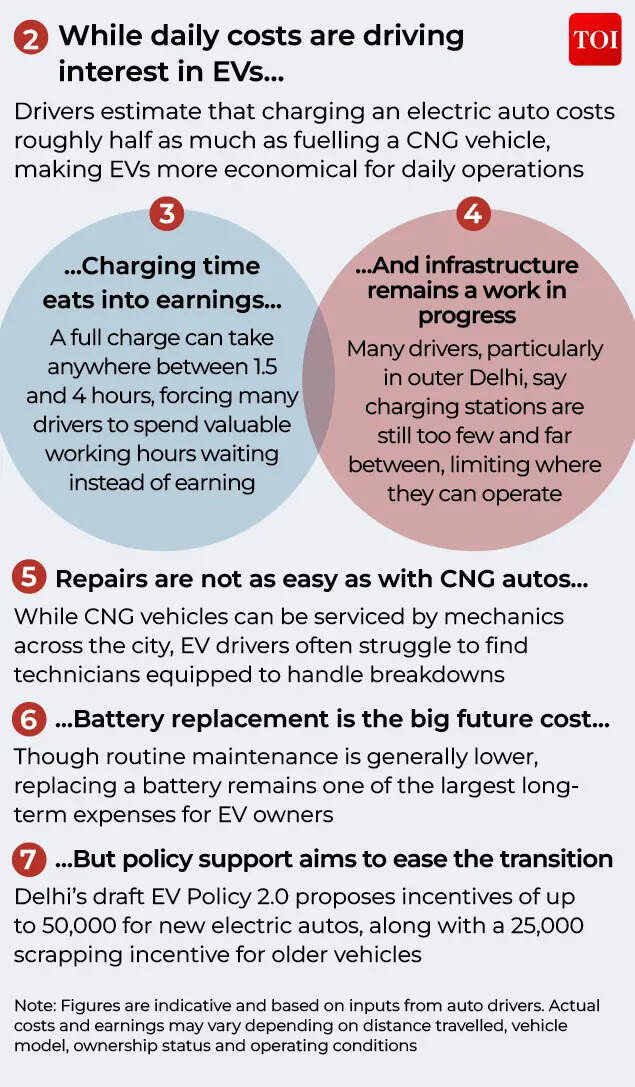
On a hot afternoon near Lodhi Garden, Vikram Sharma waits beside his electric cargo three-wheeler as it charges. Unlike Mamta, he cannot charge at home and depends entirely on public charging stations. A full charge provides a range of 110-120 km.Before switching to electric, Sharma operated a CNG cargo vehicle. One advantage of EVs, he said, is regulatory flexibility. Cargo vehicles often face ‘no-entry’ restrictions during certain hours. EVs enjoy exemptions in some cases, helping operators complete deliveries more efficiently.Yet charging remains a challenge. “It takes up to four hours on a slow charger and about one-and-a-half hours on a fast one,” he said.For a commercial operator, those hours represent lost earning time, underlining a key challenge that extends beyond passenger autos. Delhi’s electrification push is increasingly encompassing cargo movement, delivery fleets and logistics operations. That means charging infrastructure must serve multiple categories of users simultaneously.To accelerate adoption, the draft policy proposes financial incentives for e-autos. Eligible buyers would receive Rs 50,000 during the first year, Rs 40,000 in the second and Rs 30,000 in the third. An additional scrapping incentive of Rs 25,000 has been proposed for owners replacing older BS-IV and earlier vehicles with electric auto-rickshaws.The incentives acknowledge a fundamental challenge: upfront costs remain one of the biggest barriers to adoption. However, drivers and industry stakeholders say incentives alone may not be enough.Charging availability remains uneven across neighbourhoods. Anil Chhikara, faculty member at Asian Institute of Transport Development, said, “Many drivers live in rented accommodations where installing private charging points is difficult. Service ecosystems are also still developing. Unlike CNG vehicles, which can be repaired by mechanics across the city, EVs often require specialised technicians.”Financing also remains a concern. Many drivers operate on thin margins and depend on loans. Uncertainty over battery life, resale value and maintenance costs influences purchase decisions.Delhi’s proposed shift to e-autos inevitably invites comparisons with the transition to CNG in the early 2000s. That transformation succeeded not simply because of regulatory mandates, but because infrastructure gradually expanded to support the change. CNG stations multiplied, fuel availability improved and public confidence grew.
‘Need to build an ecosystem’
The challenge before policymakers today is similar, though technologically more complex. Electric mobility requires not only charging stations but also reliable electricity supply, battery servicing networks, trained mechanics and permit systems that enable rather than restrict adoption.For commuters, the change may be visible through quieter rides and cleaner streets. For drivers such as Mamta, Shukla and Sharma, the transition is measured differently , in charging hours, repair bills, permit renewals and daily earnings. Their experiences suggest that the success of Delhi’s e-auto revolution will not be determined by policy targets alone.“We understand it depends on whether the city can build an ecosystem that makes electric mobility not merely mandatory, but practical. Only then can Delhi replicate the success of its CNG transformation,” minister Singh said, adding that the city’s fast charging capability is expanding.
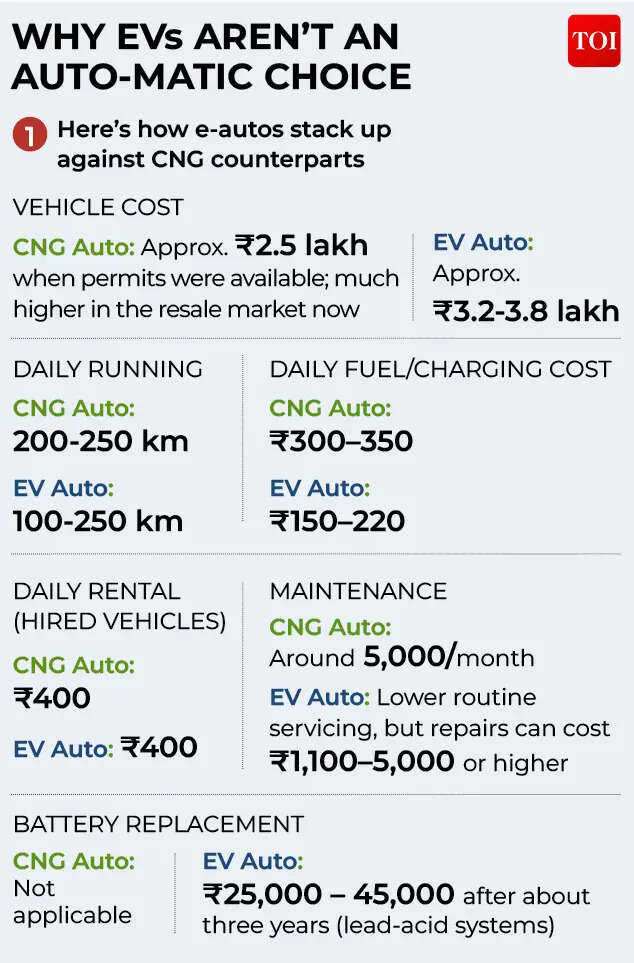
Why EVs aren’t an Auto-Matic choice
For drivers, the biggest attraction of e-autos remains lower running costs. While a CNG auto typically costs Rs 300-350 a day for operations spanning 200-250 km, EV drivers estimate daily charging expenses at Rs 150-220.However, the upfront investment is substantially higher. A CNG auto cost Rs 2.5 lakh when permits were readily available, though resale prices have risen sharply due to permit curbs. In comparison, e-autos cost over Rs 3.2 lakh, depending on the manufacturer and battery configuration.While manufacturers welcome the new policy’s direction, they argue that demand will accelerate only when charging infrastructure expands and financing becomes easier for drivers.The technology itself presents both opportunities and challenges. EVs have fewer moving parts and lower routine maintenance requirements than conventional autos. However, battery replacement is a significant expense, with lead-acid battery systems typically requiring replacement after three years. They cost anything between Rs 25,000 and Rs 45,000.According to union general secretary Soni, a large-scale transition can succeed only if adequate infrastructure is in place.“Drivers need confidence that charging facilities will be available wherever they operate, including in the city’s outer parts. There should also be a robust spare-parts network and subsidies of Rs 1.5 lakh to make the switch viable. Most importantly, the transition should be voluntary, not compulsory,” he said, adding that govt should consult auto unions before implementing such policies.