




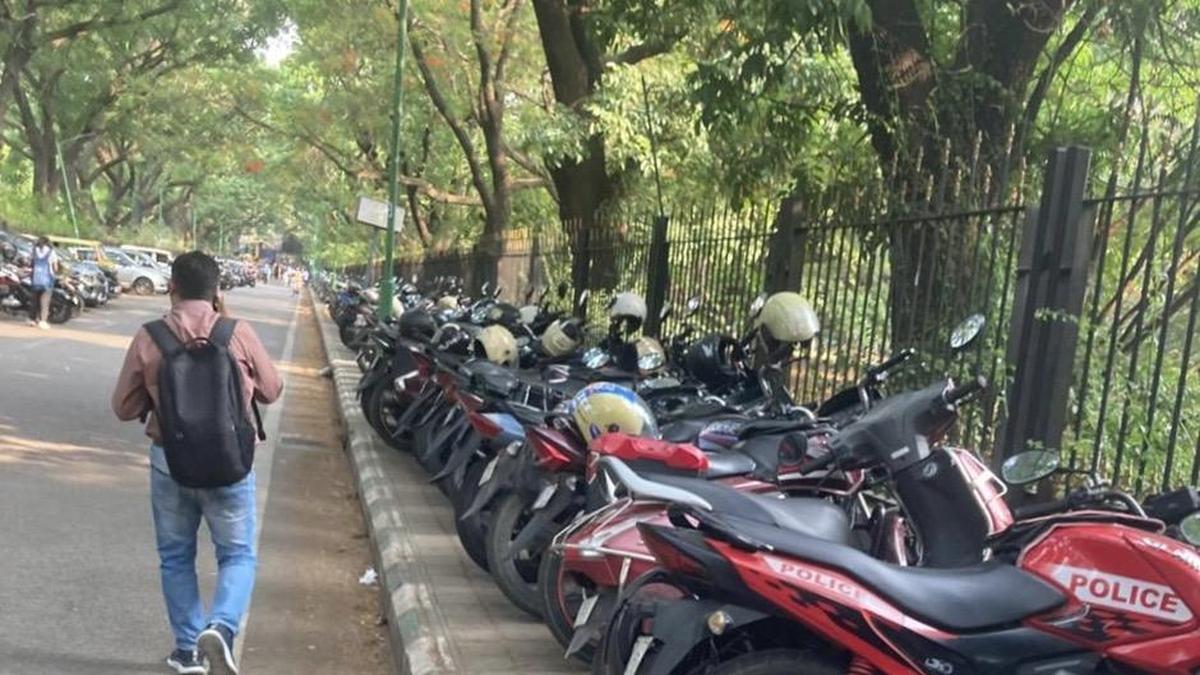

A row of Police vehicles parked on the footpath in Cubbon park force the pedestrians to walk on the road, during IPL match in Bengaluru.
| Photo Credit: Nagesh Prabhu
Why is the SC judgment declaring the right to walk on footpaths a significant one?
A Bench of Justices P.S. Narasimha and Atul S. Chandurkar has, in its judgment (Maniyar Iliyaz@Shaik Riyaz versus P. Ayyappan), said a footpath’s relevance is more than that of a narrow strip of land where the ‘less-fortunate’ ones take cover from being knocked down by vehicles speeding on multi-lane motorways.
Does the judgment disconnect the fundamental right to claim a footpath with routine road accident cases?
Justice Narasimha’s judgment divorces the footpath from the theme of motor accidents. The sole objective of a footpath is not to avoid accidents. The pathways have an identity and a greater purpose of their own.
The footpath caters to the most essential, the most fundamental of rights — the pleasure of walking. The court said the presence of a broad footpath is a reflection of civilisational advancement and respect for the freedom to walk. The tracks offer the public access to urban spaces through movement by walking.
The judgment declared that the right to walk on a comfortable and safe footpath held “priority over movement by motor vehicles”.
How does the judgment highlight the tragedy of footpaths as scarce resources cared for by none?
In a way, the judgment suggests that footpaths suffer from a situation described in environmental law as the ‘tragedy of the commons’ or the degradation of a precious resource when many individuals use it. Safe and broad footpaths have become a scarce resource, riddled by encroachments, garbage and pavement trade. Each person who uses it thinks the other would take care of it, until finally, the resource exhausts or disappears.
Secondly, the apex court has reasoned that broad footpaths, besides amplifying the beauty of cities, must also enable equitable access to all. Nothing should be done to thwart the public’s free access to common spaces.
Justice Narasimha has observed that access to common spaces, in both urban areas and rural areas, should be distributed in such a way that it was “not a monopoly of the motorised class alone”. Article 39(b) of the Constitution mandates that material resources of a community must be distributed so as to sub-serve the common good. Authorities must consider the “common good” of both pedestrians and motor vehicle owner while designing a material resource like land to build roadways. A wide, well-demarcated and uninterrupted footpath could “change the beauty of and equitable access to our cities and towns”.
Has walking retained any significance in the Indian imagination?
The court pointed out that the act of walking have had diverse roles in the Indian imagination. Walking was a struggle for the not-so-unfortunate, a meditation in motion for many, resistance for others, discovery for the inquisitive, a cohesive strategy for sharp socio-political minds.
From the first sparks which ignited the national struggle for freedom to the complexities of modern politics, the idea of walking as a means of expressing an opinion or drawing public attention remains a constant. Walking was not just motion, but embodied the fundamental freedoms of speech and expression, of peaceful protest and the right to form associations and unions for gaining the just rights of workers.
However, laws like the Motor Vehicles Act of 1988 paid homage to movement by wheels. They even “undermined the precious rights of walkers”. Justice Narasimha said the tendency to subjugate safe and comfortable footpaths to motor transport was a civilisational problem.

Have ‘duty-bearers’ failed to effectively hold footpaths in trust for the public? Is there a need for statutory law and regulator?
The strict “duty-bearers” of effectively managing footpaths are urban development authorities, municipal corporations, municipalities, and panchayats. Footpaths are held in trust by these bodies for the public’s benefit. They are the material resources of the community.
The judgment is not satisfied by merely declaring the right to walk safely on a wide and clearly demarcated footpath as a basic right, but recommends to the government to implement the fundamental right through a statutory law, and moreover, establish a regulator to hear aggrieved pedestrians.
The court recalled how the Parliament and State legislatures had played positive roles to effectuate the actual exercise and enjoyment of fundamental rights on the ground in the past.
Besides, modern statutes had entrenched a new character of institutional governance by establishing regulatory bodies. These bodies institutionalise memory through perpetual seal and succession; institutionalise expertise by incorporating specialisation, institutionalise diversity through composition and also institutionalise integrity through accountability.

One of the examples the court drew in this context was the Right to Education Act, which had declared the fundamental right to free and compulsory elementary education under Article 21A in Sections 3 to Section 5. The National Commission for Protection of Child Rights was recognised as the regulator.
Justice Narasimha said a similar Act and a regulatory body must be devised by the legislature to protect the fundamental right to walk on demarcated footpaths. The statutory framework would not only ensure the working of the fundamental right on the ground but also identify the duty-bearers. The court said such an Act must also establish a full-time regulator to plan, enforce, and implement this precious right. The apex court has directed its Registry to send a copy of the judgment to the Central Ministries and the Law Commission of India to “reflect on the compelling necessity for initiating the necessary legal framework”.
Published – June 21, 2026 11:40 am IST