







Constitutions arrange their commitments in tiers. Some are enforceable in court; others are addressed to the conscience of the legislature and the executive. The distinction is a discipline, intended to keep judges from writing into law what the elected branches have declined to enact. When that discipline slips, what the framers chose to leave aspirational becomes, by degrees, a command.
A recent order of the Madras High Court is a case in point. On May 27, a day before Bakrid, a Division Bench heard, and at a single sitting disposed of, K. Surya Prasanth v. Secretary to the Government. It directed the State of Tamil Nadu to ensure that “no cow or calf is slaughtered on the eve of Bakrid or on any other day”. The order, passed by Justices G.R. Swaminathan and V. Lakshminarayanan, binds the Chief Secretary and the Additional Director General of Police. On closer view, it is something more contestable than a routine application of settled law.
The legal scaffolding the bench invokes is real, and it is worth stating plainly what the Supreme Court has and has not decided. Three authorities carry the order. The first is Mohammed Hanif Quareshi v. State of Bihar (1958), where a five-judge bench held that the sacrifice of a cow on Bakrid is not an obligatory practice for Muslims, and so is not protected by Article 25. The second is State of West Bengal v. Ashutosh Lahiri (1995), which reaffirmed that holding and struck down a State exemption permitting cow slaughter on the festival.
The third is State of Gujarat v. Mirzapur Moti Kureshi Kassab Jamat (2005), where a seven-judge bench sustained a total ban on the slaughter of cow progeny and gave fuller weight to Article 48: The State shall endeavour to organise agriculture and animal husbandry on modern and scientific lines and shall, in particular, take steps for preserving and improving the breeds, and prohibiting the slaughter of cows and calves and other milch and draught cattle.
A statute read backwards
Tamil Nadu, unlike several northern States, has never imposed a total ban on cattle slaughter. The Tamil Nadu Animal Preservation Act, 1958, regulates rather than prohibits. Section 4 forbids the slaughter of any animal without a fit-for-slaughter certificate from a competent authority. Under Section 4(3), such a certificate may issue where the animal is over 10 years and unfit for work and breeding. It may also issue where the animal has become permanently incapacitated through injury, deformity or incurable disease. The statute thus contemplates lawful, certified slaughter of aged and useless cattle. It is a licensing regime.
The bench reads the internal conjunction in clause (a) strictly, holding that an animal must be both over ten and unfit for work and breeding. That reading is fair enough. But the order then takes a longer step. Because the provision “enables cow slaughter and is at variance with Article 48”, it says, the provision must receive a strict construction.
The Constituent Assembly debates make the point unmistakable. On 24 November 1948, as the House considered what would become Article 48, Pandit Thakur Das Bhargava recorded that he had wanted the prohibition on cow slaughter placed in Part III, which deals with Fundamental Rights. He had been told it could not go there, since Fundamental Rights dealt only with human beings.
In the same debate, Z.H. Lari, a Muslim member from the United Provinces, told the Assembly that it was “better to come forward and incorporate a clause in Fundamental Rights that cow slaughter is henceforth prohibited, rather than it being left vague in the directive principles” (Part IV). Syed Muhammad Saadulla, the former Premier of Assam, said he would not stand in the way if the framers placed the protection openly in Part III or Part IV. He would oppose, however, any amendment grounded on economic rather than religious reasons.
With these views on the record, the Assembly still declined to put cow protection in Part III. It placed the provision in Part IV, in the language of state endeavour, and in a chapter the Constitution itself declared unenforceable.
In Quareshi itself, the Supreme Court struck down a total ban on the slaughter of cattle that had ceased to be useful. It held the ban an unreasonable restriction on the butchers’ trade under Article 19(1)(g), and added that the Directive Principles could not override fundamental rights. Mirzapur Moti later qualified that holding. But it did so only to the extent of sustaining a total ban duly enacted by a competent legislature and tested against the Constitution. It did not license a court to manufacture a near-total ban by construction, in a State whose legislature chose a regulatory scheme instead.
If the statute permits certified slaughter, where does the prohibition come from? The bench locates it in a government order, G.O.Ms.No.1715, which it found not in the State’s pleadings but in a practitioner text, Maneka Gandhi’s *Animal Laws of India*. The order, reported to date from August 30, 1976, bans the slaughter of cows and heifers in the interest of milk production and the rural economy. Executive power being co-extensive with legislative power, the bench reasons, the government order has the force of law and must be enforced.
Two difficulties attend this move. The first is textual. The government order, as reproduced in the judgment, bans cow slaughter “in all the slaughter houses in Tamil Nadu”. It addresses licensed premises. The bench deploys it to justify a prohibition on slaughter everywhere, including the certified slaughter the 1958 Act expressly allows.
The second difficulty is doctrinal. The bench’s premise, that executive power is “co-terminus” with legislative power, echoes the Supreme Court’s judgment in Ram Jawaya Kapur v. State of Punjab (1955). But that case establishes the reach of executive power into fields the legislature has not occupied; it does not license executive action that contradicts a statute already in force. The proviso to Article 162 and a consistent line of authority confine the executive to acting consistently with enacted law. Where the 1958 Act expressly permits certified slaughter, a 1976 order cannot be read to abrogate that permission by implication.
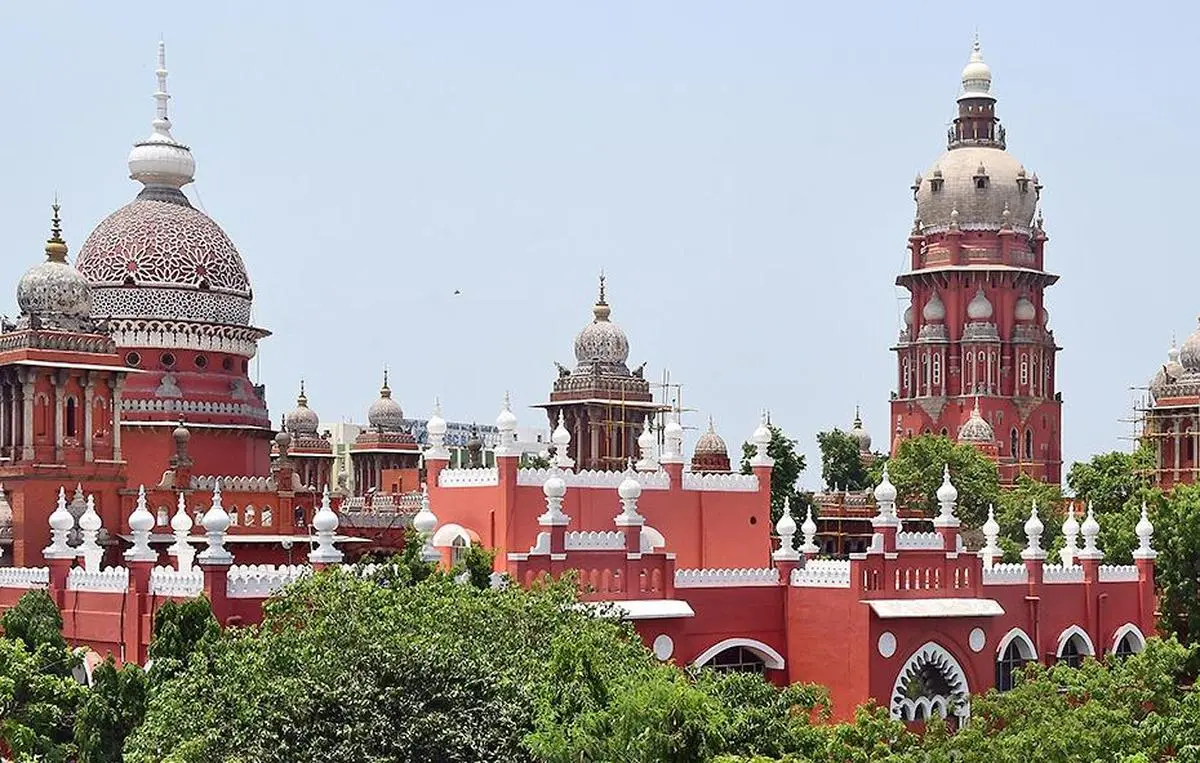
A view of the Madras High Court in Chennai.
| Photo Credit:
K. PICHUMANI
The procedural posture is where the order is most exposed. This was a petition for a writ of mandamus, heard and finally disposed of in a single sitting on the eve of the festival. The petitioner’s case rested on his own averment that arrangements had been made to slaughter cows in places not designated as slaughterhouses. The State filed a counter-affidavit. The bench records, at paragraph 6, that the respondents “conceded the veracity” of the averments in the writ petition.
The counter-affidavit, as quoted in the order, does not concede this. Paragraph 4 of the High Court’s order, citing Paragraph 4 of the counter-affidavit, records that the police visited the site and inspected a temporary shed erected for sacrifice in a non-public area. They found no obstruction to traffic and no offence to the religious sentiments of other communities. That is a refutation of the petitioner’s premise, not an admission of it. The factual foundation for the relief, that slaughter was being arranged in public places, is contradicted by the very affidavit the bench treats as conceding it.
The wider context is not incidental. The petitioner before the Madras High Court was K. Surya Prasanth, an office-bearer of the Hindu Makkal Katchi, a Hindutva party based in Coimbatore. Two days earlier, on May 26, the Supreme Court had declined urgency to a substantively similar plea filed by Satish Kumar Aggarwal, former vice president of the Akhil Bharat Hindu Mahasabha, seeking nationwide enforcement of cow slaughter laws before Bakrid.
A bench led by Justice Surya Kant observed that the petitioner had “remembered this a day before”. The Madras High Court, hearing a comparable plea on the eve of the same festival, took a different view of the same calendar. On May 29, the State filed a compliance report before the same bench in pursuance of the court’s direction.
The petitioner’s prayer before the High Court sought a direction to consider his representation and to prevent slaughter “in public places”. The order grants something altogether larger: a perpetual, State-wide direction that no cow or calf be slaughtered on the eve of Bakrid or on any other day.
Even on the authorities the bench relies on, this sweep is hard to sustain. Ashutosh Lahiri was concerned with the slaughter of healthy cows on Bakrid, and Quareshi went so far as to protect the slaughter of aged and unfit cattle. The 1958 Act still contemplates the certified slaughter of such animals. A blanket direction covering every cow and calf, on any day of the year, overrides what the statute permits. It also collides with Quareshi, which held that the State could not wholly forbid the slaughter of cattle that had ceased to be useful.
The missing reasoning
Around this legal core the order wraps a wider rationale. It invokes the reverence for the cow from the time of Lord Krishna. It cites the prohibition of cow slaughter under certain Muslim rulers. And it draws on the scholar Dharampal’s thesis that mass slaughter began only to feed the colonial army. None of this is necessary to the holding. A statute either permits certified slaughter or it does not; the question turns on Section 4, not on civilisational history. Reasoning of this kind, offered in a judicial order that disposes of a religious-freedom claim on the eve of the very festival it concerns, reads less as the ground of the decision than as its justification after the fact.
None of this is to say the petitioner had no case. Slaughter in undesignated public places, if it were occurring, would breach Section 6 of the 1958 Act and the licensing rules. An authority that ignored a credible representation could properly be directed to act. A narrow order requiring the authorities to enforce the existing law against unlicensed public slaughter would have been unimpeachable. The bench had that order available to it.
The distinction matters beyond Tamil Nadu. Article 48 has been migrating from aspiration to enforceable command. The shift began through legislation and was sustained in Mirzapur Moti. It now proceeds through judicial construction of a regulatory statute. A Directive Principle that the Constitution declared unenforceable is being made to do the work of a prohibition the legislature did not enact. When a court reads a licensing law as a ban because a Directive Principle would prefer a ban, the question is no longer what the statute says. It is what the judge would have the statute say.
V. Venkatesan is Contributing Editor at Supreme Court Observer. Views expressed are personal.
Also Read | Cow vigilantes and the pathology of violence
Also Read | ‘The cow was neither unslayable nor sacred in the Vedic period’