









Among the many quiet humiliations of public culture, few match the absurdity of watching a perfectly ordinary potato being escorted into the ceremonial theatre of regional authenticity. At the recent Rashtrapati Bhavan banquet for the Vietnamese President, To Lam, the menu reportedly included “Bhatinde wale aloo: baby potatoes with freshly pounded kadhai herbs (go figure) and dried mango powder”. The potato, one presumes, bore its stately burden with more composure than the menu itself.
First things first. Before gaining admittance to official paper, “Bathinda” has had to pass through the usual orthographic rinse and emerge as “Bhatinda”. This casual offence has long stopped bothering us Bathinda-walas, the attempted Hindification—with its faint and unrequested promise of cosmopolitan polish—never really stuck. Alas, Chandigarh has had no such luck. Even second-generation Chandigarh residents are likely to say Chandigarh with the soft dental d, instead of Chaṇḍīgaṛh, with the tongue curled back into the harder ḍ. Anyway, I digress. There is a familiar violence in such small slips. Place names carry memory, history, local pride, and everyday vox populi. To Hindify and gentrify them nonchalantly, especially in a setting dedicated to national representation, is to begin the performance of local authenticity by mis-transcribing the local itself.
But then, more importantly, believe it or not, there is no great Bathinda potato. No ancient Malwa tuber tradition. No secret lineage of amchur-scented aloo guarded by grandmothers between Bathinda’s be-ruined fort and its now dysfunctional thermal plant. Bathinda has potatoes as every other place has potatoes: common, useful, unglamorous, absorbed into the repertoire of every rich and poor kitchen. They may be excellent in someone’s home, crisped in mustard oil, darkened with masala, brightened by amchur (dried mango powder), rescued by chopped green chillies. But that excellence belongs to the quotidian intelligence of the usual kitchen. It does not somehow become the culinary patrimony of a city.
This is precisely where the marketing fraud operates. The modern market and its army of social media influencers have trained us to believe that every place must have an essence, and that this essence must be edible, photographable, captionable, and available on a tasting menu. A town cannot simply have weather, bus stands, coaching centres, grain markets, cantonment roads, bazaars, and people who eat what other people eat. It must have a signature dish. It must yield a flavour. In other words, it must be—or be made—legible as content.
The counterfeit economy of locality
The Presidential menu’s “Bhatinde wale aloo” belongs to that counterfeit economy of locality: the Instagrammer’s obsessive pursuit of the “real” Punjab, the “authentic” local, the “forgotten” dish of some town, lane, dera, dhaba, or grandmother’s courtyard. Account after Instagram account promises access to the source: the real Amritsari this, the real Lahori that, the real Malwai something else. Very often, the result is a dish invented (oftener, improvised) by the very apparatus that claims to have discovered it by “research”. The local is first hammered to the cues of rusticity, spice, earthiness, and nostalgia before being sold back with a city or town name pasted on the label.
The damage works twice over. First, what may actually be local, modest, unspectacular, seasonal, caste-marked, class-marked, improvised, or too ordinary for display gets erased. Then an invented speciality is attached to the place, and the counterfeit begins circulating as authentic knowledge. Influencers start parroting it. Menus begin referencing it with faux storiettes. Food writers—oh those food writers—start nodding solemnly. A fabricated association inhabits a duplicate halo of “heritage”. Before long, one can find oneself listening to a self-branded food historian wisely explaining the “Bathinda style” of potatoes with professorial confidence.
This hunger for micro-authenticity is especially revealing because it pretends to honour difference and the small tradition, while only really making a place’s unremarkable dignity available for scalable consumption. The local here is just garnish. It appears only when it can be plated. One could perchance argue that the ordinary must be elevated (to what end, though?), but only if elevation did not mean extraction. The method is all too simple: take a name, add a spice profile, invent a provenance, and let the social media machine confer respectability. What remains outside this process—the actual local memory, uneven discontinuous histories, boring continuities, unattractive details, and the uninteresting textures of place—is left behind.
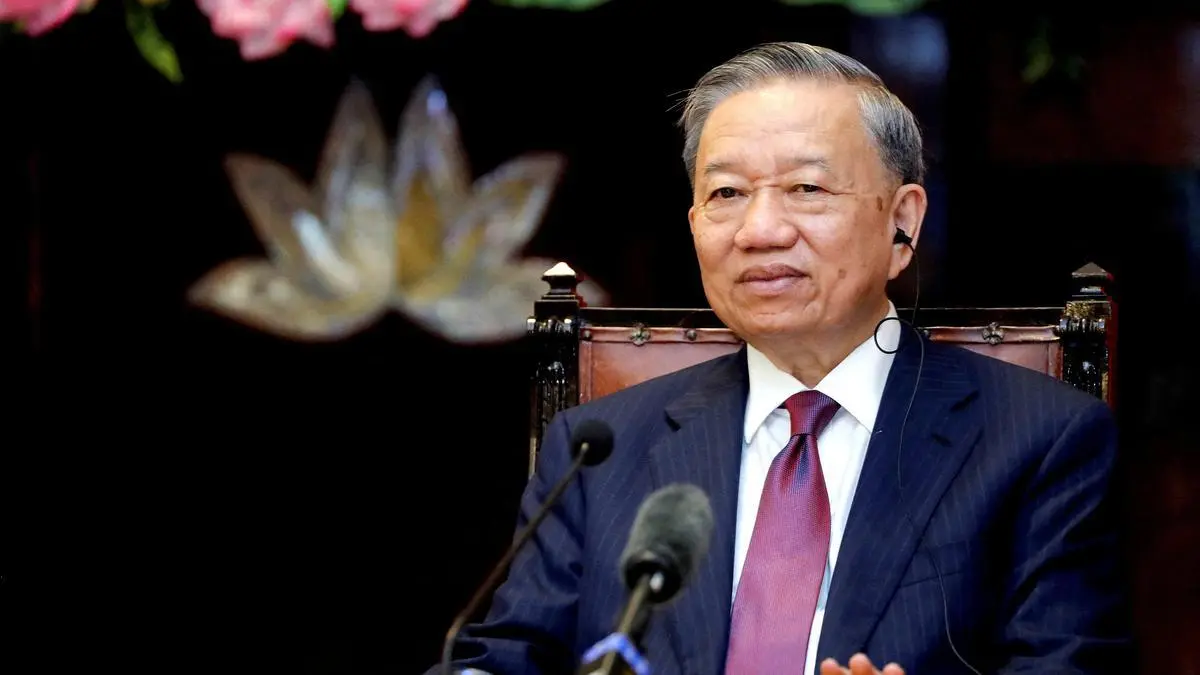
Vietnamese President To Lam.
| Photo Credit:
REUTERS
Bathinda, until recently, was fortunate to have ambled along in its non-descriptness. For the 90s kids, it was still a peaceful small town where it was possible to cycle to school without fearing annihilation under the polished bulk of an SUV. This was most likely the last such generation to have enjoyed the simple childhood pleasures of cycling to school with friends. The weather had not yet become perennial punishment. There were no expressways slicing through the town’s hum. There was one intersection with a red light, and even that was treated less as a traffic rule than as a polite suggestion.
Nobody followed it with any particular sincerity, and nobody seemed to die of that insincerity either. A little scooter ride to the canal could still count as bliss. That was the scale of pleasure: modest, local, wind-struck, and unphotographed. It appeared in the national imagination only as a rare aside. In Dilwale Dulhania Le Jayenge, for instance, Anupam Kher’s character invoked our then little town as shorthand for rustic flight, describing himself as “Bathinda se bhaga hua alhad, ganwar”.
Then, alas, vikas (development) arrived in Bathinda, unbidden and wearing a hat made of iron and concrete. Airport, refinery, expressways, flyovers, real estate, scaffolding, digging, glass, concrete, dust. The city began to resemble every other urban graveyard in north India: too ugly to love, too expensive to leave, too motorised to walk, too hostile to the intimacy of an old scooter by which one had once known it. Today, beggar children perform body-breaking tricks at traffic signals for loose change. Urban heat hovers over the city like a curse. Squalor, petty crime, serious crime, private hospitals, coaching centres, banquet halls, and speculative property: this is our new civic grammar, and it is here to stay. But don’t worry, most Bathinda residents who have made good on this “progress” are happy.
Bathinda’s old towny anonymity had a kind of innocence. The new visibility is mostly a wound with hoardings plastered all over. And once Jab We Met happened, Bathinda burst onto the scene. Even the political royalty of Punjab suddenly turned to it. Suddenly, one did not have to say, vaguely, “I am from Punjab.” One could proclaim “Bathinda”, and be understood. Sort of.
Jab We Met’s ersatz Bathinda got recognised, but recognition arrived with simplification. The city was flattened to a certain comic directness, a certain noisy Punjabi legibility. It entered the national imagination less as a place than as an immediately usable sign. The banquet potato pushes that process along with a more genteel nudge. The old joke has put on a satin jacket.
A waiting room for departure
Bathinda’s most recognisable modern signature is not some university, museum, archive, theatre, or food tradition, but the IELTS centre. The young from neighbouring villages and small towns have poured into them by the thousands, often after their families have sold or mortgaged ancestral land to pay tuition for a three-month coaching course. Not the visa fee. Not the first semester abroad. The coaching fee for an English-language exam. That is Bathinda’s great modern legacy: a town that is a waiting room for departure, a place where aspiration comes to have its tryst with destiny in band scores.
And then there is the darker sobriquet: Punjab’s “cancer capital”. The infamous Bathinda–Bikaner train became known as the sordid “cancer express”, carrying patients by the hundred from the Malwa region to hospitals in Bikaner. Bathinda now has its own All India Institute of Medical Sciences (AIIMS) and a glut of private hospitals. Healthcare, one is assured, is top-notch. The body, after all, must be repaired somewhere after the urban squalor, the chemical crop, the carcinogenic water, the counterfeit-dairy products, and the soot-heavy air have finished with it. To say nothing of the more ordinary and common afflictions of modern Indian life: sugar, carbs, sedentary panic, medicalised existence. Perhaps this is where the humble aloo does, after all, belong. Not as a signifier of some gold-plated heritage tradition that belongs in a presidential banquet, but as part of Bathinda’s actual modern biography: comfort food, carbohydrate, filler, family staple, and an enthusiastic minister of metabolic disease.
There is also something particularly galling about the ceremonial setting. A private restaurant can, within limits, invent whatever sells. It can name a dish after a railway crossing, a lover, a fort, or an imaginary grandmother. The market has always survived on such verbal embroidery. But a presidential banquet carries a very different burden. It is a stage for representation. It speaks in the language of the republic, of hospitality, of cultural seriousness. Its menu is not merely a list of things to be eaten. It should be a miniature map of how the nation imagines and represents itself, especially to a guest.
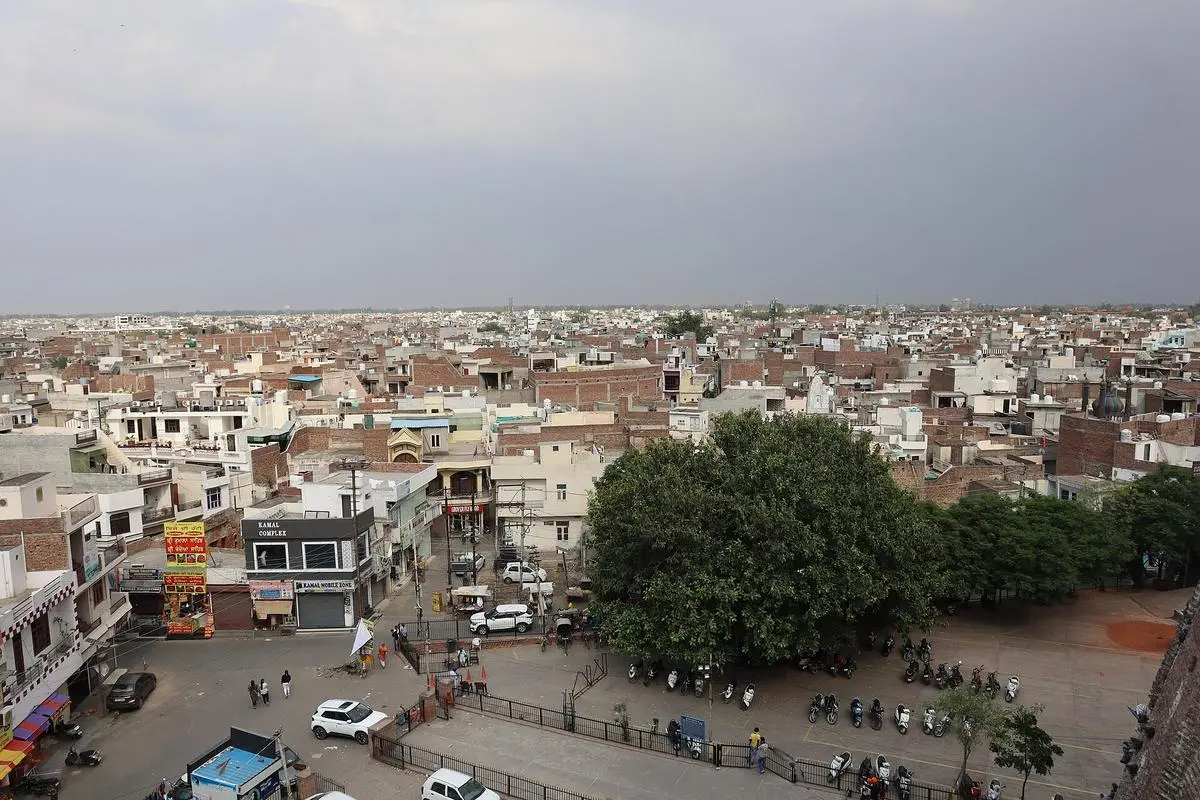
The city skyline of Bathinda from Bathinda Fort. Bathinda, located in Punjab’s Malwa region, is widely known today for large-scale migration coaching centres, including IELTS institutes.
| Photo Credit:
Wikipedia
That is precisely why the “Bhatinde wale aloo” rankles a Bathinda wala so much. The dish reflects the laziest version of cultural federalism. Sprinkle the menu with regional names, produce an illusion of diversity, and hope nobody asks whether the attribution means anything. The name is summoned without the place being known.
One might say, with some generosity, that the intention is harmless. Isn’t it always? Perhaps the menu needed a broader northern spread. Perhaps “Bathinda” sounded more specific than “Punjabi aloo”. But fakery becomes respectable exactly through harmlessness, through aesthetic convenience, and through the soft authority of official contexts. The counterfeit would never declare itself as fraud. It arrives smiling warmly, garnished, and printed on thick paper in elegant fonts.
Bathinda does not need this potato. No city does. There is dignity in the unremarkable, and there is historical value in refusing the compulsion to turn every locality into a branded speciality. The ordinary potato in an ordinary kitchen may bear more truth than a hundred curated invocations of local authenticity. But it need not pretend to be ancient, distinctive, or presidential.
So yes: will the Bhatinde wale aloo please stand up? And once they have stood up, may they kindly identify their source, produce witnesses, correct the spelling, and explain why Bathinda was made to take the blame?
Kanav Gupta is a postdoctoral research fellow at the Department of Music, University of Nottingham, UK.
Also Read | Shark’s fin and shiuli
Also Read | Yamuna: Fish, food, and survival