




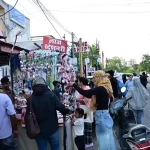


It is a few days after the BJP taking over power in West Bengal, and I am strolling down the streets of Jadavpur in south Kolkata. In this area, there is no celebration of the kind shown on television. It is quiet, as though nothing has happened. In 2011, on a similar day, when the CPI(M) was ousted and the Trinamool came in, the scene was markedly different. There were Mother India cardboards laden with metaphor at every street corner, unbridled debate at tea stalls, sighs of relief. I do not believe any of it had to do with the victory of the Trinamool; for me, that win belonged to the Singur-Nandigram movement—to the people. It was not a victory of any kind of grand electoral strategy.
Before that, in 1977, the landslide victory of the Left Front had been both a State and a national phenomenon; it heralded the end of the Emergency and the state-sponsored brutalisation of Naxalites. Then, as in 2011, people had thronged the streets in celebration. Even before that, the election of 1967 had sounded the death knell of the Congress, on the heels of two Bengal Food Movements, anti-people policies, and manufactured famines. The people of Basirhat, the town I come from and which is tied inextricably to the name of the young martyr Nurul Islam, had flooded the streets to celebrate the United Front that year. Today, despite the BJP’s landslide victory, the general atmosphere does not seem celebratory. Rather, it is cautious.
Is this victory an important political signal? Does the idea of Bengal stand fundamentally altered? Or is there strength enough in that identity to survive this assault? At the start, let me make a distinction between the Bengal identity and the Bengali identity. The former is a political identity; it is class-inclusive, inviting under its label the wealth-creating basic classes. The Bengali identity, on the other hand, is a cultural identity claimed by the bhadralok, which does not allow the basic classes to cross its thresholds. It is one that worships Tagore as god and bourgeoisie cultural domination. But the Bengal identity lends its name to revolt against oppression. Bengal is the Tebhaga Movement and the revolutionary peasant woman Ahalya of Kakdwip. It is the Language Martyrs. It is Naxalbari. The core identity of Bengal runs red.
Chief polluter
In every election, we have seen issues that pitch the ruler and the oppressed squarely against each other. For instance, 1967 and 1977 were the Congress versus the people, 2011 was the CPI(M) versus the people, when, Mamata Banerjee, even though not a Leftist, had to don the mask of one. In every election, the policy question was a rousing one. In 2011, the question of agriculture versus industry extended from party circles into the ranks of intellectuals and academicians and among the people. Slogans rejecting the Nano car in favour of a pot of rice were touching. The CPI(M) came up with a ludicrous counter that showed an animated Nano car shedding tears from its headlights/eyes.
An artist’s impression of the Tebhaga Movement, where tenant farmers and sharecroppers rose in protest against landlords.
| Photo Credit:
Satheesh Vellinezhi
This election was not about ideologies or even policy—by design. Doles, pay commissions, and pending Dearness Allowances occupied centre stage. In fact, the BJP did not even bring Hindutva to the forefront. The BJP and the Trinamool vied to be the chief polluter of the idea of Bengal.
Now, shedding all vestiges of urban snobbery, let us resort to the practical wisdom of the people who live close to the soil. In the 1980s, my political work was based in and around Dhanyakuria, Begampur, Bibipur, Metia, and Baduria in Basirhat. I saw, first hand, the manifestation of the people’s innate wisdom during the bakery movement that encompassed 12 bakeries and 105 workers and lasted 139 days. Together with the workers, we, a Leftist activists’ organisation, obstructed the main bus route for three hours every day. The CPI(M) workers opposed us using the police. Then, we fought against the eviction of hawkers, a resistance that spilled into the Lok Sabha vote boycott. We walked alongside cinema employees in a struggle of 142 days, demanding letters of appointment for them. Labourers and shop workers revolted. There was then a demand for better treatment at hospitals.
Why bring these up now? To draw the simple conclusion that resistance does not need to concern itself to any significant degree with who happens to be the oppressor at a given time. By now, the BJP’s modus operandi in engineering the Bengal win is as clear as daylight. In 2023, the BJP government altered the process of selecting the Chief Election Commissioner and other Election Commissioners such that the ruling party would always have a 2:1 influence.
This amended law brought in Gyanesh Kumar, responsible for the exclusionary character of the voter list. Even though the Special Intensive Revision (SIR) process was carried out once in 11 other States, in West Bengal, it was implemented twice. In the first round, combining the draft and the final lists, 64 lakh people were excluded. Realising this might not be enough, a discombobulating “Logical Discrepancy” factor was cited to exclude another 34 lakh. The Supreme Court then lent a hand in excluding 7 lakh more. In total, 91 lakh people were excluded—almost 12 per cent of the pre-SIR voter list. The SIR thus became a Himalayan obstruction in the way of any true reflection of the people’s will.
Members of Votadhikar Raksha Mancha stage a protest demanding voting rights for deleted voters in Kolkata on April 14, 2026.
| Photo Credit:
Manvender Vashist Lav/PTI
One realises that the excluded citizens will get no justice from the SIR Appellate Tribunal. Former Chief Justice of the Calcutta High Court, Justice T.S. Sivagnanam, resigned from the tribunal, saying it would take four long years to clear appeals. The Supreme Court has colluded with the Election Commission of India, doing nothing but ask some rhetorical questions in hypothetical cases. If not cancel the whole process, the court could have insisted that the election this year be carried out on the basis of last year’s voters’ list. There is a provision to that effect in the Representation of the People Act. But the court chose not to. The opposition parties resisted in name; in practice, they often aided the SIR.
What then of the people? Oh, sad Abhimanyu, assailed by six blood-lusting, mammoth charioteers.
The BJP’s grand strategy
In November 2025, as part of a rights activists’ group, I worked in two villages in the south of Barasat to get an inkling of what the people thought about the SIR. Well, we found that the Trinamool and their panchayat members were working like a well-oiled machine to aid the SIR process there. There was no resistance. Discussions mostly concerned preparations for the election; SIR was just a side dish on the menu. The people were made to believe the Trinamool would stay in power, asked to trust Didi. We tried to rouse the people but failed. Regardless, we established a small rights organisation there and continue to wait for the people to stand up. That is the thorn: a certain regression in people’s consciousness since the 1970s. Daily livelihoods are subject now, more than ever, to the whims of political leaders and parties—anathema to Bengal’s red psyche of the 1970s.
In truth, the BJP’s Bengal victory owes itself to a grand strategy. From 1977 to 2011, the CPI(M) government constituted a party society in the State using the local administration. It established the raj of area-specific local committees. Its focus was not on the people, but on the party people. In their repertoire, they had only a few semi-Communist programmes of the likes of Operation Barga. Singur-Nandigram was the nail in their coffin. The Trinamool followed in the CPI(M)’s footsteps and created its own party society, with only two additions to its policy: immense corruption and a kind of competitive communalism of its own against the BJP’s communal politics. CPI(M) turncoats who joined the Trinamool need no particular mention.
BJP supporters celebrate the party’s majority in the polls on the counting day of the West Bengal Assembly election. Kolkata, May 4.
| Photo Credit:
Debajyoti Chakraborty/ ANI
Enter the BJP. Apart from making structural inroads into power using the SIR, it also capitalised on people’s grievances against corruption while simultaneously injecting communalism into the veins of Hindu voters. Consequently, 80 per cent of the Hindu vote has gone to the BJP. Those who were in the circles of Trinamool influence until a few weeks ago are now with the BJP crowd. This smooth translocation of ideological (dis)loyalty is at odds with the spirit of Bengal.
The situation can be formulated thus: if the 1947-1977 period was the time of, say, the Real Bengal, the 1977-2026 years have marked the denouement. However, there is still room left for alternative people’s politics and its unequal battle against the overarching structure of decline. I have seen, during this time, 10 unions formed by unorganised labourers practising grassroots democracy in Basirhat, poor landless farmers resisting in Birbhum’s Khanpur village, Naxalite resistance in undivided Dinajpur in the 1980s, the people’s revolution in Singur-Nandigram-Lalgarh, the protests against the National Register of Citizens and the SIR—all swimming on, against the current.
Today, if we are to stop the BJP’s aggressive Hindutva fascism, then we must return to the value-based politics of the 1970s. The BJP practises deep-state politics. In the style of Hitler’s Gestapo, it keeps under the police radar every individual, practice, movement, and expression. The aim is to bring the entire country in its grip. India is to become a police state and its citizens are to live in a countrywide open-air prison. The ruling party will maintain its eagle-eyed surveillance from its satellites. It will continue its politics of occupation. It will man every state institution with RSS representatives, creating one more fascist instrument.
But Bengal—it is the name of a long history of daring. Undivided Bengal played the role of vanguard during the freedom movement. Andaman’s Cellular Jail still bears testimony to that. Post-1947, even after it was divided, Bengal carried on that tradition. We cannot forget Latika, Pratibha, Ila Mitra. One must not mistake a sleeping warrior for the dead.
The slumbering spirit of Bengal will be awakened by the organised-unorganised labourers, the peasants and the proletariat, the gig workers, the cyber coolies, the selfless student leaders, the women who daily resist patriarchy, the Dalit-Adivasi-Namasudra populace, the artists and the intellectuals. However, the need of the hour is to string together these different islands of movements. Every individual who enlists for this task must do so, in the complex post-globalisation world, in the spirit of a true student. To forget to dream would be her only unpardonable sin. Yet, to sorrowfully reminisce a glorious past is an act of squandering the self. Can Bengal indulge in such wasteful luxury? History says no.
Sukhendu Sarkar is a socio-political activist who used to teach Economics at Sivanath Sastri College, Kolkata.
Also Read | Why the BJP’s big win in West Bengal is not a surprise
Also Read | Born again in saffron