








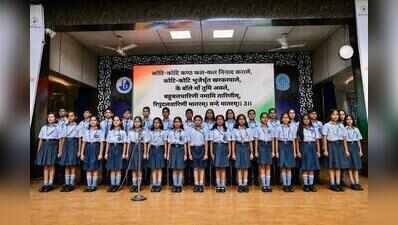
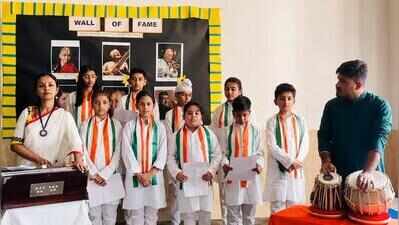

Noida: Across schools in NCR, “sujalam, suphalam…” is rolling off classroom screens, echoing through assemblies and being replayed on teachers’ phones on a loop. These last couple of weeks, students have devoted their music classes to a singular objective — mastering six stanzas of Vande Mataram before Independence Day.While learning isn’t a problem, it’s the ‘who can teach it’ question that has seen schools scramble to find experts fluent with the song. While the first two stanzas of Bankim Chandra Chatterjee’s Vande Mataram are widely known, few are conversant with the full version – and fewer still with the right pronunciation of the Sanskrit verse.With govt now making the full rendition of Vande Mataram mandatory, the decision coinciding with the national song’s 150th-year celebrations, some schools have borrowed Bengali teachers from other institutions while others are circulating recordings, putting lyrics on giant screens or turning to YouTube.Vande Mataram, according to rules, has to be sung before the national anthem at all events, such as Independence Day celebrations, where both need to be sung. The rules also specify the duration of the full rendition of Vande Mataram at approximately 3 minutes and 10 seconds.At Grads International School in Noida, teacher Sanchari Bhattacharya — who is pursuing a PhD in music — recorded the complete song and shared it with principals across the city. “Most of Vande Mataram is written in Bengali, with Tatsama and Tatbhava words. It is very difficult for students to understand and pronounce them correctly. Several schools requested a full recording. Sanchari is not just training our students, she’s explaining to them the exact meaning of the song,” said Aditi Basu Roy, the school’s principal and president of All India Principal Association.Mount Abu School in Delhi has woven the song into regular music lessons and assemblies for familiarisation. Its lyrics are being projected on a large screen in the native language so that children can read along as the recording plays. “The second and third stanzas are very rich, but the words are quite difficult for children. We play Vande Mataram repeatedly — even during short breaks — so that they listen to it and gradually learn it by heart,” principal Jyoti Arora said.Blue Bell Model School in Gurgaon has decided to leave students up to Class V out of the tougher portions of the song after finding the kids struggling with it. “The idea is to build familiarity first and tackle the difficult stanzas when children are older and better equipped to handle them,” a teacher at the school said. The school’s choir is working on the full song. A teacher at Blue Bell has presented the song as a dance drama, while a history teacher has explained its origins, context and relevance. “We want students to understand the song rather than simply memorise it,” said principal Alka Singh.At Chaitanya School in Noida, the full song has been rehearsed for two months as students were found to be familiar only with the first stanza. “The song is no longer confined to an Independence Day rehearsal. It’s being repeated across music periods, assemblies and other activities so that students hear its tune and words often enough to become comfortable with them,” a teacher said.For Roy, however, getting every syllable right is only half the exercise. “Simply memorising or singing it during assemblies is not enough. What matters is understanding the meaning of its lyrics and the values they represent,” she said, pointing to “sujalam, suphalam” and the song’s celebration of the country’s greenery, rivers and fertile fields.A teacher at a Delhi school underlined the importance of understanding the song so that its meaning also translates into action. “If children sing about a beautiful and abundant motherland, they should also understand that protecting forests, hills and waterbodies is a way of respecting the country described in the song,” she said.Govt schools, most of which don’t have dedicated music teachers, are finding it harder. “Teachers are learning the song through YouTube before teaching it to students. Many teachers are looking up meanings online to explain them properly,” said Praveen Sharma, district president of Primary Teachers Association in Noida.

