




Deep in the archives of Jammu and Kashmir’s revenue offices, bound registers many decades old continue to speak in Urdu. The script, which runs across yellowing pages that document landholdings, inheritances, and disputes, forms the administrative memory of the region. It is this long-standing relationship between language and governance that has now been thrust into the spotlight.
On April 10, the Revenue Department, under Chief Minister Omar Abdullah, released amended draft recruitment rules that removed Urdu as a mandatory qualification for several key revenue posts, including positions that are central to maintaining land and revenue records in the region. The government subsequently put up the draft rules for public feedback. What appeared to be a technical revision quickly snowballed into a political storm.
This controversy did not emerge in isolation. It was built on a precedent set months earlier by the Central Administrative Tribunal (CAT), whose ruling had already raised anxieties about the sidelining of Urdu in the Muslim-majority Kashmir Valley.
In its order dated July 14, 2025, the tribunal had held that candidates applying for the post of Naib Tehsildar in Jammu and Kashmir were no longer required to know Urdu. Making the language mandatory, it observed, would amount to discrimination. The judgment effectively relaxed a long-standing eligibility condition.
The CAT’s order drew sharp criticism from political parties in Kashmir, who said it ignored the ground realities of the region and risked privileging Hindi at the cost of Urdu. Critics argue that the prominence accorded to Hindi and Sanskrit in Kashmir—particularly since August 5, 2019, when the Union government revoked the region’s special status—reflects a wider ideological push by the BJP. This, they contend, has coincided with the marginalisation of regional languages across India.
“Urdu is indispensable and a unifying force that has over the years kept the linguistic mosaic of Jammu and Kashmir together,” a political observer who did not wish to be named told Frontline. “What we are witnessing now is a series of changes that, taken together, suggest a gradual undermining of the language which aligns well with BJP’s broader political project that seeks to recast Kashmir’s Muslim majority landscape and promote Hindi.”
Rewriting the rules
In 2020, a year after New Delhi revoked Jammu and Kashmir’s special status and bifurcated the erstwhile State into two Union Territories, Parliament passed the Jammu and Kashmir Official Languages Act, 2020, recognising Hindi, Kashmiri, and Dogri as official languages alongside English and Urdu.
“This has been done based on the demand by the people,” the then Union Minister for Information and Broadcasting Prakash Javadekar told reporters in Delhi. However, the move opened new fault lines in the region.
“The BJP and RSS have long sought to mainstream and culturally assimilate Kashmir’s Muslims and have viewed language as one of the means to do so,” noted the aforementioned political observer. “The events of 2019 provided a perfect opportunity for the party. With the region under Central rule, the BJP introduced the Act, which diluted Urdu’s centrality, as the party views it as a marker of Muslim identity and imposed Hindi in a region where people have a little connection to it.”
Besides being a marker of identity, Urdu in Kashmir also functions as a language that people actively rely on in daily life. Much of the region’s land and revenue documentation continues to be in Urdu. Even the roznamcha (daily diary) of police stations are recorded in Urdu. Its use extends to courts and lower tiers of administration as well, making it difficult to separate governance from the language itself.
This deep institutional presence has influenced recruitment norms within Jammu and Kashmir’s Revenue Department for a long time. On June 9, 2025, the Jammu and Kashmir government advertised 75 posts of Naib Tehsildar across the Union Territory, specifying “graduation with knowledge of Urdu” as a required qualification under the Jammu and Kashmir Revenue (Subordinate) Service Recruitment Rules, 2009. In Jammu and Kashmir’s revenue structure, the Naib Tehsildar has historically been a key functionary, responsible for overseeing land records and maintaining administrative order at the tehsil level.
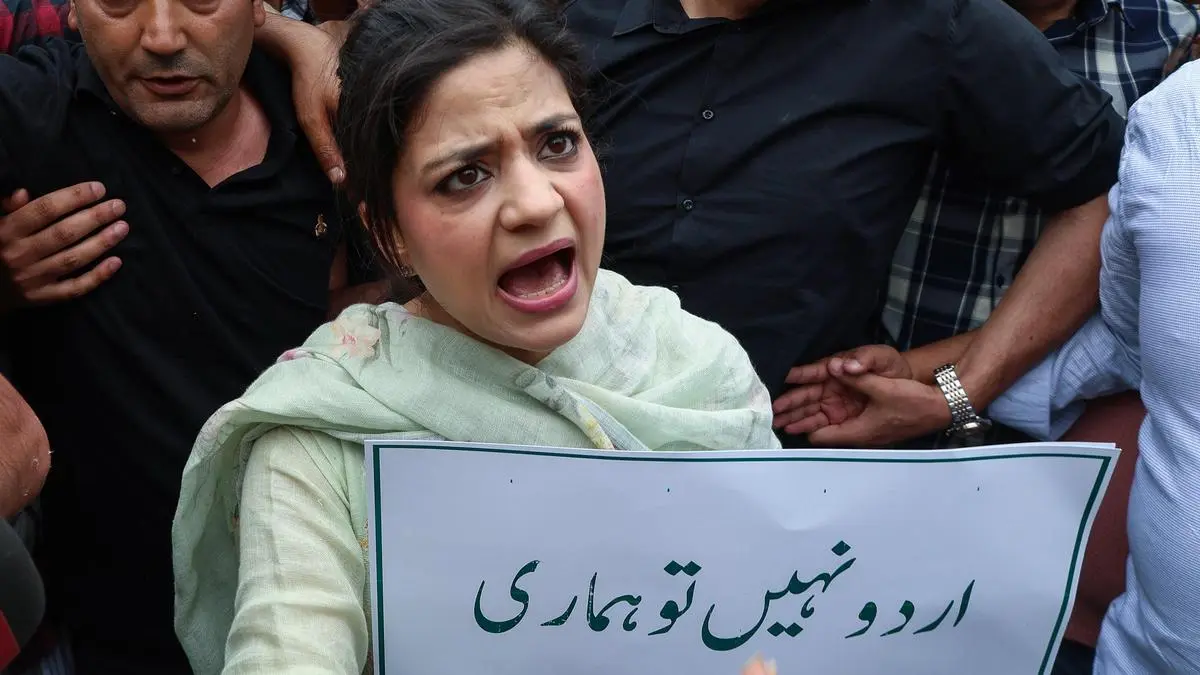
Within days, the notification triggered protests in Jammu. On June 13, BJP leaders and workers staged demonstrations against the Urdu requirement, calling it “regionally biased” and “illegal”. The agitation intensified over the following weeks, with BJP legislators demanding a rollback and warning of escalating protests. Subsequently, 29 BJP legislators, all from the Jammu region, sought the Lieutenant Governor’s intervention.
The CAT directed the recruitment board to accept applications from candidates with knowledge of any one of the five official languages, effectively ending Urdu’s exclusivity for the post. The BJP celebrated the CAT’s ruling with much fanfare.
The matter eventually reached the CAT. On July 14, acting on a petition, the tribunal stayed the provisions mandating Urdu. It observed that making Urdu compulsory, particularly in light of the Jammu and Kashmir Official Languages Act, 2020, would be “discriminatory.”
The CAT directed the recruitment board to accept applications from candidates proficient in any of the five official languages, ending Urdu’s exclusive status for the post. The BJP welcomed the ruling and celebrated the decision with much fanfare.
Chief Minister Omar Abdullah had defended the requirement, saying administrative work would suffer if recruits could not understand Urdu.
A political commentator argued that the CAT’s ruling is part of a larger trajectory in which Urdu’s economic significance is being scaled down alongside efforts to elevate Hindi as the national language.
“The present dispensation in Delhi has, over the years, marginalised Urdu across much of India, and Kashmir remains one of its last major bastions,” observed the analyst who wished not to be identified. “Earlier, in Kashmir, Urdu was closely tied to economic opportunity, as many [government] jobs required knowledge of the language. So, beyond its social importance, people learned Urdu out of economic compulsions. The BJP’s approach now is to remove Urdu as a job requirement, which would eventually discourage people from learning it, as its economic value would simply disappear.”
A revenue official emphasised that without a working knowledge of Urdu, it is extremely difficult to interpret Jammu and Kashmir’s revenue records. “The revenue record system here has been in use for centuries and is almost entirely in Urdu,” the official told Frontline. “Therefore, it is a practical requirement and without the knowledge of Urdu, at least upto to the Tehsildar level, a person cannot do justice to their job without understanding the terminology and context in the revenue documents. [Government] cannot run a system built in Urdu without people who understand Urdu.”
Former Chief Minister and Peoples Democratic Party (PDP) chief Mehbooba Mufti said there appeared to be a concerted attempt to “delete” Urdu from the region’s administrative and historical fabric. She described the move as part of a “broader effort to erode the Muslim cultural and religious identity” of Jammu and Kashmir.
It is against this backdrop that the April 10 decision of the Omar Abdullah government assumes greater significance. The proposed changes to recruitment rules in the Revenue Department came at a time when concerns over the Centre diluting Urdu’s centrality in Kashmir had already kept much of the region on the brink.
Facing mounting criticism in Kashmir, Chief Minister Omar Abdullah tried to strike a conciliatory note. Acknowledging that the proposal had reached his office, he said, “I do not deny that the proposal came from the department but I have not cleared it. There is no intention of approving it.” He added, “There is no move to drop Urdu. We have only sought public feedback and the file remains with me.”
A third political analyst, who, too, did not wish to be named, said: “Though Omar has said that the department sent him the file and that he will not approve it, it still raises questions about who is actually running the government and its departments, where such proposals are coming from, and why there was a need to bring this forward in the first place.”
Despite Omar Abdullah’s assurances, the PDP alleged that the ruling National Conference (NC) government had left Urdu out of a recent land records digitisation exercise in Jammu and Kashmir.
“If no official order has been issued fiddling with Urdu why does the government’s digitisation software for Jamabandi exclude it entirely,” PDP spokesperson Najmus Saqib posted on the social media platform X. “Why is the language being erased through a backdoor? Entire land records of J&K are on the verge of being tinkered with.”
“The proposal does not appear to have been brought out in a vacuum. The Omar Abdullah government seems to be moving closer to New Delhi, possibly out of concern over the space the PDP has been carving out by highlighting the NC’s shortcomings since it returned to power in 2024,” noted the aforementioned political observer. “In an attempt to keep PDP at bay, the NC appears to be aligning with BJP’s approach by gradually weakening the centrality of Urdu, a language in which Aatish-e-Chinar [the autobiography of Sheikh Abdullah, the first Prime Minister of Jammu and Kashmir after 1947 and Omar Abdullah’s grandfather] was first made available to the public.”
The second political commentator argued that despite Omar Abdullah’s clarification, the Revenue Department’s notification appeared ill-timed, particularly as the government was already facing public criticism for not fulfilling key election promises and for not taking a firmer stand against New Delhi.
“Since the NC came to power, it has conveyed that the majority does not always prevail. It is no secret that even though Jammu and Kashmir has an elected government, it is still, in many ways, run from Delhi. In this context, whether the demands of the majority population prevail depends largely on how the government chooses to exercise its authority,” the commentator added.
The anxieties around Urdu are not confined to Kashmir alone. Across parts of India, the language has increasingly become a site of political contestation after the BJP’s rise in 2014, with sections of the right wing framing it primarily as a “Muslim language”.
There have been instances of objections to Urdu signage, schools dropping the language from their curricula and signboards, and resistance to its presence in public spaces. Scholars and observers have repeatedly argued that the trend reflects a broader shift in which language is being recast through a communal lens, often overlooking Urdu’s deep historical roots and its close linguistic ties to Hindi. But in Kashmir, where Urdu remains an integral part of the region, the consequences run deeper.
From Nikkah namas (Islamic marriage contracts) to commercial agreements, Urdu remains intrinsically important to Kashmir. For a large section of the Muslim population, it also serves as a primary gateway to Islamic religious literature as well as historical and literary texts. Its relevance is reflected in education, too, with many students continuing to study Urdu up to the matriculation level, while Hindi attracts relatively limited interest and Sanskrit almost none.
This sense of unease in Kashmir has surfaced in other instances as well. A 2025 news report claimed that the Union Ministry of Education was considering the introduction of Sanskrit as a mandatory subject in schools across Kashmir. The announcement added a fresh layer of anxiety to an already simmering issue.
The Directorate of School Education later clarified that no such move had been approved. It added that it had only sought feedback on a proposal submitted to Jammu and Kashmir’s Lieutenant Governor by Purshotam Lal Dube, who heads Samskrita Bharati, an NGO that advocates for the inclusion of Sanskrit in Jammu and Kashmir’s schools and colleges under the provisions of the National Education Policy 2020. The proposal, shared with the Education Department for comments, had not been adopted. The department maintained that no process had been initiated to introduce Sanskrit as either a mandatory or optional subject in schools.
However, the episode quickly found political resonance. The PDP, which has been vocal about what it describes as an attack on the region’s linguistic heritage, reiterated its concerns, even as critics pointed to the party’s own record on the issue.
“When PDP was in alliance with the BJP, several centrally sponsored schemes carried Sanskrit names, but the party rarely attempted to resist or localise them in the valley by using Urdu,” noted the third political analyst. “They can now argue that these were Central schemes and that a State government had limited scope to intervene but other States like West Bengal, Tamil Nadu, Kerala, and Punjab have done so for years. So, no serious effort was ever made by them or any local political party to safeguard the language.”
The language reset
When the princely state of Jammu and Kashmir took shape under Dogra rule in the 19th century, Persian functioned as the official and court language— a legacy of earlier regimes—and continued in that role for several decades. This changed in 1889, when Maharaja Pratap Singh replaced Persian with Urdu.
The move mirrored broader changes across north India under the British, where Urdu had already been adopted in courts following the decline of Persian. Urdu’s Perso-Arabic script, combined with its growing use in governance, made it a practical successor to Persian.
The choice of Urdu was also shaped by the region’s linguistic diversity. With Kashmiri, Dogri, Balti, and several other languages spoken across different regions, Urdu emerged as a common language that could function across the Himalayan region. Its adoption allowed the State to standardise record-keeping and official communication without privileging any one regional language over another.
By the early 20th century, Urdu had firmly entrenched itself in governance, education, and public life. It became the medium of instruction in many schools, the language of official correspondence, and a key vehicle for print culture including newspapers and literary writing. After 1947, this continuity was formally recognised in the Constitution of Jammu and Kashmir 1956, which retained Urdu as the official language of the State, while permitting English for administrative use.
However, over the decades, Urdu’s prominence in Jammu and Kashmir gradually diminished due to multiple factors, including the rise of regionally driven linguistic identities.
“In recent years, there has been a marked rise in language chauvinism,” the third political observer said. “It reflects the underlying ethnic and cultural divide in Jammu and Kashmir, which the BJP is capitalising on.”
The shift has become more visible after 2019 when Parliament introduced three more languages to Jammu and Kashmir’s then-official languages, Urdu and English through the Official Languages Act. “It became quite evident after the Official Languages Act was introduced that communication would not be carried out in Kashmiri or Dogri,” noted the observer. “Instead, the move was directly aimed at bringing in Hindi to overshadow Urdu.”
Observers have pointed to telling changes in official practice after 2019. Under the constitutional frameworks of 1934 and 1939, and later under the Jammu and Kashmir Constitution, Urdu held a central place in state functioning, including the presentation of the Budget. However, after 2019, the Budget and other official documents have largely been in English and Hindi, though Urdu has been reinstated following the return of an elected government.
Other symbolic changes have also pointed to a shift away from Urdu in administrative functioning; the renaming of the Public Health Engineering Department as “Jal Shakti” by the Lieutenant Governor administration in 2020 is often cited by critics as a marker of this trend. Similarly, the Vande Bharat Express, which recently connected Kashmir with Jammu after decades, features announcements only in English and Hindi.
The sidelining of Urdu has been observed beyond political circles as well. The environmental activist Raja Muzaffar Bhat drew attention to a milestone in Kashmir that displayed the names of Srinagar and Jammu only in Hindi.
While Urdu remains intricate to Kashmir, observers believe that its future hinges on whether it continues to hold practical value in the official system or gradually diminishes in importance through a series of incremental changes.
Zaid Bin Shabir is a journalist based in Srinagar.
Also Read | Institutions cause the death of languages: Shafi Shauq
Also Read | Liked, shared, unread