





Last Updated:
Astronomers may have stumbled upon a bizarre early-universe object combining a black hole and dense gas, potentially explaining JWST’s mysterious “little red dots”




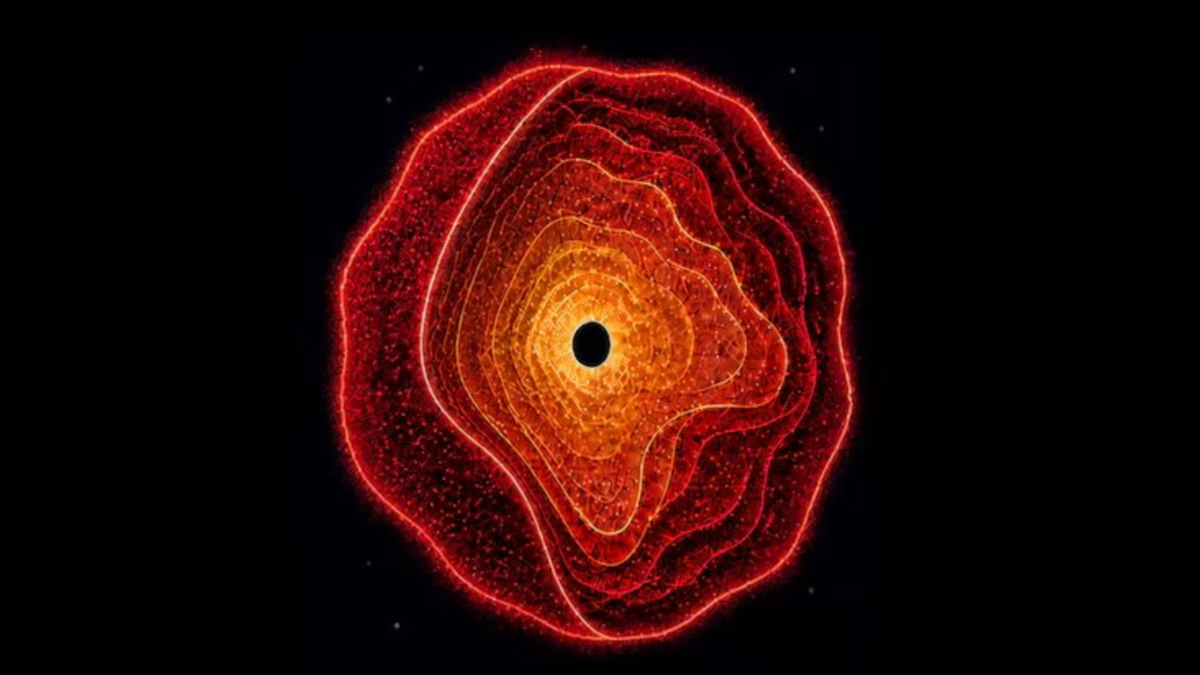
The bizarre object, nicknamed a “black hole star”, could provide a new explanation for some of the mysterious red dots spotted by JWST (Image-X/@latestinspace)
Astronomers may have identified an unusual type of cosmic object that could offer new clues about some of the most puzzling observations made by NASA’s James Webb Space Telescope (JWST). The object, described as a possible “black hole star”, appears to combine characteristics associated with both an enormous star and a rapidly feeding black hole.
Astronomers may have stumbled upon a bizarre cosmic object unlike anything previously observed. Dubbed a possible “black hole star”, the object appears to blur the line between a gigantic star and a rapidly feeding black hole, and could help explain some of JWST’s most mysterious discoveries.
The discovery has gained attention online after a post shared by X account @latestinspace went viral. The post claimed that astronomers had discovered an entirely new type of cosmic object called a “black hole star”, describing it as being roughly the size of our solar system and capable of producing energy vastly greater than that of ordinary stars.
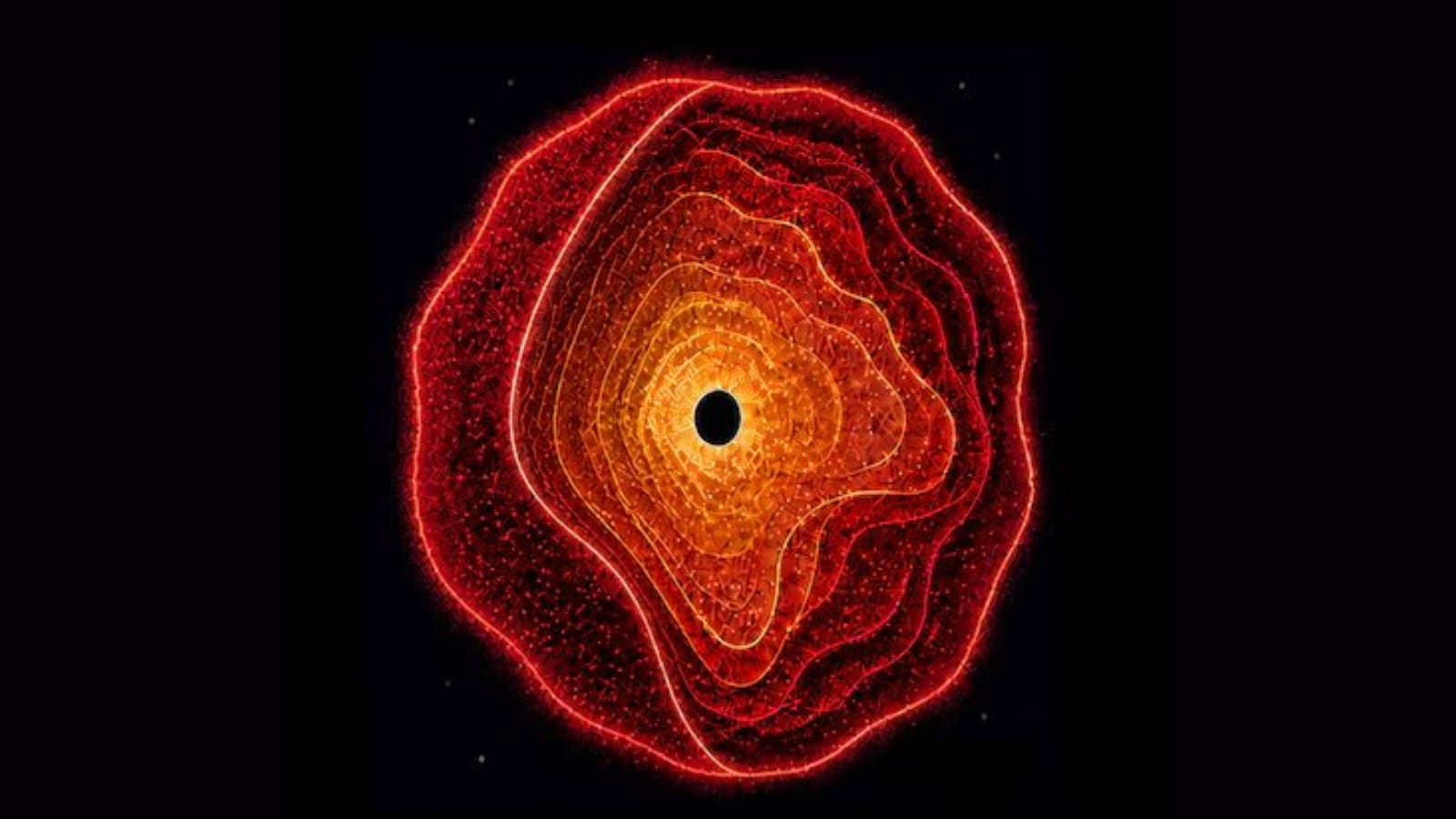
According to the post, the discovery could also help explain the mysterious “little red dots” that JWST has detected in deep-space observations of the early universe.
The scientific idea behind the object is particularly intriguing. Researchers suggest that what appears to be an enormous star could actually be a supermassive black hole surrounded by an extremely dense cloud of gas.
Instead of the object shining primarily because of nuclear fusion, as stars do, much of its energy would come from material falling towards and feeding the black hole.
A study involving researchers at the Massachusetts Institute of Technology (MIT) describes the object as a possible new astrophysical configuration. The researchers analysed an exceptionally bright and red source from the early universe, observed when the cosmos was only hundreds of millions of years old. The source, known as MoM-BH-1, dates to roughly 660 million years after the Big Bang.
The object appears extremely compact but extraordinarily luminous. Its properties suggest that it does not fit neatly into the conventional categories of either a star or a typical active black hole. Instead, scientists propose that it could represent a black hole embedded within a massive, dense and turbulent envelope of gas.
This scenario is especially significant because JWST has detected a population of mysterious objects known as “little red dots” in the early universe. Scientists have been debating their true nature since the telescope began revealing these unexpected sources.
One leading explanation is that at least some of them could be black holes surrounded by dense gas, giving them an appearance that resembles stars.
The term “black hole star” therefore does not necessarily mean that scientists have discovered a conventional star containing a black hole. Rather, it refers to a proposed configuration in which a rapidly growing black hole is hidden within a dense gaseous environment, making the entire structure appear star-like.
The possibility is important because understanding such objects could help scientists investigate how supermassive black holes managed to grow so quickly during the universe’s infancy. Researchers have long struggled to explain how black holes containing millions or even billions of times the Sun’s mass could emerge so early in cosmic history.
The viral post also triggered several reactions from users, with some questioning the terminology and others pointing out that similar objects had been theorised previously.
“”Black hole star” is an unfortunate choice of names because it isn’t a star at all. The high energy glow occurs from gas accretion rather than fusion, but I guess “black hole with glowing red cloud” is cumbersome,” said one user.
Another user questioned why such a powerful object had taken so long to be detected, writing: “If it emits that much, why are we only just now seeing it? Maybe I’m a pea brain but something isn’t adding up,” said another.
A third user pointed out that the concept itself has theoretical roots dating back years: “These were theorised to have existed since 2012, they are called quasi-stars. i’m glad that they are finally getting some attention,” said a third user.
NEWS 🚨: Astronomers have discovered an entirely new type of cosmic object called a “black hole star”It’s the size of our solar system, emits 100 billion times more energy than any star, and may finally explain JWST’s mysterious “little red dots” pic.twitter.com/uBILVcoGdF
— Latest in space (@latestinspace) August 13, 2026
Another commenter highlighted the enormous distance involved and suggested that the object’s present-day state could be very different from what astronomers are observing:
“Keep in mind this object we are observing now is from 660 million years after the Big Bang, and the brightness is from the object consuming maybe above the Eddington limit. Today this object is likely a SMBH consuming (and emitting) much less,” said a fourth.
Key Questions Answered
 Ask News18
Black hole stars could have been common in the early universe, as a 2026 study found candidates consistent with black-hole-star models across a broad range of cosmic history. This suggests the phenomenon may not be limited to a single unusual object.
Ask News18About the Author

A team of writers at News18.com bring you stories on what’s creating the buzz on the Internet while exploring science, cricket, tech, gender, Bollywood, and culture.
August 15, 2026, 13:30 IST
Read More


