







The reclaimed water from the STP will be used for watering saplings to be planted along the Adyar and maintaining plants on medians on Rajiv Gandhi Salai.
| Photo Credit: B. VELANKANNI RAJ
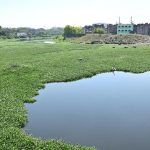
The Water Resources Department has recently partnered with non-governmental organisations (NGOs) to curb sewage pollution on stretches of the Adyar.
Various measures have been undertaken in the past to arrest sewage flow into the Adyar through minor waterways and storm-water drains at different locations. The Chennai Metropolitan Water Supply and Sewerage Board (CMWSSB) had constructed modular sewage treatment plants (STPs) in the city, including at Todhunter Nagar in Saidapet and Karaima Nagar covering Kundrathur.
In line with the interventions to rejuvenate the river, efforts are being taken to intercept wastewater flowing into the river and treat it through another modular STP. Work has started for the construction of the modular STP, with a capacity to handle 0.625 million litres a day, near the Adyar-Buckingham Canal intersection on South Lock Street.
While the WRD has earmarked about 6,000 sq.ft for the STP, the project will be implemented by a consortium of organisations, including SIV Impact Inc and CEMCOT.
The modular STP will use upflow anaerobic sludge blanket coupled with moving bed biofilm reactor treatment technology. It will feature automated operation, monitored through a supervisory control and data acquisition system, and is expected to generate minimal bio-sludge.
Krishna Mohan of Chennai Resilience Centre, the voluntary organisation facilitating the project, said the reclaimed water will be used for watering saplings to be planted along the river and maintaining plants on medians on Rajiv Gandhi Salai (Old Mahabalipuram Road). A portion of the reclaimed water will be released into the river to help groundwater recharge.
“We are also exploring the possibility of supplying treated water to industries and large apartment complexes for non-potable uses such as landscape irrigation and cooling towers at a subsidised rate. This would support reducing freshwater use,” he said.
The initiative is intended to serve as a model and could be replicated in other waterways such as the Mambalam drain.
The ₹10-crore project, funded by Amazon, will also involve operation and maintenance for 10 years to ensure sustainability.
Published – June 19, 2026 11:41 pm IST