






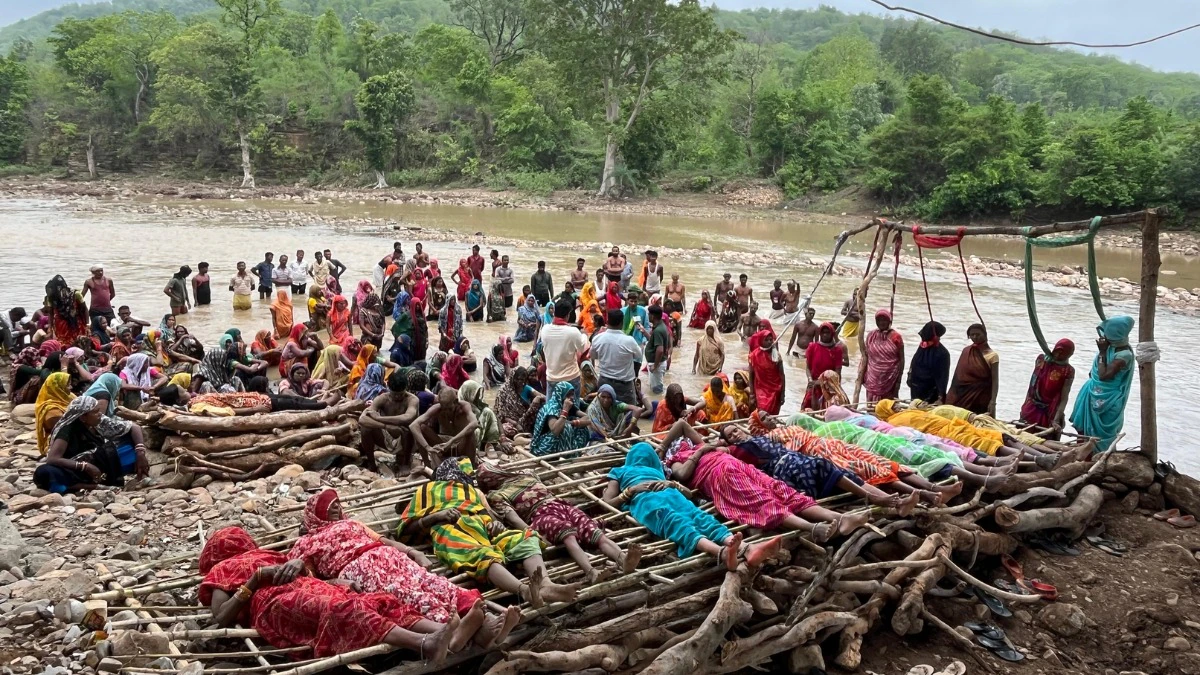
A noose rests loosely around the necks of tribal women in Madhya Pradesh’s Chhatarpur. Beside them, another group lies motionless on a symbolic funeral pyre, while a few metres away, villagers stand waist-deep in the Barana River. None of these are acts of despair. They are carefully chosen forms of protest by tribals who say they are fighting not just for compensation, but for the right to remain rooted to the land they have called home for generations.
As India’s first river-linking initiative gathers momentum, the Ken-Betwa River Link Project has also sparked an equally determined resistance, with each act of protest underscoring the growing tensions between development and displacement.
Protesters alleged that authorities had taken possession of their land without paying full compensation, leaving hundreds of displaced families stripped of their agricultural land, livelihoods and cultural identity. They also accused the administration of carrying out illegal evictions, filing false police cases against villagers and excluding several affected families from official rehabilitation lists.
The Rs 44,605-crore Ken-Betwa Link Project promises to irrigate 10.62 lakh hectares, provide drinking water to 62 lakh people and generate 130 MW of electricity. Touted as a transformative infrastructure project, it seeks to transfer water from the Ken basin to the Betwa basin, addressing water scarcity across parts of Madhya Pradesh and Uttar Pradesh.

But for hundreds of tribal families living in villages, this ambitious project has come to represent something else entirely: displacement, uncertainty and a long struggle for rehabilitation.
UNFULFILLED ASSURANCES AND INCOMPLETE REHABILITATION
The protest has been spearheaded by Jai Kisan Organisation leader Amit Bhatnagar, whose indefinite hunger strike has become another focal point of the agitation. Bhatnagar alleges that families affected not only by the Ken-Betwa project but also by the Majhgaon and Runjh irrigation projects have been denied justice despite repeated promises.
According to protesters, displaced families have lost agricultural land, forests, water sources, livelihoods and cultural identity. They also accuse authorities of illegal evictions, disconnecting electricity, filing false police cases and failing to include all affected families in official rehabilitation lists.
One of their key demands of protestors is transparency.
Bhatnagar disputes the administration’s claim that 638 previously excluded families have now been included in the project-affected persons list, alleging that names from villages such as Mainari continue to be missing. Protesters have demanded that complete beneficiary lists be publicly displayed in every affected village.
Another central demand concerns compensation.
The protesters argue that authorities have taken possession of land without paying full compensation, alleging violations of the Right to Fair Compensation and Transparency in Land Acquisition, Rehabilitation and Resettlement Act, 2013. They maintain that construction work on the dam should not proceed until rehabilitation is completed.
MANY FACES OF RESISTANCE
The agitation has unfolded in phases, with every passing week introducing a new and more dramatic form of peaceful protest.
It began with Chita Satyagraha, where displaced villagers lay on symbolic funeral pyres, saying they had already “died” after losing their homes, fields and forests.
Then came Mitti Satyagraha, as protesters covered themselves in soil, asserting that the land they cultivated for generations formed an inseparable part of their identity.
The movement soon shifted into Jal Satyagraha, with villagers standing for hours in the waters of the Barana River, a familiar method of protest used in several displacement movements across central India.
Now, the agitation has reached its most striking stage: Phansi Satyagraha, or the symbolic hanging protest. Tribal women have placed nooses around their necks, demanding either complete rehabilitation or state-sanctioned euthanasia if the government cannot ensure justice.
The imagery is deliberate.
Tribal women accused the government of failing to fulfil its promises and said they should be allowed euthanasia if authorities could not ensure justice and protect their rights.
WOMEN AT THE FOREFRONT
The movement has increasingly been led by tribal women. They have emerged as the face of every stage of the agitation – from standing in river waters to lying on funeral pyres and now wearing symbolic nooses. Their participation reflects more than opposition to displacement.
For many, forests, rivers and farmland represent not just economic assets but social, cultural and spiritual spaces that define community life. Losing them, they argue, means losing an entire way of living.
As the protest intensified, large numbers of women also joined relay hunger strikes, turning what began as a local land acquisition dispute into a wider movement centred on dignity, identity and survival.
POLITICAL VISIT AND ENQUIRY
As agitation stretched into its second week, the protest attracted political attention.
Leader of Opposition Umang Singhar visited the site, met displaced families and extended the Congress’ support to the movement. During the visit, he questioned the administration’s handling of the agitation and sought an enquiry into allegations that police personnel had intimidated protesters.
He also criticised the absence of basic facilities such as drinking water, food and medical assistance at the protest site despite demonstrations continuing for nearly two weeks.

Singhar proposed forming a joint committee comprising government officials and representatives of the Jai Kisan Organisation to examine the rehabilitation process and compensation-related concerns.
His visit marked a turning point, transforming what had largely remained a local farmers’ movement into a significant political issue in Madhya Pradesh.
ADMINISTRATION PUSHES BACK AGAINST ALLEGATIONS
The Chhatarpur district administration has rejected allegations that affected families have been ignored. Collector Parth Jaiswal said officials from Chhatarpur and neighbouring Panna district have been holding discussions with protesters to understand and address their grievances.
According to the administration, demands raised during an earlier round of protests in April had already been fulfilled. Officials have also pointed to the Madhya Pradesh Cabinet’s recent decision to enhance the rehabilitation and relief package, maintaining that fresh demands are now being raised.
The administration further said that many of the protesters belong to adjoining Panna district, where tribal communities have also been affected by the river-linking project.
DEVELOPMENT VERSUS DISPLACEMENT DEBATE
The Ken-Betwa Link Project occupies a unique place in India’s water infrastructure plans. Long projected as a solution to chronic water shortages in the Bundelkhand region, it has often been showcased as a model for future river-linking initiatives.
Yet, on the banks of the Barana River, the conversation is not about canals, irrigation potential or power generation. It is about what development costs those who live closest to it.
For the tribal families gathered near Kupi village, compensation is only one part of the demand. They insist that rehabilitation must mean more than financial assistance, it must restore livelihoods, recognise community ties and protect cultural identity before displacement becomes irreversible.
As officials continue negotiations and the project moves forward, the images emerging from the protest site have become powerful reminders of the human questions that accompany India’s biggest infrastructure ambitions.
– Ends
With inputs from Lokesh Chaurasiya