





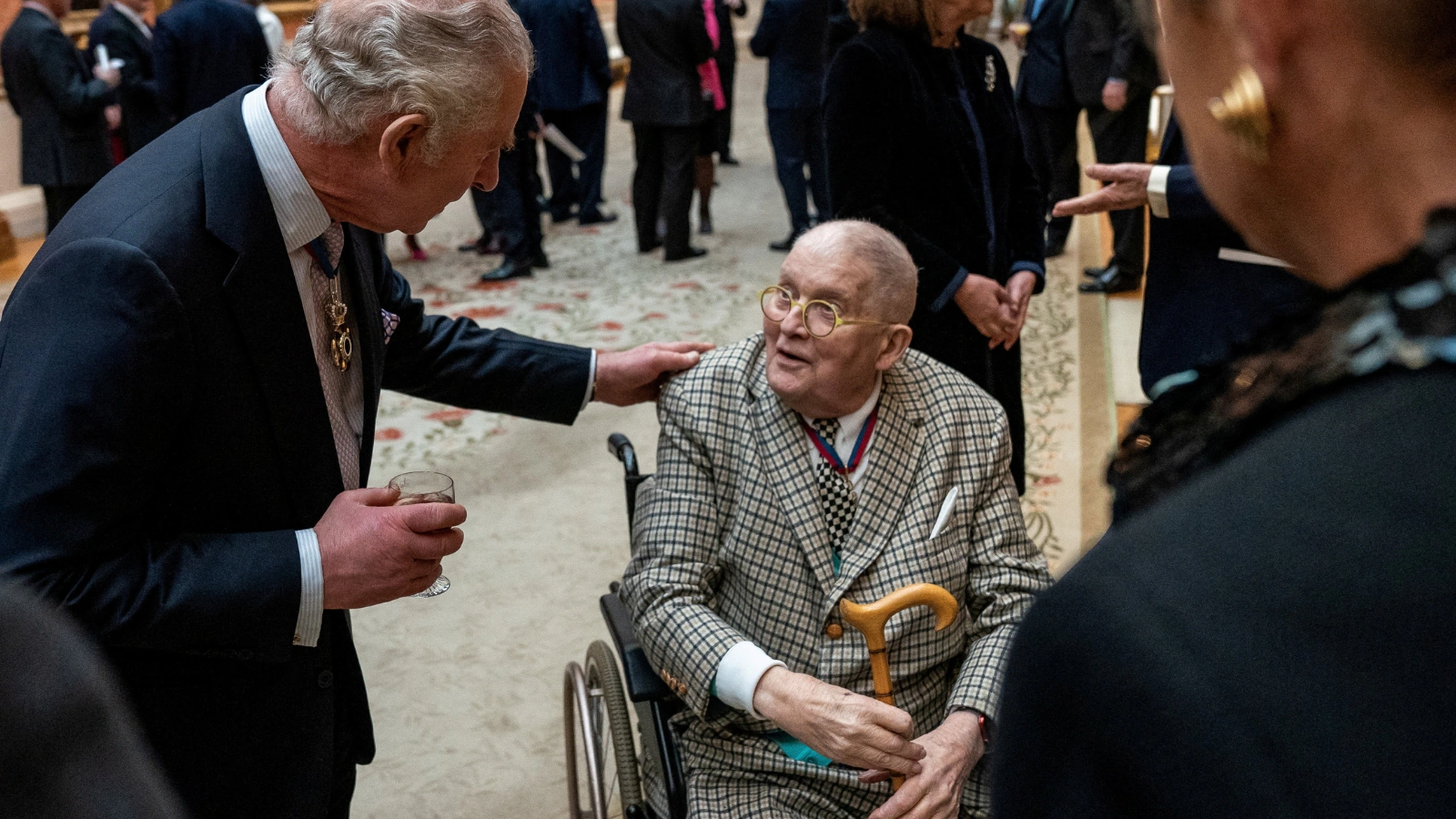
British artist David Hockney, who transformed California swimming pools into some of the most recognisable images in modern art and spent seven decades constantly reinventing himself, died on June 12, 2025, just weeks before his 89th birthday. From becoming one of the first major artists to depict gay relationships with tenderness and openness to embracing the iPad as a creative tool in his later years, Hockney’s life was defined by an unwavering refusal to stand still.
Growing up in the industrial city of Bradford in northern England, Hockney became fascinated by the sharp shadows he saw in Laurel and Hardy films. To him, they suggested a place where the sun always shone.

He found that world in Los Angeles after moving there in the 1960s. Swimming pools, palm trees and suburban patios became recurring motifs in his work, rendered in luminous colours and flattened perspectives that helped redefine contemporary painting.
“I had spent the first 20 years of my life in the gothic gloom of the North,” Hockney once said. “Here I felt free.”
2. His pool paintings made auction history
Hockney’s fascination with California culminated in some of the most famous artworks of the 20th century.
His 1972 masterpiece, Portrait of an Artist (Pool with Two Figures), sold for $90.3 million at Christie’s in 2018, then the highest price ever paid at auction for a work by a living artist.
Two years later, The Splash (1966) fetched £23.1 million at Sotheby’s.
Yet Hockney remained remarkably detached from wealth.
Story continues below this ad
“The moment I first sold pictures to earn a living, I felt rich,” he told AP. “You are a rich man if you do the things you want to do.”
3. He painted gay lives long before acceptance
Hockney came out as gay at a time when homosexuality remained a criminal offence in Britain.
As an art student, he gave his works provocative titles such as We Two Boys Together Clinging, Going to be a Queen for Tonight, Doll Boy and Two Men in a Shower. His paintings brought visibility, intimacy and tenderness to same-sex relationships decades before they entered mainstream culture.
He also challenged artistic conventions by portraying young male bodies with the same attention that artists had historically reserved for female nudes.
Story continues below this ad
4. He never stopped experimenting
Few artists embraced reinvention as enthusiastically as Hockney.
Over more than 70 years, he worked across acrylics, oil painting, printmaking, photography, fax machines, opera set design, video installations and digital drawing.
His 1986 photographic collage Pearblossom Highway challenged traditional ideas of perspective. He later argued that Old Masters had relied more heavily on optical devices than historians acknowledged. He even designed a stained-glass window for Westminster Abbey.
In his later years, the iPad became one of his favourite artistic instruments.
Story continues below this ad
5. His message during Covid-19 became his legacy
Perhaps Hockney’s most memorable gesture came during the Covid-19 lockdown.
Living in Normandy in 2020, he spent his days creating iPad drawings of spring unfolding in his garden and sending them to friends around the world.
Attached to them was a simple message:
“Do remember they can’t cancel the spring.”
The phrase resonated far beyond the pandemic, eventually illuminating the Fondation Louis Vuitton in Paris during a major retrospective in 2025.
Even approaching his 89th birthday, Hockney showed little interest in slowing down.
Story continues below this ad
“You don’t retire doing this,” he once said. “You just do it until you fall over.”
For an artist who spent a lifetime finding new ways to see the world, it was perhaps the most fitting epitaph of all.
(With inputs from agencies)
(This article was written by Seekriti Saha, an intern at The Indian Express)