








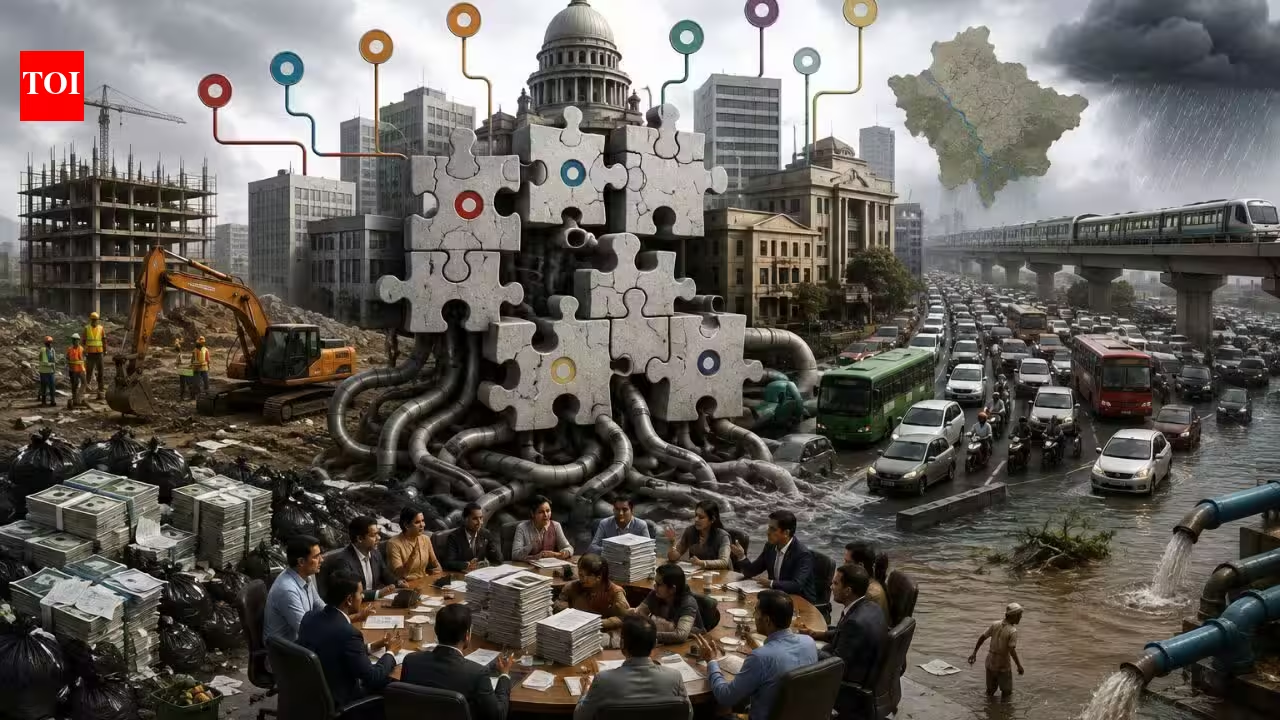

Delhi has one of the country’s most complexadministrative structures, where responsibility for a singlepublic issue is often fragmented across multiple authorities. The result: You,the citizen, suffers, but the buck stops nowhere.Too many cooksA road getting dug up soon after it was constructed is not an unusual site in the city. Unlike any other Indian city, governance in Delhi is divided among the Centre, Delhi govt, Municipal Corporation of Delhi, Delhi Development Authority, New Delhi Municipal Council, Delhi Cantonment Board and several other agencies, with most of these often lacking coordination. This results not only in delays, but also wasteful expenditure of public money. In many cases, even neighbouring states, such as Uttar Pradesh and Haryana, control key infrastructure that directly affects the city’s functioningWhat a wasteThe lack of coordination among multiple agencies often results in avoidable duplication of work and also serious inconvenience to the general public. “One agency spends weeks building or resurfacing a road, only for another agency to arrive soon to dig it up for laying a water pipeline, underground power cables, sewer lines or some other underground utility network. Such instances are not a rare sight in Delhi and lead to delays, unwise spending of public money, traffic congestion and inconvenience to residents,” said an official who didn’t want to be named
Some examples where Delhi finds its hands tied
Monsoon woes
In 2023, when parts of the capital were flooded, Delhi faced a major coordination challenge with Haryana, which controls the ITO barrage. Differences over the barrage’s maintenance, funding and operation had persisted for years, exposing gaps in coordination between the two govts. Delhi govt has since initiated the process to take over the barrage’s operation. Haryana has given in-principle approval, but the transfer is yet to be completed.Another key barrage, Okhla Barrage, located on the Delhi-Uttar Pradesh border, is operated by the Uttar Pradesh irrigation department. Any decision on its operation requires coordination between Delhi and Uttar Pradesh. Officials said coordination tends to become challenging when different political parties govern Delhi, UP and Haryana
Drainage
Stormwater drains across Delhi are maintained by MCD, PWD, the irrigation and flood control department, DDA and NHAI. During every monsoon season, waterlogging at a single location can involve several agencies because each is responsible only for a particular stretch of the drainage network. Coordination failures often delay remedial action even when the problem is evident
Drinking water
Delhi’s dependence on neighbouring states extends beyond flood management. Much of the capital’s drinking water reaches the city through Munak Canal, which is owned and maintained by Haryana as part of the Western Yamuna Canal system. Although Delhi funded the canal’s construction which was done by Haryana, the neighbouring state maintains the entire stretch including the 22km stretch passing through the city, and operational control remains with Haryana, underscoring how Delhi’s water security depends on inter-state cooperation
Heritage
Conservation in areas such as Shahjahanabad involves multiple stakeholders, including Archaeological Survey of India, MCD, DDA, PWD, utility agencies and traffic police, making even relatively simple restoration projects administratively challenging
Road maintenance
A commuter travelling from south Delhi to central Delhi may unknowingly use roads maintained by Public Works Department, MCD, National Highways Authority of India, NDMC, DDA and Delhi Cantonment Board. A pothole, damaged footpath or malfunctioning streetlight may, therefore, fall under entirely different agencies depending on the exact location
Delays and cost overruns
The overlapping jurisdictions are also one of the key reasons why infrastructure projects frequently miss deadlines. A flyover or elevated road may be executed by PWD but built on land owned by DDA, require tree-felling permission from forest department, shifting of water pipelines by Delhi Jal Board, relocation of electricity cables by power discoms, clearances from railways if a railway crossing is involved, and approvals from NHAI if it interfaces with a national highway. Delays by any one agency can stall the entire projectFor residents, however, these jurisdictional boundaries mean little as they expect timely delivery of services, irrespective of which authority is legally responsible. Delhi’s governance structure is a product of its unique constitutional position as the India’s capital as national and local interests are to be taken into account. It, however, shows that in the capital, responsibility is shared – but accountability is often far harder to locateWhile a federal and democratic system necessarily involves multi-level governance to accommodate diversity, the duplication of functions among multiple authorities often undermines administrative efficiency. There is a strong need to rationalise the number of agencies performing overlapping functions, improve coordination and establish clear institutional responsibilities to ensure efficient and timely public service delivery – K Mahesh, senior IAS officer and honorary president of Delhi Administration Officers Academic Forum