




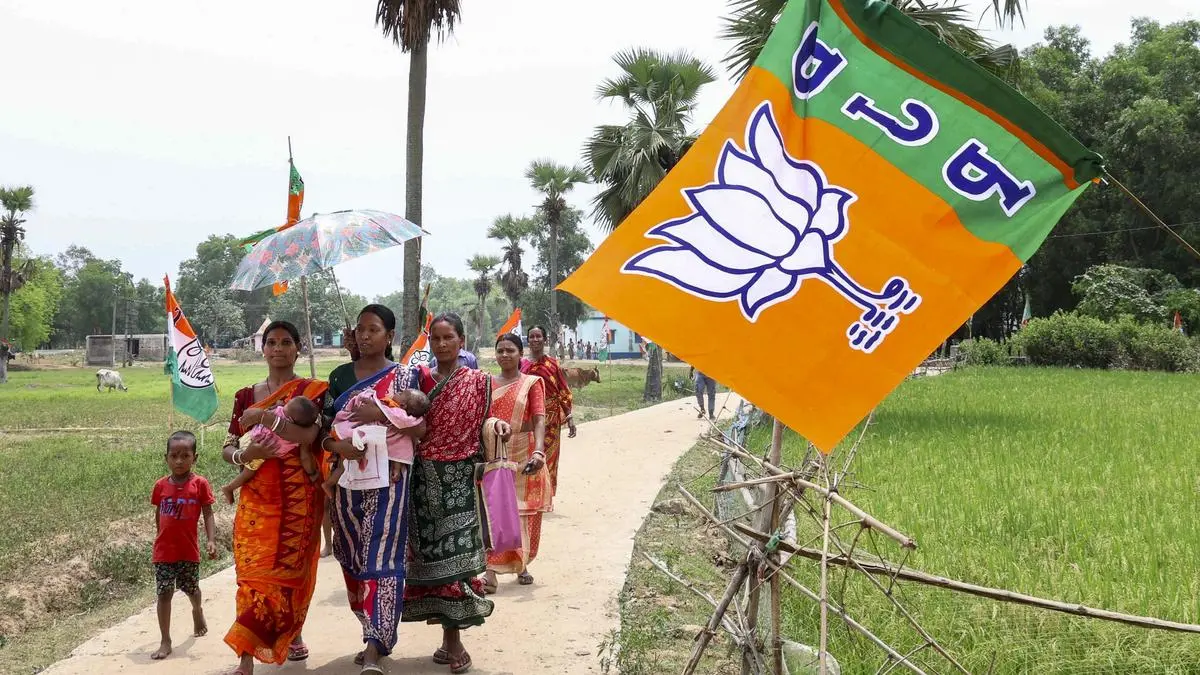
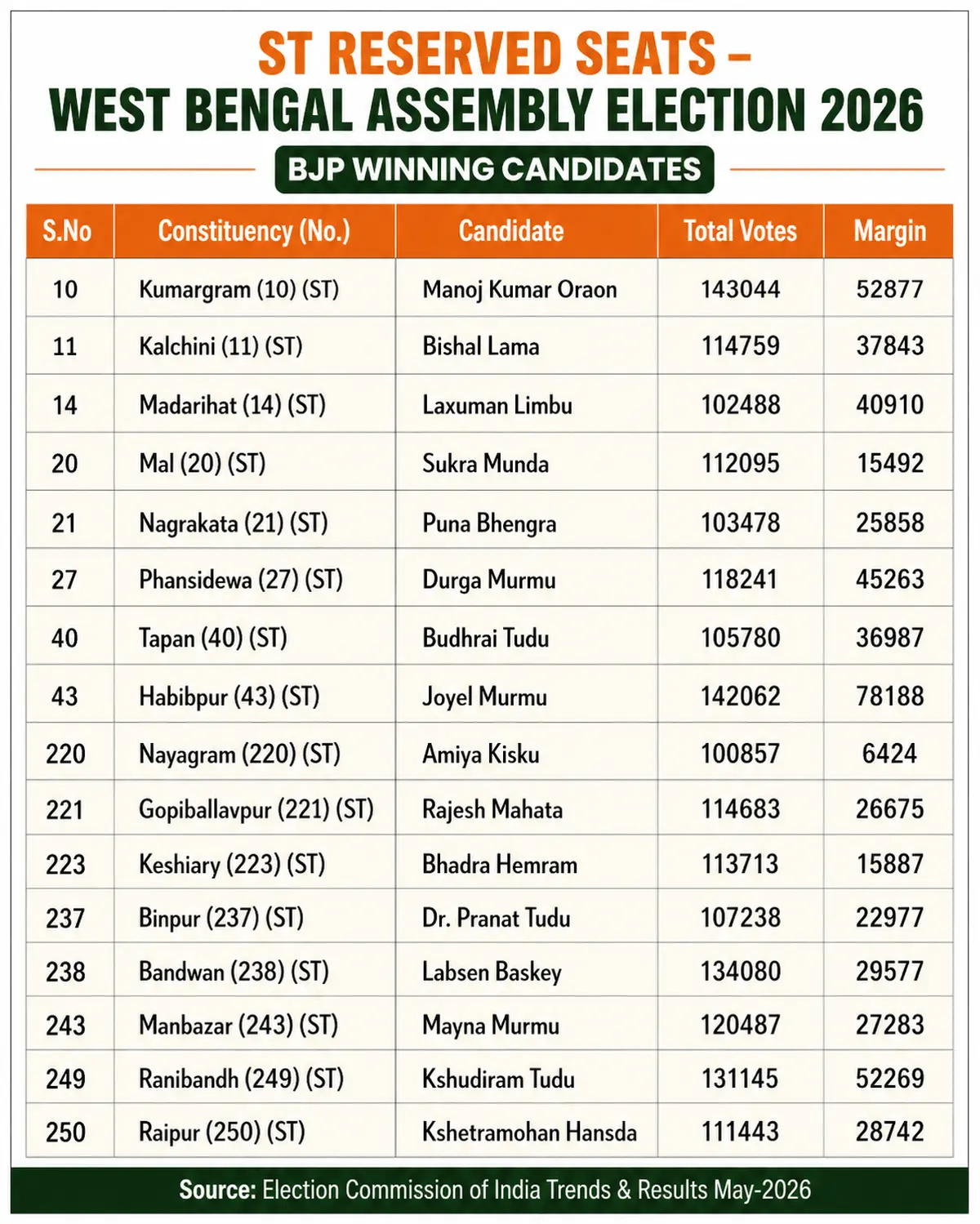
In a year coinciding with the 125th birth anniversary of Shyama Prasad Mukherjee, West Bengal has witnessed a historic realignment of its political map. After 15 years, Mamata Banerjee’s tenure came to an end and the focal point for the saffron storm was not merely the urban centres, but also the thick Sal forests of the 16 Scheduled Tribe reserved seats. At first glance, the BJP’s 100 per cent victory in these seats appears to be emblematic of a major shift from welfare politics to the dominance of administrative and identity issues. Even more importantly, it seems indicative of a change in the position of tribal communities from beneficiaries of welfare politics to politically minded actors.
One important reason for the election result is what can be described as the “27 lakh population paradox”. Although the 2011 Census counted some 5.2 million Scheduled Tribes, the latest administrative figure showed about 8 million tribes only, which amounts to a disparity of nearly 2.7 million tribes. Tribal groups read the situation as an attempt to weaken the community’s ST status through the issuing of fake certificates, which caused anxiety about identity security and led to strong demands for certificate verification, particularly among young people in Bankura and Paschim Medinipur.
The suspicion that the government’s administrative machinery was facilitating this process for vote-bank considerations added further to the mistrust. Against this backdrop, the BJP’s offer of a Special Intensive Revision (SIR) scheme to “detect and delete” such false entries offered voters an institutional solution to what they saw as a life-and-death issue of identity protection.
There were also some internal changes that took place in tribal politics, which impacted the results. With the emergence of leaders like Ajit Prasad Mahato and the formation of equidistant politics, the idea of tribal loyalty in Junglemahal began to decline. For instance, in constituencies like Gopiballavpur and Manbazar, the fragmentation process helped voters transcend old affiliations. At the same time, changing relations between the Kurmi and the Santhal altered political ground realities.
The change in voter preference was evident in the election results in Binpur, in which Pranat Tudu triumphed over Birbaha Hansda. This signified that there was a move away from mere symbolism (the question of recognition to the Sarna Code) to more concrete issues related to identity such as employment opportunities, education, and legitimate ST status.
In parallel, the deterioration in educational facilities became another structural pressure factor. There was a reported fall in the number of tribal hostels from 1,000 to 300, limiting access to schooling for first-time students in far-off locations. Further, the Utsashree scheme worsened the situation by facilitating the relocation of teachers to cities, leaving so-called “teacherless villages” behind. This gave rise to a generational revolt: tribal youth, especially those aspiring to join secondary education institutions and colleges, emerged as a political mobilising force. Gradually, they came to realise that welfare schemes such as Lakshmi Bhandar were merely stop-gap arrangements that provide relief but were not adequate for empowerment, which includes effective schools, hostels, and efficient teaching systems.
The dignity issue
The issue surrounding President Droupadi Murmu’s protocol that played out in March turned out to be a critical emotional juncture that moved the electoral debate away from issues of welfare to those of dignity and representation.
The controversy erupted when the venue of the presidential visit was switched from Bidhannagar to Gossainpur, which is more distant than the first location. Moreover, Murmu’s statement: “Is Mamata (my younger sister) angry with me?” coupled with the fact that no high-ranking State government representatives were there to officially welcome Murmu made the situation even more serious.
What made it a political issue was not only the State versus Centre conflict, but also the “national versus regional” dignity issue. Indeed, for the tribes, Droupadi Murmu is a “daughter of the soil”, not just a constitutional office holder. In the case of the Santhal, Oraon, and Munda, in particular, it resulted in creating an “identity dignity response”.
The outsider-insider question
The BJP campaign saw a deliberate change in positioning from being labeled as a “party of North India” to positioning the party within the local culture and politics of West Bengal. The BJP’s leaders were seen interacting with the local culture by visiting Thanthania Kalibari, showing a willingness to connect with Bengali culture and religion instead of projecting an outsider image. At the same time, the positioning of Suvendu Adhikari in the region proved to be effective in overcoming the outsider-insider dilemma.
SIR and high turnout
With regard to the electoral rolls, the Special Intensive Revision (SIR), which marked out over 9.1 million names, turned out to be a mobilisation driver, especially in the tribal constituencies.
Here, the SIR was not seen as a mere administrative function; rather, it was seen as a form of “purification mechanism” linked closely with identity protection. The threat of exclusion along with the worry regarding “fake” entries led to a process that can be referred to as reverse-polarisation mobilisation. This led to tribal migrants coming back to their constituencies to protect their electoral identity, resulting in a remarkable turnout rate of 92.47 per cent.
National implications
The victory in Bengal has wider ramifications than State politics alone, with significant geopolitical and ideological implications. From a geopolitical point of view, the BJP win will fortify India’s eastern corridor of governance, running right up to the border of Bangladesh via the Siliguri Corridor (also known as “the Chicken’s Neck”). This will increase connectivity between mainland India and its northeastern States while at the same time including tribal-majority areas within the governance structure of the nation. Ideologically, the Bengal victory takes on special significance in light of the 125th birth year of Shyama Prasad Mukherjee, for which the Ministry of Culture has launched a two-year commemoration.
The mandate in this belt signifies a paradigm shift in the tribal political mindset. It appears to have been motivated not only by charismatic leadership or ideological compatibility, but rather by the convergence of three factors:
• Cultural recognition (illustrated by the Murmu incident)
• Security of identity (fake tribal certificates, SIR)
• Empowerment issues (schools, dormitories, teachers)
It seems to indicate that tribal voters might have ceased to see themselves as only recipients of welfare programmes and more as stakeholders seeking recognition, participation, and development.
Vishal Tiwari is a senior research fellow at Dr Harisingh Gour Central University, Madhya Pradesh.
Also Read | For the ECI, why are some States more equal than others?