


Of the four States and one Union Territory that went to the polls in April this year, the outcome of West Bengal’s evoked the maximum interest and controversy.
The ruling party at the Centre put in every possible effort it could into its electioneering. The Prime Minister himself addressed 18 election rallies in the State. He even stopped by a jhaal muri shop to buy a packet of the snack.
The Union Home Minister struck camp there for nearly two weeks and addressed about 50 rallies. In addition, several National Democratic Alliance Chief Ministers and Union Ministers stormed the State as did scores of MPs, MLAs, and party and government leaders from other States, and everyone vigorously campaigned in Bengal.
If this was an unprecedented concentration of effort by the BJP and its allies, the deployment of Central government machinery like the enforcement agencies as well as paramilitary forces was no less forceful and visible in their presence and activity.
The declared outcome was a landslide victory for the BJP. It handed a humiliating defeat to Chief Minister Mamata Banerjee’s Trinamool. The Chief Minister lost her own seat with a margin of over 7,000 votes.
The BJP won a two-thirds majority and increased its total seats from 77 in 2021 to 207 today. The Trinamool’s tally came down from 215 in 2021 to 80 this time. The BJP’s vote share went up from 38.39 per cent in 2021 to 46.20 per cent in this election, recording a hike of 7.81 per cent. The Trinamool’s, on the other hand, fell from 48.55 per cent in 2021 to 41.12 per cent, marking a 7.43 per cent erosion. In percentage terms, however, the difference between the TMC and the BJP is only 5 per cent.
The BJP’s overall strike rate saw an increase: from 26.28 per cent in 2021 to a whopping 70.65 per cent now. Trinamool’s strike rate drastically fell from 74.14 per cent in 2021 to a mere 27.59 per cent in 2026. The mere 5 per cent vote share difference over the incumbent Trinamool translated to about 43 per cent more strike rate and 127 more seats for the BJP.
The tsunami-like result was not predicted, and it felt unreal. But it was accompanied also by an equally unreal, brisk pace of voting in the State. This gives rise to some serious questions about the integrity of the election process.
An examination of the votes cast per minute during the reporting time slots of the Election Commission of India (ECI) shows an unreal and suspiciously brisk rate of polling between 7 am and 3 pm in both Phase 1 and Phase 2. All the data used in this analysis are the ECI numbers as reported by the print and audiovisual media. The final figures were taken from the ECI’s own portal.
In Phase 1, between 7 am and 9 am, one vote was cast every 47.2 seconds; between 9 am and 11 am, a voter took 39.7 seconds to cast a vote; between 11 am and 1 pm, the polling rate was one vote every 42.2 seconds; between 1 pm and 3 pm, it took 53.50 seconds per vote. It was only from 3 pm until the end of polling, during two time slots, that the polling pace looked closer to reality. Between 3 pm and 5 pm, the polling rate was 80.0 seconds per vote, and between 5 pm and closing time, it took 139.5 seconds per voter to cast their vote.
Phase 2 is no less unreal. Between 7 am and 9 am, it took 50.0 seconds for a voter to cast her vote; between 9 am and 11 am, it was 42.5 seconds; between 11 am and 1 pm, a voter took 43.4 seconds; and between 1 pm and 3 pm, the time taken by a voter was 52.1 seconds. As in Phase 1, in Phase 2 as well, it is only between 3 pm and closing time that the pace of polling looks credible. Between 3 pm and 5 pm it was 81.1 seconds, and from 5 pm until close of polling it was 272.7 seconds per voter.
The number of minutes available for polling in a booth are 660. All 660 minutes would be available only if there is absolutely no downtime. A mild downtime would bring down the available time to 630 minutes; a moderate downtime will give 600 minutes for polling. A severe downtime will shorten the available time to 570 minutes, and a very severe downtime will cut the time available to a mere 540 minutes.
Without any downtime at all, to achieve the reported polling percentage in Phase 1, a voter, on average, had to cast their vote in only 52.4 seconds. And in Phase 2, a voter, again with no downtime, supreme efficient time management, and an assembly-line-like voter movement on a conveyor belt, took just 55.2 seconds to cast their vote.
In both phases put together, the average time available per voter was 53.7 seconds for the booth to record the average polling of 738 votes that approximates the overall poll percentage in the state.
If less than 54 seconds were available per voter, a booth could not have met the average of 738 voters. If it took 60+ seconds for a voter on average to cast their vote, a booth could have handled only 660 voters. And if it took about 70 seconds, a booth could not have absorbed more than 566 voters.
If one factors in any downtime in a booth, even a moderate one that takes away, say, 60 minutes from the total available time, then the time available to cast a vote further shrinks to an unimaginable and incredible level of acceleration—about 47 seconds per vote.
If Bengal registered a polling rate of 53.7 seconds per vote, then that is, indeed, a world record. By any conservative estimate, there is likely to be about 80 minutes of downtime or slowdown caused by human factors such as tea/water breaks, lunchtime rotation, toilet breaks, slowdowns on account of personnel fatigue and to accommodate elderly or disabled voters, the roll-search delays, party agent and Presiding Officer interventions, etc. It is truly miraculous to conduct polling by completely eliminating all these factors.
In addition, there is likely to be a machine downtime of between 60 and 90 minutes.
Factors such as slow mock poll closure, reset time, EVM/VVPAT malfunction, control unit malfunction, EVM replacement, violence/security interruptions, etc., are common. The ECI in Bengal seems to have reduced this downtime also to zero. That again is no less than miraculous.
Let us look at what happens in a booth.
A voter’s entry into the polling room from the queue is followed by identity verification, Form 17A entry, signature/thumb impression registration, indelible ink marking, slip/movement control, control unit activation, movement to the voting compartment, symbol display and VVPAT drop, and, finally, machine reset to make it ready for the next voter.
The fastest that all these functions can be completed can still not be less than 60 seconds, even if they were done in a fiendishly efficient manner with not a moment lost.
If we are to believe that the ECI cut that time down by about 40 per cent in some time slots during the day, that would be akin to believing that one had seen horses flying above Bengal’s polling booths.
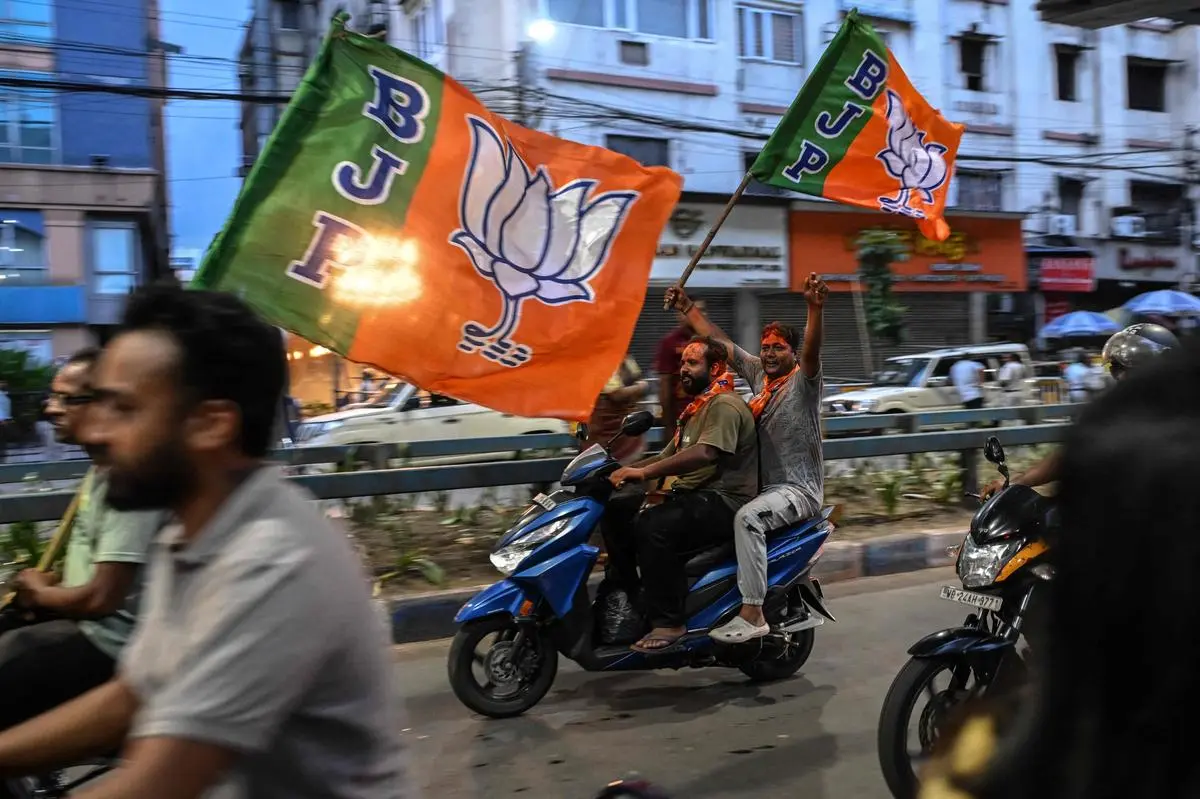
Supporters of the BJP celebrate after taking the lead during vote counting for the West Bengal Legislative Assembly elections, in Kolkata, on May 4, 2026.
| Photo Credit:
DIBYANGSHU SARKAR/AFP
In terms of voter turnaround time and briskness of polling, the West Bengal polling comes across as a clear outlier not only in the country but also in the world. The polling and election protocols of Bhutan come closest to India’s. In the 2024 National Assembly election there, 106.7 seconds was the average time available per voter to cast their vote.
In Brazil, which is a large-scale EVM democracy, the average time available per voter was 123.1 seconds in the 2022 general election. In South Africa, which is a paper ballot democracy, 76.7 seconds were available on average per voter in the 2024 general election. In the UK, which is another important paper ballot democracy, the average poll time in the 2024 general election was 102.2 seconds per voter.
In contrast, in Bengal, the average was only 53.7 seconds per voter, with the time shrinking further in some time bands to as low as 39.7 seconds per voter. An incredible hike in voting percentage much after the official closing time was clearly exposed in Andhra Pradesh earlier this year. Polling ends at 6 pm in India. An 8.38 per cent polling rate was recorded between 8 pm and 11.45 pm, and an additional 4.13 per cent polling between 11.45 pm and 2 am on the morning of the following day in 3,500 booths. This was called out on February 14.
In response, the ECI appears to have taken care to achieve its desired polling percentage well within the official polling hours in Bengal.
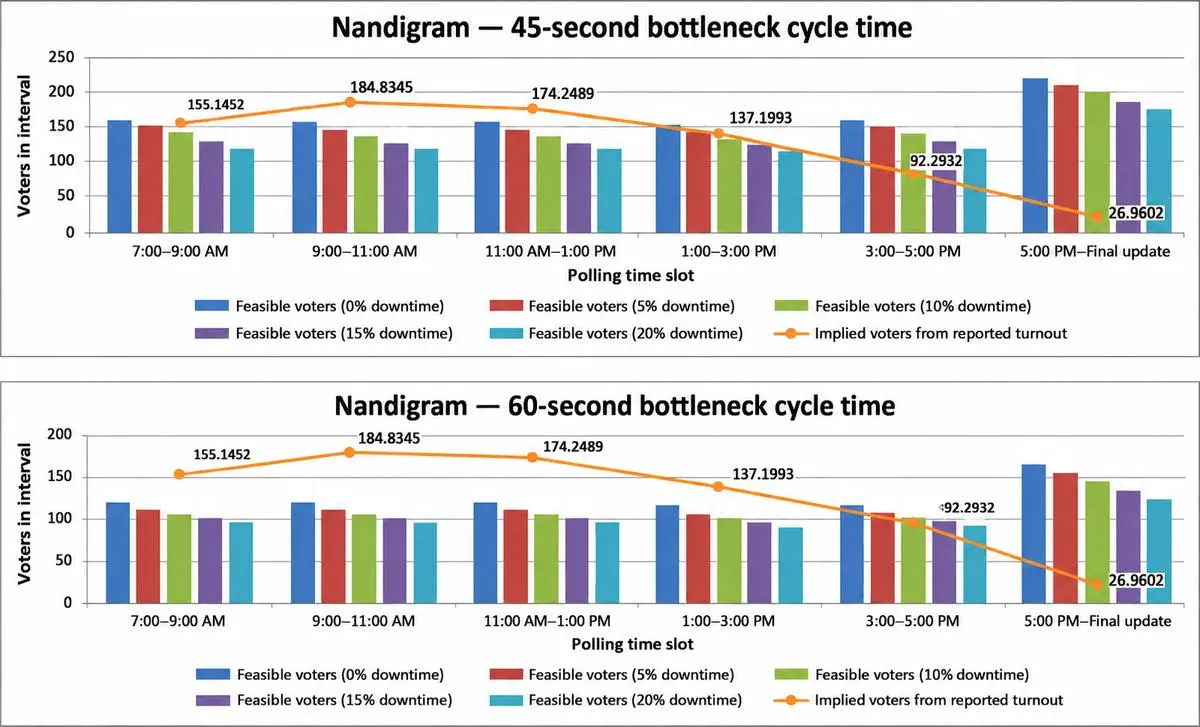
Each chart compares interval-wise implied voters from reported turnout with feasible voters under downtime scenarios at a fixed bottleneck cycle time.
While it took until 2:00 am the following day to arrive at 80.66 per cent polling in Andhra Pradesh, it only took until around 6:00 pm to achieve 92.47 per cent polling in both phases in Bengal. In other words, what happened in Andhra Pradesh after polling had officially closed for the day was achieved within the official polling hours in Bengal.
The data from different reporting slots across many constituencies in Bengal clearly show that the officially announced polling figures far exceed the number of votes that can feasibly be polled in the given time. They are unrealistic even at the polling rate of 45 seconds per vote with zero downtime. In almost all time slots before 5 pm, the excessive quantum of polling renders the polling figures highly suspicious, thus rendering Bengal’s declared verdict extremely questionable.
The data from Nandigram, for instance, captures this well. It can be replicated for many more constituencies across the State.
Another significant factor
Deletions are another element to be factored into the outcome of the Bengal election. These deletions occurred due to the Special Intensive Revision (SIR). The incumbent Chief Minister Mamata Banerjee lost in her constituency of Bhabanipur, where 51,000 names were deleted from the lists, and the margin of her defeat was 7,234. Similarly, the outcomes in at least 49 constituencies decisively swung by winning margins that were lower than the number of SIR deletions.
There are well-researched arguments to show that the overall tallies of parties cannot be attributed solely to SIR deletions, but it is an error to look at SIR deletions only from the point of view of electoral outcomes. The SIR exercise has long-term and deeper implications for the polity. It is designed to transform the nature of India’s political society, not merely to impact the outcome of this or that election.
The SIR exercise in its wake will create two classes of Indians: one with the right to vote and another without the right to vote. It achieves what was aimed for by the CAA-NRC a few years ago. The “C” word in the earlier avatar had evoked stiff resistance from large sections of society and had to be stalled. But since the SIR is marketed as an exercise only to clean up electoral rolls of Shifted, Absent, Dead, and Duplicate (SADD) voters, it encounters little resistance today. This was aided by the unofficial campaign by ECI “sources” that large numbers of foreigners were detected and deleted, which resonated with some people. This marketing made SIR’s implementation easier despite it being a bloodless political genocide in its ultimate effect on the polity.
Some researchers have estimated that had all the deleted voters, and especially those under adjudication and not yet declared ineligible, had voted and voted 100 per cent for the incumbent ruling party, it would still not have tipped the overall outcome in its favour. This claim has merit supported by arithmetic. One such estimate concludes that the present winner would have ended up with 181 seats instead of 207 but would not have changed who sits in the Nabanna in Kolkata. SIR, therefore, should not be judged on the basis only of the electoral outcome. But, equally, the main issue in Bengal’s election result is more significant than the much-touted anti-incumbency. It is the compromised integrity of the electoral process.
The large-scale disenfranchisement under SIR, the unusually rapid polling, the ECI’s partisan behaviour, the large deployment of central paramilitary forces, the biased implementation of the model code of conduct, the sweeping changes in Bengal’s administrative machinery—all these have to be taken into account to fully understand Bengal’s declared election results. And these elements make the mandate extremely questionable. The fact that nearly 34 lakh voters were not adjudicated but were yet denied their right to vote vitiated the Bengal election even before polling began.
Driving the silent tsunami in Bengal was also the severely compromised integrity of the electoral process. Nothing reveals the seriousness of this compromised integrity more than the unreal pace of polling: 53.7 seconds per vote with zero downtime.
Parakala Prabhakar is a political economist and author of The Crooked Timber of New India.
Also Read | Do voters reward government performance?
Also Read | Why women voters mattered