




Every Monday, we bring you UPSC Current Affairs Pointers—a concise, exam-focused guide to help you stay ahead in your Prelims and Mains preparation.
— Cuttack’s silver filigree hub is struggling due to government curbs on silver imports.
— A 1,000-year-old city, Cuttack is famous for its Rupa Tarakasi (silver filigree) work of intricate design and fine craftsmanship. It has also received the Geographical Indication tag in March 2024.
— In Odia, “tara” means wire and “kasi” means to design. As part of Rupa tarakasi, silver bricks are transformed into thin fine wires or foils and used to create jewellery, artefacts or showpieces.
— Though the exact origin of the filigree art in Cuttack is unclear, it is known to have existed as far back as the 12th century, with the art form receiving considerable patronage under the Mughals.
— Typically, Tarakasi art is hereditary, with artisans learning it from their ancestors and supplying products to jewellery shops across the country and to Utkalika, the Odisha state-owned agency. The grand chandi medhas – or silver filigree tableaux – are also popular in puja pandals.
Story continues below this ad
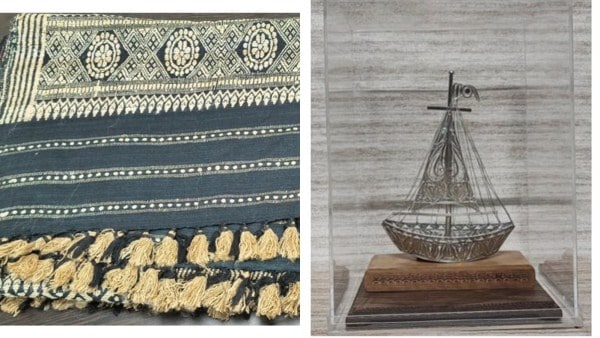 Muga Silk stole from Assam which is a fabric renowned for its natural golden sheen and durability alongside a Shirui Lily-inspired silk stole and silver sailboat is a masterpiece of Tarakasi, the ancient art of silver filigree from Cuttack, Odisha, often referred to as India’s “Silver City”. (Source: Express Photo)
— During Prime Minister Narendra Modi’s recent five-nation diplomatic tour, he presented the diplomatic leaders a diverse range of gifts showcasing India’s cultural diversity.
— PM Modi gifted two exquisite garment accessories — a Muga silk stole from Assam, and an off-white Shirui Lily silk stole from Manipur — to his Italian counterpart Giorgia Meloni.
— Muga silk, known as the “golden silk” of Assam, is a rare textile from the Brahmaputra Valley. It is produced without any artificial dyes.
— The Shirui Lily silk stole draws its inspiration from the misty heights of Shirui Kashong Peak in Manipur. It is named after the rare Shirui Lily, a delicate bell-shaped flower with pale pinkish-white petals that blooms nowhere else in the world.
Story continues below this ad
— Queen Máxima of the Netherlands was presented with a pair of Meenakari and Kundan earrings sourced from the royal ateliers of Rajasthan.
— Uniting two historic art forms — Meenakari (enamelling onto metal) and Kundan (the setting of uncut gemstones in refined gold foil) — the orange and blue pair carried special significance for the Netherlands. While orange honours the Dutch royal House of Orange-Nassau, blue reflects serenity, openness and the nation’s enduring relationship with water.
— Norwegian Prime Minister Jonas Gahr Støre received a pressed orchid painting and orchid paperweights made of real pressed orchids and ferns from Sikkim.
— Norwegian King Harald V was presented with an intricate silver sailboat model, a piece of Tarakasi, the ancient art of silver filigree from Odisha’s Cuttack.
Story continues below this ad
— UAE President Sheikh Mohamed bin Zayed Al Nahyan was gifted a Rogan painting with the Tree of Life, sourced from the state of Gujarat. Rogan is a rare and exquisite textile art form from the Kutch region, and the Tree of Life motif in Rogan art is an ancient symbol of interconnectedness, strength, renewal and continuity.
Report
- Sample Registration System (SRS) Statistical Report 2024
— The Sample Registration System is a large-scale demographic sample survey that is being conducted in a random sample of villages and urban blocks.
— It is released by the Office of the Registrar General & Census Commissioner, India.
What are the silent features of the SRS Report?
(i) In 2024, the Crude Birth Rate (CBR) at the National level stands at 18.3 exhibiting a decline of 0.1 points over 2023. The maximum CBR has been reported in Bihar (26.8) and the minimum in Kerala (11.1).
Story continues below this ad
(ii) The Infant Mortality Rate (IMR) declined by one point to 24 in 2024 at the National level. Chhattisgarh recorded the highest IMR at 36, while Kerala reported the lowest at 8.
(iii) Sex Ratio at Birth has gone up by 1 point to 918 in 2022-24 from 917 in 2021-23. Chhattisgarh and Kerala have reported the highest Sex Ratio at Birth at 978 and 974 respectively, while Uttarakhand has the lowest (872).
(iv) The Total Fertility Rate (TFR) is estimated at 1.9 in 2024. Bihar recorded the highest TFR at 2.9, while Delhi had the lowest at 1.2.
(Source: Census of India)
International Cooperation
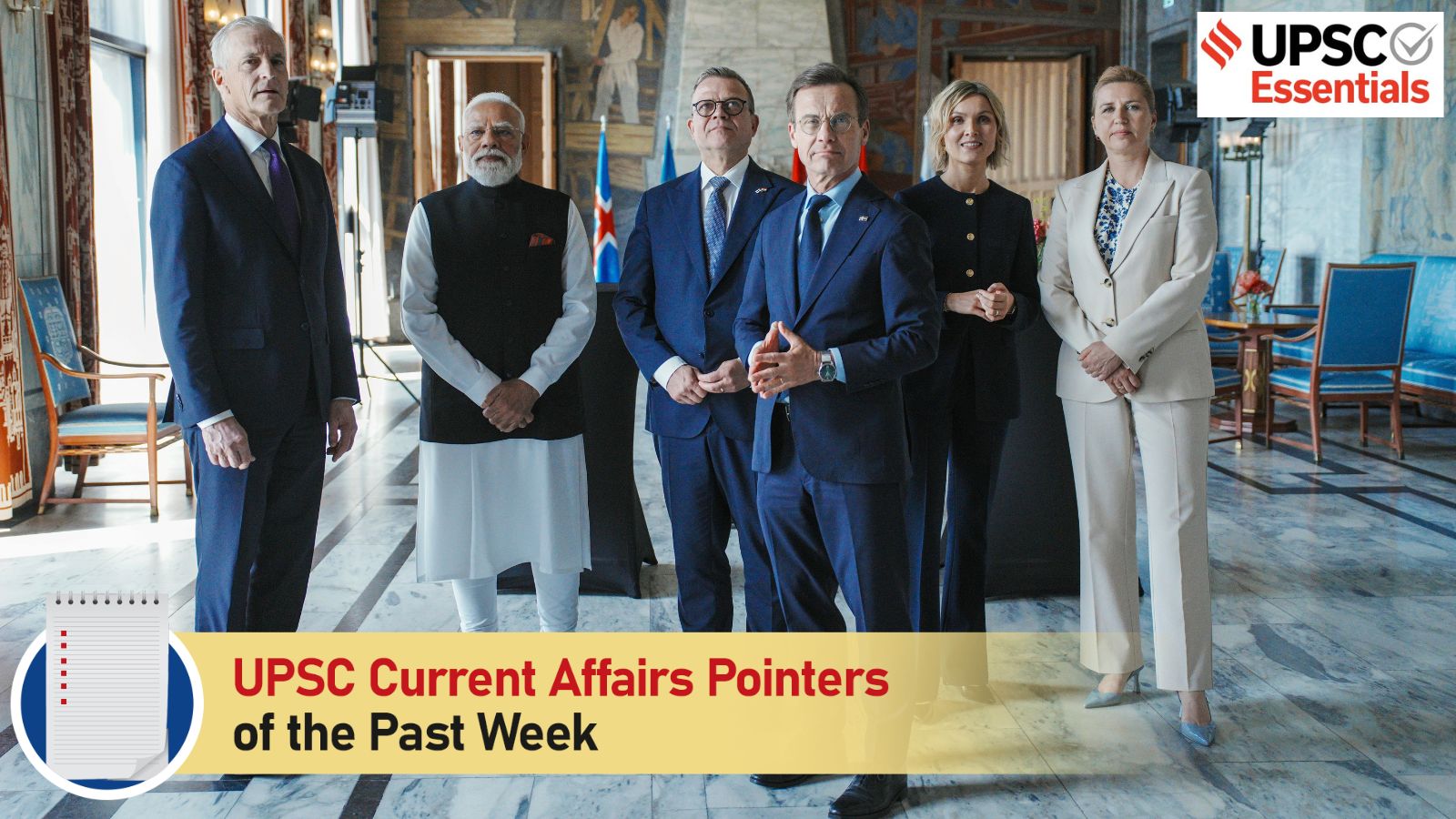
— Prime Minister Narendra Modi was in Norway for the third India-Nordic summit. He also visited three more countries — the Netherlands, Sweden and Italy.
— The first India-Nordic summit was held in Stockholm (2018) and the second in Copenhagen (2022), bringing together leaders of India, Norway, Sweden, Denmark, Finland and Iceland. Only the US holds an equivalent summit-level engagement with the Nordics.
Story continues below this ad
— The India-Nordic trade in goods and services reached $19 billion in 2024 (exports $9.4 billion, imports $9.6 billion).
— In Sweden, PM Modi was conferred with the ‘Royal Order of the Polar Star, Degree Commander Grand Cross,’ one of Sweden’s oldest and most distinguished honours, instituted in the 18th century. It was conferred by Her Royal Highness Crown Princess Victoria.
— The award is Sweden’s highest honour conferred on foreign Heads of Government in recognition of exceptional public service and contribution towards strengthening relations with Sweden.
— Prime Minister Modi is the first Asian leader to be conferred the award.
Outcomes of the meeting:
Story continues below this ad
— India and Sweden elevated the bilateral relationship to a Strategic Partnership. Both leaders endorsed the upgraded Joint Action Plan 2026–2030 to implement the Strategic Partnership.
— The partnership rests on four pillars:
(i) Strategic Dialogue for Stability and Security;
(ii) Next-Generation Economic Partnership;
(iii) Emerging Technologies and Trusted Connectivity
(iv) Shaping Tomorrow Together – People, Planet and Resilience.
— They also agreed that a bilateral summit, “India–Sweden: Stronger Together – towards 2047”, will be held in India in 2027.
— Both leaders called for a new four-year phase of Leadership Group for Industry Transition (LeadIT), LeadIT 3.0, to be announced at COP31. COP31 will be hosted in Antalya (Türkiye) from November 9-20, 2026.
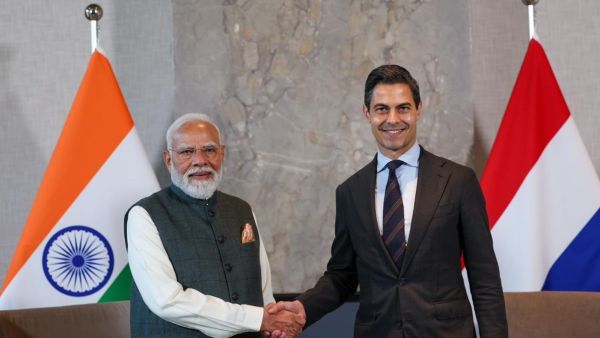 PM Modi and his Dutch counterpart Rob Jetten (Photo: X/Narendra Modi).
— Prime Minister Narendra Modi paid an official visit to the Netherlands on 16-17 May 2026. This marked Prime Minister Modi’s second visit to the Netherlands.
— PM Modi and the Prime Minister of the Netherlands, Rob Jetten have decided to elevate their bilateral ties to a ‘Strategic Partnership’ by agreeing on a comprehensive five-year roadmap (2026–30).
— Both the leaders signed 17 pacts spanning semiconductors, critical minerals, migration, water management, and renewable energy.
— The MoU for semiconductor was signed between Tata Electronics and ASML, which aims to support the semiconductor fab facility in Dholera, Gujarat.
| ASML is the world’s only producer of extreme ultraviolet (EUV) lithography machines, the highly sophisticated systems required to manufacture advanced semiconductors. Without its machines, the production of cutting-edge chips becomes virtually impossible. |
— On defence cooperation, they agreed to plan a structured Joint Tri-services interaction between the Ministries of Defence and the Directorates of International Military Cooperation to coordinate bilateral military cooperation, including cooperation between Defence Industry and Research Centres, the statement said.
— PM Modi paid an official visit to Italy on 19-20 May 2026 on the invitation of the President of the Council of Ministers of the Italian Republic, Giorgia Meloni.
— Both leaders reaffirmed their commitment to cooperate on the India-Middle East-Europe Economic Corridor (IMEC).
Major outcomes of the meeting:
— They have decided to elevate India-Italy relations to the level of a Special Strategic Partnership.
— They announced the creation of INNOVIT India, an innovation hub located in India aimed at strengthening cooperation between the respective innovation ecosystems, supporting startup acceleration programs, market access and business matching.
— They also agreed to launch a ‘Dialogue on Maritime Security’, with the aim of increasing maritime security cooperation, coordination and the exchange of information and best practices in the maritime domain.
— They welcomed the launch of ‘ICI-Italy Calls India: A University-Enterprise Talent Bridge’ aimed at enhancing the talent of Indian students enrolled in Italian universities by offering concrete pathways for guidance, matching and qualified integration into Italian enterprises.
— They signed an MoU on “Italy’s participation in the development of the National Maritime Heritage Complex in Lothal”.
— They also signed a MoU for cooperation in critical minerals.
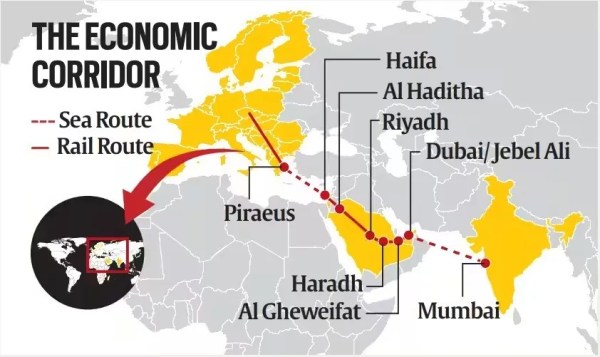 Source: ‘India’s Arab-Mediterranean Corridor: A Paradigm Shift in Strategic Connectivity to Europe’, a paper by Michael Tanchum published by National University of Singapore and Institute of South Asian Studies. Issue No. 14, August 2021.
— The India-Middle East-Europe Economic Corridor (IMEEC or the IMEC) is a landmark project announced during the G20 Leaders’ event in New Delhi in 2023. It aimed to stimulate economic development by enhancing connectivity and integration among Asia, the Middle East, and Europe.
— It will have two separate corridors, the east corridor connecting India to the Arabian Gulf and the northern corridor connecting the Arabian Gulf to Europe, along with a railway route for supplementing trade exchanges between India, the UAE, Saudi Arabia, Jordan, Israel, and Europe.
— India, Saudi Arabia, the UAE, France, Germany, Italy, the European Union and the United States signed an MoU for its development, linked to the Partnership for Global Infrastructure and Investment (PGII).
Economy
— The Reserve Bank of India (RBI) has approved a record surplus transfer of Rs 2,86,588 crore to the Central Government for the accounting year 2025–26, offering a significant boost to the Centre’s finances.
— A significant contributor to higher surplus was the central bank’s large-scale sale of US dollars in the foreign exchange market to support the rupee amid persistent depreciation pressures, leading to substantial trading gains for the RBI.
— At the same time, the RBI raised the contingency risk buffer (CRB) to Rs 109,379 crore to create a safeguard in case geopolitical tensions escalate or crude oil prices worsen.
— CRB serves as the RBI’s financial safety cushion, consisting of funds reserved to absorb unexpected risks arising from currency volatility, interest-rate shocks, financial crises, market losses and operational risks.
— The transferable surplus for 2025-26 has been arrived at on the basis of the revised Economic Capital Framework (ECF) as approved by the Central Board, the RBI said.
— The revised ECF provides flexibility to maintain the CRB between the range of 4.5 per cent and 7.5 per cent of the size of the Balance Sheet. It has maintained the CRB at 6.5 per cent of the size of the RBI balance sheet.
— The Technical Committee of the RBI Board, headed by Y H Malegam, which reviewed the adequacy of reserves and a surplus distribution policy, had recommended, in 2013, a higher transfer to the government.
Defence
— The Defence Research and Development Organisation (DRDO) on May 19 completed the final deliverable configuration development trials of the ULPGM-V3 in both air-to-ground and air-to-air modes.
— The trials were carried out using an integrated ground control system (GCS) to command and control the ULPGM weapon system.
— The GCS features state-of-the-art technologies to automate readiness and launch operations.
— The ULPGM-V3 is fitted with a high-definition dual-channel seeker, an advanced guidance system using multiple sensors to accurately track targets — allowing it to strike a wide range of threats.
— The missile can be deployed in both plains and high-altitude regions and is capable of operating during both day and night. It is also equipped with a two-way data link, enabling operators to change or update the target even after the missile has been launched.
— The missile can be fitted with three different types of warheads depending on the mission.
— The missile can engage both stationary and moving targets with precision in all-weather, day-and-night combat conditions.
Environment
— Despite the top court’s raps, Jharkhand has filed a review petition against the apex court’s reiterated order directing it to notify Saranda’s elephant forests as a wildlife sanctuary.
— Saranda, meaning seven hundred hills, forest division in West Singhbhum district of Jharkhand covers about 856 sq km, and 816 sq km is a reserved forest, and the rest is a protected forest.
— It is a biological hotspot and well known for its dense sal trees, rich wildlife, and natural beauty.
— It presently harbours elephants, four-horned antelope, and sloth bear, and is experiencing habitat degradation and fragmentation and is home to three elephant corridors, providing connectivity with other neighbouring forests.
— In 1968, undivided Bihar declared 314 sq km of sal forests as the Saranda Game Sanctuary.
— More than half a century later, efforts to secure the landscape under the Wildlife Protection Act, 1972 ran into prolonged resistance from the Jharkhand government, drawing repeated Supreme Court rebukes for showing “clear contempt” and even “taking the Court for a ride”.
— The first instance globally of a Western hoolock gibbon using an artificial canopy bridge over a railway line was recorded in Assam’s Hollongapar Gibbon Sanctuary recently.
— The Hoollongapar Gibbon Sanctuary, previously called the Gibbon Wildlife Sanctuary or Hollongapar Reserve Forest, is an isolated evergreen forest in Jorhat district, Assam, India. It was renamed on May 25, 2004.
— It is home to India’s only gibbons, the hoolock gibbons, and Northeast India’s only nocturnal primate, the Bengal slow loris.
— The Hollongapar sanctuary got its first artificial canopy bridge in 2015. The rigid iron structure (see photo) remained unused because its design did not accommodate the hoolock gibbon’s specialised suspensory form of movement, known as brachiation, in which the animal swings hand-over-hand through the canopy.
— Arboreal (tree-dwelling) species rely on continuous tree canopies to move, forage, and disperse. Linear infrastructure such as roads, railways, powerlines and canals often interrupts this continuity, isolating wildlife populations in fragmented forest patches.
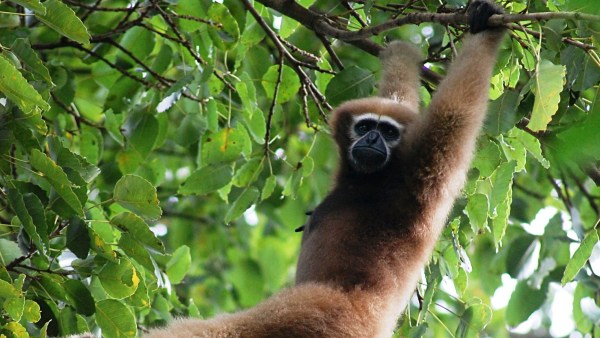 Western Hoolock Gibbon is the only non-human ape species found in India (Image: Wikimedia Commons)
— The forests of Northeast India are home to the country’s only apes: the western hoolock gibbon (Hoolock hoolock) and the eastern hoolock gibbon (Hoolock leuconedys).
— The western hoolock gibbon is found in all the states of the northeast, restricted between the south of the Brahmaputra River and east of the Dibang River. It is also found in eastern Bangladesh and north-west Myanmar. It is listed as Endangered in the IUCN Redlist and Schedule 1 of the Indian (Wildlife) Protection Act 1972.
— The eastern hoolock gibbon inhabits specific pockets of Arunachal Pradesh and Assam in India, southern China, and north-east Myanmar. It is listed as Vulnerable in the IUCN Redlist.
(Source: wwfindia.org)
— Due to heatwave conditions in Delhi, Sanjay Lake in East Delhi’s Trilokpuri turned into a fish graveyard.
— The deaths came amid rapidly receding water levels at the lake, with officials attributing the situation partly to a critical pipeline supplying treated water from Kondli sewage treatment plant (STP) to the lake developing leakages and remaining under repair.
— Environmental experts said low water levels during a heatwave may result in pollutants becoming more concentrated. Higher temperatures also reduce the ability of the water to hold dissolved oxygen, while decomposing organic matter and waste consume more oxygen.
— Sanjay Lake is a popular artificial lake in Delhi, developed by the Delhi Development Authority to provide a natural recreational spot for locals and tourists.
Diseases
(Just FYI: UPSC has consistently included questions on health and diseases in its examinations over the years. For instance, in 2014, a question about the Ebola virus appeared in the Prelims, and in 2017, a question about the Zika virus was featured. Therefore, it is crucial to stay updated on diseases that are currently in the news.)
— On May 16, the World Health Organization (WHO) declared the latest Ebola outbreak in the Democratic Republic of Congo (DRC) and Uganda a “public health emergency of international concern”.
— Ebola is a zoonotic disease: that is, it originates in animals and can spill over to infect humans.
— According to a WHO fact sheet, fruit bats of the Pteropodidae family are presumed to be natural hosts of the Orthoebolavirus, which can get transmitted to humans when people come into close contact with the “blood, secretions, organs or other bodily fluids of infected animals… found ill or dead”.
— It is caused by viruses belonging to the Orthoebolavirus genus of the filoviridae family.
— Of the six Orthoebolavirus species identified to date, three strains have been known to cause major outbreaks: the Ebola virus causing Ebola virus disease (also known as the Zaire strain), the Sudan virus causing Sudan virus disease, and the Bundibugyo virus causing Bundibugyo virus disease.
— WHO confirmed that the Bundibugyo strain has caused the current outbreak.
Persons in News
(Just FYI: Noting historical personalities’ anniversaries aids UPSC prep. UPSC often includes such personalities in questions, so revisiting their lives refreshes your static syllabus.)
— On May 20, Leader of Opposition in the Lok Sabha Rahul Gandhi unveiled a statue of Veera Pasi, a “forgotten hero” who had fought the British during the Revolt of 1857, in Raebareli.
— Veera Pasi was a trusted companion and commander of Rana Beni Madhav Baksh Singh, the ruler of the Shankarpur Estate in modern-day Raebareli during the 19th century.
— A Dalit belonging to the Pasi caste, Pasi was born on November 11, 1835, into an impoverished family in Lodhwari village of Raebareli district.
— He lost his parents at an early age and went to live at his sister’s house. In the local dialect, a brother living with his sister’s family was called “Veerna”, which later evolved into the name “Veera”.
— Pasi was recruited by Singh for his army, after he was impressed by the former’s strength and went on to become one of his most trusted lieutenants.
— According to local folklore, when the British captured Singh during the 1857 revolt, Pasi displayed remarkable bravery by rescuing Singh from prison. The British government then announced a reward of Rs 50,000 for the capture or information on Pasi’s whereabouts.
| In 2024, after the general election, Awadhesh Prasad, Samajwadi Party (SP) MP from Faizabad (Ayodhya), had invoked “Veerangana” Uda Devi and “Maharaja” Bijli Pasi, two prominent personalities of the Pasi (Dalit) community while taking oath in the Lok Sabha.
Uda Devi was part of the royal guard of Begum Hazrat Mahal of Awadh and participated in the 1857 revolt. She is credited with having mobilised people to take up arms against the British. In November 2022, the SP had commemorated Uda Devi’s death anniversary at its party headquarters. Bijli Pasi is among the most prominent Dalit icons, having ruled over some parts of UP in the medieval period. The Yogi Adityanath-led BJP government in UP has announced plans to renovate and redevelop Bijli Pasi’s fort in Lucknow as a tourist destination. |
Places in News
(Just FYI: The location of the place is important, considering that UPSC has asked several questions about places that were in the news, such as Aleppo and Kirkuk, in the 2018 UPSC Prelims. The best way to remember them is to plot them on a world map.)
— Prime Minister Narendra Modi on 17th May visited the iconic Dutch water management project Afsluitdijk – a 32-km dam and causeway.
— Afsluitdijk is considered a global benchmark in flood control and land reclamation, protecting large parts of the Netherlands from the North Sea while enabling freshwater storage.
— Constructed nearly 80 years ago, this 32-kilometer-long barrier dam separates the North Sea from a freshwater lake.
— The dam also protects large low-lying regions of the Netherlands from severe flooding, making it a global benchmark in flood control. Its most remarkable feature is that it blocks salty seawater and creates a vast freshwater reservoir inside.
— Besides freshwater storage, the Afsluitdijk project also integrates shipping, transportation connectivity, and renewable energy generation.
— During the PM visit to the Netherlands, a Letter of Intent was signed between India’s Ministry of Jal Shakti and the Netherlands’ Ministry of Infrastructure and Water Management for technical cooperation on the Kalpasar Project of the Gujarat government.
— The Kalpasar Project envisions the construction of a massive dam across the Gulf of Khambhat to utilise the waters of seven rivers that currently flow into the sea.
— The project aims to create a vast freshwater reservoir in the gulf, integrating tidal power generation, irrigation, and transportation infrastructure development.
— PM Modi and his Italian counterpart, Giorgia Meloni visited the iconic Colosseum, pictures from which took the Internet by storm.
— Constructed in 80 AD, the Colosseum was built under Emperor Vespasian. Although he died before it was completed, it was later finished under his two sons, Emperors Titus and Domitian. The name “Colosseum” originated from the colossal bronze statue of Emperor Nero.
— Located in the centre of Rome, it is the largest ancient amphitheatre and is the largest standing amphitheatre in the world. The oval-shaped building spans 6 acres and measures 189 meters long, 156 meters wide, and 894 meters tall, consisting of three levels with a series of semicircular arches.
— As per the official website, these arches are supported by pillars and columns of the travertine stone, and can accommodate up to 50,000 people. Its iconic arches stand nearly 30 metres tall, with a total of 80 arches forming part of its grand structure.
— The lower level was mainly used for administrative and organisational purposes, while the upper tiers were designed to accommodate large gatherings, assemblies, and public events for the Roman people.
— It is declared as a UNESCO World Heritage Site and ‘One of the New Seven Wonders of the World’.
Sports
(Just FYI: With the unpredictability of the UPSC examinations and questions like the ICC World Test Championship question 2021, you can’t be sure of anything. It is wise to know what it is and not go into too much detail.)
— Arsenal won the 2025/26 Premier League champions, winning the title for the first time in 22 years.
— It’s the 14th English title for Arsenal, putting them behind only Liverpool and Manchester United at 20.
— Arsenal’s success means the title has been won by three different clubs in the last three seasons, following Liverpool in 2024/25 and Man City in 2023/24.
— This is only the fifth time the Premier League has produced three or more different winners in successive seasons.
Awards
 Taiwan Travelogue by Yáng Shuāng-zǐ, translated by Lin King won the 2026 International Booker Prize. (Booker Prize/Generated using AI)
— The book, Taiwan Travelogue by Yáng Shuāng-zǐ and translated by Lin King, was announced as the winner of the International Booker Prize 2026.
— The £50,000 (approximately Rs 65 lakh) prize, which is divided equally between author and translator, was presented by Natasha Brown.
— Taiwan Travelogue is the first book translated from Mandarin Chinese to win the International Booker Prize, and Yáng and King are the first Taiwanese and Taiwanese-American winners in the prize’s history.
— Launched first in 2005 as the Man Booker International Prize, it was a biennial honour awarded to a writer for their entire body of work.
— A biennial prize initially, it was then awarded for a body of work available in English, including translations, with Alice Munro, Lydia Davis and Philip Roth becoming some of the early winners.
— In 2015, the rules of the International Prize changed to make it an annual affair. The new rules stipulated that it will be awarded annually for a single book, written in another language and translated into English.
Test Your Knowledge
(Note: The best way to remember facts for UPSC and other competitive exams is to recall them through MCQs. Try to solve the following questions on your own.)
(1) Consider the following statements:
1. Banu Mushtaq’s short story collection Heart Lamp won the 2025 International Booker Prize.
2. The award money of £50,000 is given only to the translator of the novel.
3. Geetanjali Shree was the first Indian author to win the International Booker Prize.
Which of the statements given above is/are correct?
(a) 1 and 2 only
(b) 2 and 3 only
(c) 1 and 3 only
(d) 1, 2, and 3
(2) Consider the following pairs: (UPSC CSE 2010)
| Protected area | Well-known for | |
| 1. | Bhiterkanika, Orissa | Salt Water Crocodile |
| 2. | Desert National Park, Rajasthan | Great Indian Bustard |
| 3. | Eravikulam, Kerala | Hoolock Gibbon |
Which of the pairs given above is/are correctly matched?
(a) 1 only
(b) 1 and 2 only
(c) 2 only
(d) 1, 2 and 3
(3) With respect to the Western Hoolock Gibbons, which of the following statements is/are correct? (UPSC CSE 2026)
1. A Sanctuary in North-east India is home to this ape species listed as Endangered in the International Union for Conservation of Nature (IUCN) Red List.
2. They have specialized brachiation and can easily swing between trees.
3. They possess a strong and heavy build like gorillas, yet are remarkably agile tree climbers.
(a) 1 only
(b) 1 and 2
(c) 2 and 3
(d) 3 only
| Prelims Answer Key |
| 1. (c) 2. (b) 3. (b) |
For your suggestions and feedback, write to khushboo.kumari@indianexpress.com
Subscribe to our UPSC newsletter. Stay updated with the latest UPSC articles by joining our Telegram channel – IndianExpress UPSC Hub, and follow us on Instagram and X.
🚨 Click Here to read the UPSC Essentials magazine for May 2026. Share your views and suggestions in the comment box or at manas.srivastava@indianexpress.com🚨