




Internal reports of a 20-member EU delegation’s visit and questionnaires filled by 11 member states reveal several “common problems” in VFS Global’s India operations — from wrong data entry to appointment slots allegedly sold by staff. And, every country that took up these shortcomings with VFS reported the same result: temporary improvement followed by relapse.
These reports and questionnaires were among the latest batch of Freedom of Information (FOI) records received on May 12 by Lighthouse Reports from the EU headquarters in Brussels. They show that Slovakia, for instance, told the EU delegation it was switching to a different service provider altogether because of “consistent problems” with VFS.

According to EU records, this is what the team found during its visit to India in October 2023:
- Member states flagged “laxity in following instructions, documents not arranged in proper sequence, scanning-related issues, and IT infrastructure and bandwidth problems”.
- Wrong data entry, missing biometrics, incorrect checklists and wrongly transferred fees.
- Complaints from Lithuania and Poland of appointment slots being sold by VFS staff — Poland said it received such allegations “almost daily”.
- Sweden said it discussed VFS allegedly forcing applicants to pay for extra services with the company, and instructed VFS to introduce a signed consent form for value-added services.
- A majority of member states identified Delhi as the visa application centre with the highest number of errors. Mumbai, Goa, Pune, Hyderabad, Jaipur, Ahmedabad and Bengaluru were also named.
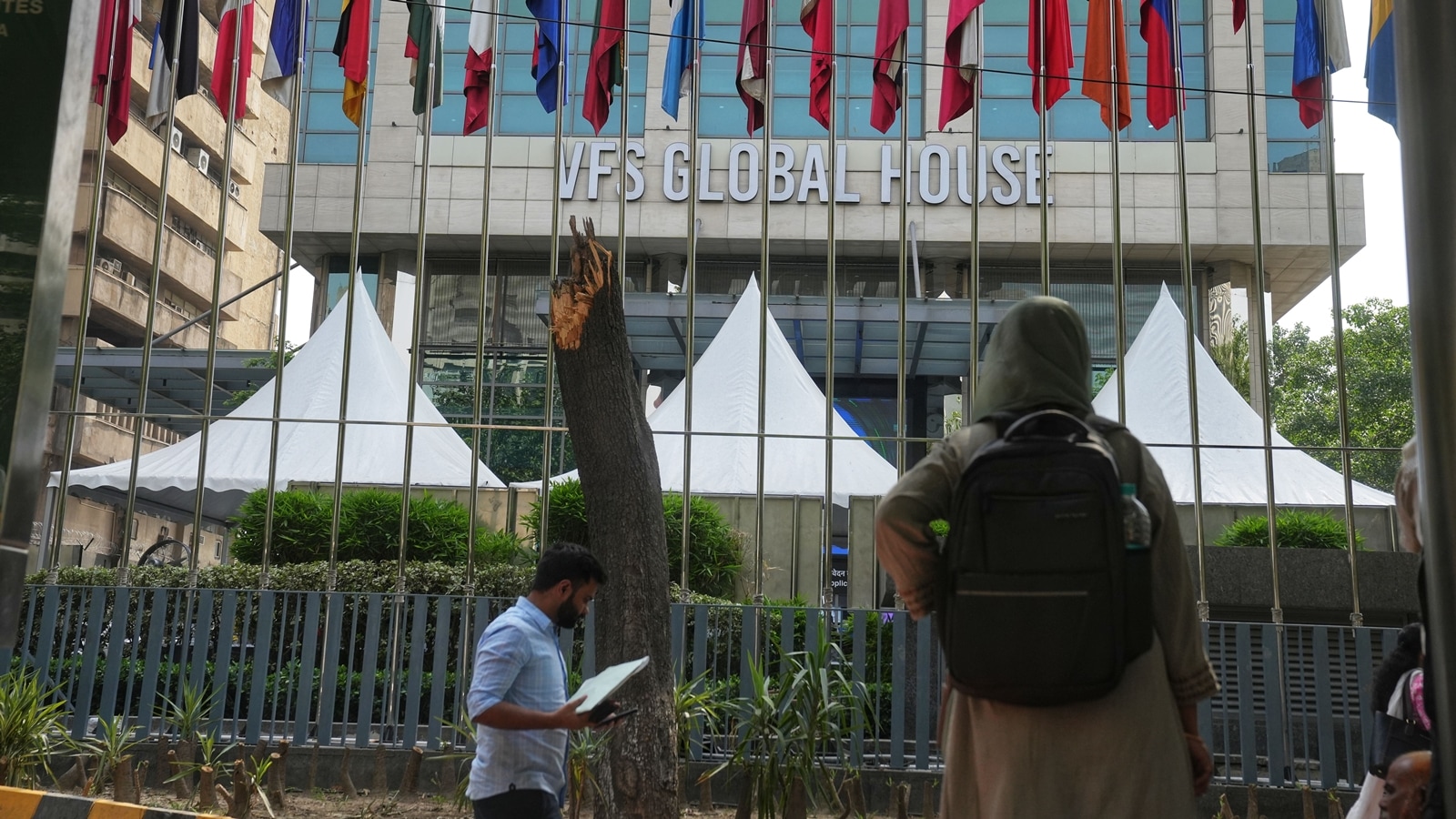 VFS Global centre in New Delhi. (Express photo by Abhinav Saha)
One theme: multiple failures
The minutes of the EU delegation meeting state: “Member states agreed on the common problems faced with VFS like laxity in following instructions, documents not arranged in a proper sequence, scanning-related issues, IT infrastructure and bandwidth problems.” Several states also flagged deficiencies in uploading documents to the cloud, attributed to VFS’s IT infrastructure.
The delegation proposed four remedies: a joint meeting with VFS to define common procedures across all member states; a public outreach exercise on EU Schengen visa policy for Indian applicants; joint spot checks; and addressing human resource gaps at specific VFS centres. The last point arose because some member states had found through their monitoring that VFS “middle management” was either under-equipped or absent entirely. One suggestion was to hire supervisors “who are able to monitor VFS staff on their job to avoid any errors”. The delegation also said VFS should be asked to explain its refund procedure in cases of inadmissible applications or incorrectly levied fees.
What questionnaires revealed
Member states were sent questionnaires covering seven aspects of VFS operations. The first asked each country to list its top three errors or defects. Some illustrative samples of the replies are telling:
Story continues below this ad
Czech Republic: Visa application quotas are never fully used. The embassy receives only 60 to 70 per cent of expected applications.
Austria: Visa applications from groups travelling together are not being received at the embassy together.
Estonia: Missing mandatory documents; missing biometrics; photographs not properly scanned.
Lithuania: Wrong checklists given to applicants; mismanagement of offline visa appointments; incorrect payment fee transfers.
Story continues below this ad
Sweden: Staff don’t check travel dates given by applicants against tickets submitted; instances identified where full names, places of birth and passport validity were entered incorrectly.
Malta: Inconsistencies in procedure; wrong data entry; improper verification of checklists.
The questionnaire also asked what happened after these deficiencies were raised with VFS. The replies pointed to systemic lapses:
Czech Republic: “Discussions held repeatedly with a temporary impact. Eventually, the VFS conduct has deteriorated again.”
Story continues below this ad
Austria: “We have discussed several times. It remains good for some time and the quality dips again.”
Estonia: “Feedback given on regular basis but sooner or later the problems reoccurred.”
Lithuania: “Common errors have been discussed with VFS, but only temporary improvement noticed. After a while some errors occurred.”
Poland: “Problems discussed many times, but they still occur.”
Slots sold, services pushed
Member states were also asked whether there had been allegations of irregularities or corruption at VFS. Most said their embassies had received complaints but that no hard evidence had been produced. The responses on specifics, however, were pointed.
Story continues below this ad
Lithuania stated: “There were some anonymous letters and complaints received from applicants that online appointment slots are being sold by VFS. The problem has been discussed with VFS, they have initiated investigations, some staff members have been replaced, but situation has not changed drastically.”
Poland said: “We receive these kind of allegations almost daily, mostly concerning selling slots. We discuss with VFS, but usually there is no hard proof that there is staff involved. Sometimes there are allegations concerning individuals who pretend to be VFS staff.”
Sweden’s response: “Embassy has received complaints from applicants who have expressed dissatisfaction with the VFS for allegedly forcing them to avail extra paid services. They claim that VFS staff did not provide them with the choice to decline. Embassy discussed with VFS and VFS has been instructed to introduce a consent form for the extra service they offered, which will require the applicant’s consent and signature.”
And yet, some member states said they needed to work with VFS Global. Switzerland said, “We have no other option to see VFS as a partner and to work intensively with them because we ourselves will never be able to accept this number of applications… there is certainly lack of a competing company in India.”
The big picture: Covid and after
Story continues below this ad
Beyond the inspection findings, leaked EU documents accessed as part of this investigation shed further light on the systemic pressures around Schengen visa processing in India. A 2023 report of the Local Schengen Cooperation group, which held seven meetings that year, captures the post-Covid strain on the system.
On the surge in applications after Covid-19 travel restrictions were lifted, the report notes: “The huge influx of requests, choking the visa processing capabilities of most member states, continued to be compounded by a noticeable increase of first-time visa requests substantiated with fake or forced documents, increasing the average processing time. Visa shopping also remained a phenomenon.”