


Preliminary Examination: Current events of national and international importance.
Mains Examination: General Studies III: Various Security Forces and Agencies and their Mandate.
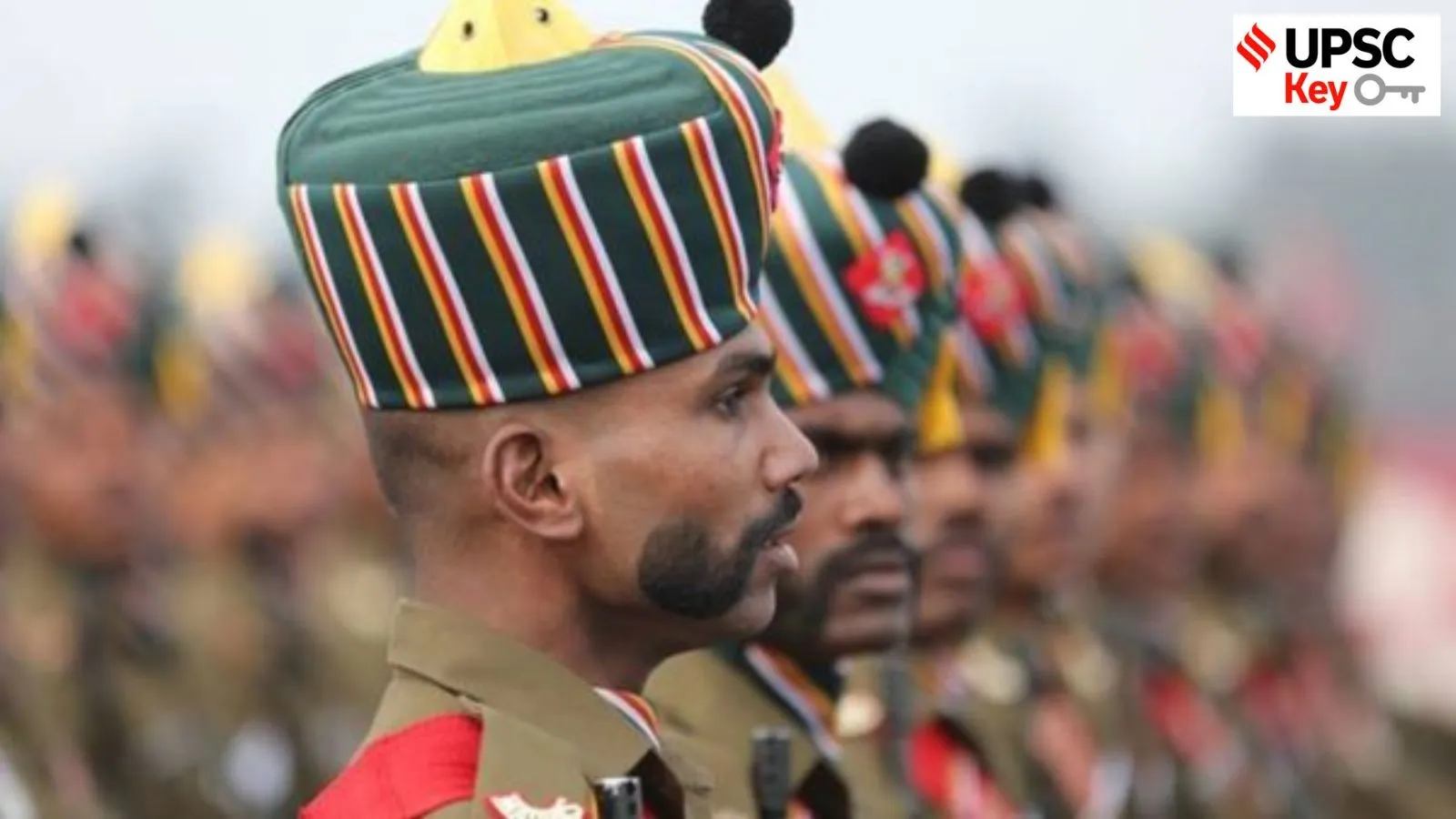
What’s the ongoing story: President Droupadi Murmu on Friday approved 78 gallantry awards, including 13 awarded posthumously, for personnel from the Defence Forces and Central Armed Police Forces. The awards include nine Kirti Chakras, of which seven are posthumous; one Bar (conferred second time) to the Shaurya Chakra; and 19 Shaurya Chakras, including one posthumous.
— What are the major gallantry awards in India? Why are they conferred? Know their hierarchy.
— Who confers gallantry awards?
— Understand the process through which military and police gallantry awards are approved.
— How are gallantry awards different from distinguished-service awards?
— Can civilians receive gallantry awards?
— What are the three services of the Indian Armed Forces? Know their respective primary roles.
— Know about different security forces of the nation. Which force guards which international border?
— Can you arrange the ranks of the Army, Navy and Air Force in equivalent order?
— Which Army, Navy and Air Force ranks are equivalent?
— Why can rank equivalence across the three services be important for joint operations?
— What is the purpose of theatre commands?
— What is the difference between jointness, integration and theatreisation?
Key Takeaways:
— The awards include five Bars to the Sena Medals (Gallantry); 36 Sena Medals (Gallantry), five of them posthumous; three Nau Sena Medals (Gallantry), and five Vayu Sena Medals (Gallantry). The Kirti Chakra awardees are Lt Col Manoj Francis PF of 21 Para (Special Forces) and Major Jitendra Rathee of 2 Para (Special Forces).
— Seven other Kirti Chakras were conferred posthumously. The armed forces personnel given the prestigious awards posthumously included Havildar Gajendra Singh of 2 Para (Special Forces), Jagbir Singh (Head Constable), Jaswant Singh (Constable), Balvinder Singh (Constable), Tariq Hussain (Constable), Bashir Ahmad (Head Constable), and Sunil Kumar (Inspector).
— Eleven Army personnel have got the Shaurya Chakra, while one each is from the Navy and the IAF. The Shaurya Chakra awardees are Major Paramveer from 36 Rashtriya Rifles; Major Tarun Vasudevan from 57 Rashtriya Rifles; Major Keshav Kumar from 12 Dogra Regiment; Major Gaurav Singh Brijwal from 21 Grenadiers; Major Vipeen Kumar from 11 Rashtriya Rifles; Naib Subedar Shankar Ram from 3 Assam Rifles; and Naib Subedar Dabbal Singh Bisht from 21 Para (Special Forces).
— Do You Know:
Medals for gallantry are awarded to members of the armed forces, paramilitary forces, and civilians for bravery and heroic action.
(1) Wartime awards: These are awarded for acts of bravery in the face of the enemy, and are primarily for armed forces personnel. The highest honours among the wartime gallantry awards are the Paramvir Chakra, the Mahavir Chakra and the Vir Chakra.
(2) Peacetime awards: The highest honours in peacetime include the Ashoka Chakra, the Kirti Chakra and the Shaurya Chakra. Peacetime awards can be awarded to armed forces, paramilitary forces, police, or civilians.
A government press release distinguishes these awards thus, “The Param Vir Chakra is awarded for the most conspicuous act of bravery and self-sacrifice in the face of the enemy, while the Ashok Chakra is awarded for similar acts of valour and self-sacrifice but, other than, in the face of the enemy.”
Other Important Articles Covering the same topic:
Previous year UPSC Prelims Question Covering similar theme:
(1) Which of the following is/are correctly matched in terms of equivalent rank in the three services of Indian defence forces?
Select the correct answer using the code given below:
(a) 1 and 4
(b) 1 and 3
(c) 2, 3 and 4
(d) 3 only
THE WORLD
US vows tougher sanction on Iran as two ships hit in Strait
Syllabus:
Mains Examination: General Studies II: Bilateral, Regional and Global Groupings and Agreements involving India and/or affecting India’s interests.
What’s the ongoing story: Two oil tankers operated by Abu Dhabi National Oil Company (ADNOC) were attacked while transiting the Strait of Hormuz on Thursday evening, escalating concerns over the safety of commercial shipping through the key energy route.
— Locate Strait of Hormuz on map. Identify the countries and geographical features surrounding it. Which countries have to use the Strait of Hormuz to access the open ocean?
— Why is the Strait of Hormuz a strategic chokepoint?
— Examine the significance of the Musandam Peninsula, which projects into the Strait.
— Which major oil and gas producing areas surround the Persian Gulf?
— Can Iran actually “close” the Strait?
— What does UNCLOS say about navigation through international straits?
— How does Iran’s geography give it strategic depth in West Asia?
— Why have US–Iran relations remained adversarial since the Iranian Revolution of 1979? Revise the major events.
— Why is the Strait significant for India?
— What does the ongoing crisis mean for India’s energy security?
— How can India reduce its vulnerability to energy chokepoints?
— How does the crisis test India’s strategic autonomy?
Key Takeaways:
— ADNOC said no one was injured and that the situation had been brought under control. The United Arab Emirates blamed Iran for the attacks, while Tehran did not immediately respond. Separately, the United States said it could maintain its naval blockade of Iran indefinitely and announced plans to intensify economic pressure on the country.
— US Defence Secretary Pete Hegseth said the American military could maintain its naval presence in the region and enforce the blockade of Iran indefinitely. “Indefinitely the United States Navy can maintain a blockade like that because we’ll rotate ships in and out, as we have, and we’ll continue to,” Hegseth told reporters during a visit to Panama.
— India has also faced disruptions to LNG supplies from Qatar, with Petronet LNG saying this week that there was still no clarity on September shipments. The company said Qatar’s force majeure had affected 56 cargoes so far, while India has been looking to suppliers including the US, Oman, Nigeria and Angola to bridge the gap.
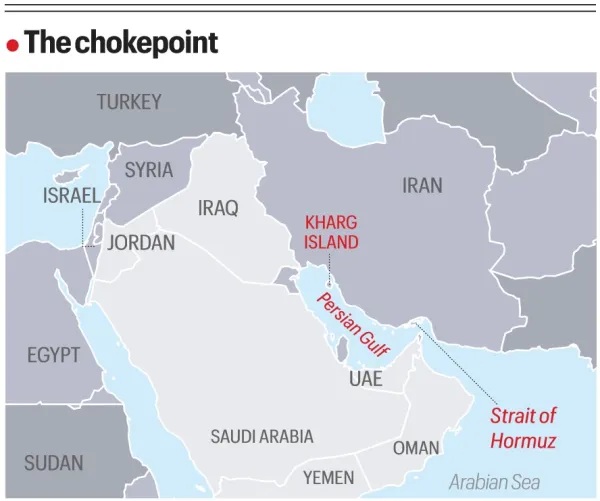 While the Strait of Hormuz-narrow waterway connecting the Persian Gulf and the Arabian Sea, is roughly 167 km long, it is just 33 km wide at its narrowest point between Iran and Oman.
Do You Know:
— The Strait of Hormuz handled an average of 20 million barrels of oil per day in 2025, which is roughly 25% of all global seaborne oil trade, and around 20% of global LNG trade, according to the International Energy Agency. It is, by any measure, the jugular vein of the global energy distribution system.
Other Important Articles Covering the same topic:
📍Iran has not decided to resume US talks, says Hormuz shipping depends on US meeting conditions
📍Iran, US on brink of war again: For India, a lot to watch out for
Previous year UPSC Prelims Questions Covering similar theme:
(2) Ships from which of the following countries have to cross the Strait of Hormuz to reach out to the Indian Ocean? (UPSC CSE, 2026)
1. Bahrain
2. Syria
3. Qatar
4. Egypt
Select the answer using the code given below:
(a) 1 and 2
(b) 1 and 3
(c) 2 and 3
(d) 3 and 4
(3) India is one of the founding members of the International North-South Transport Corridor (INSTC), a multimodal transportation corridor, which will connect:
(a) India to Central Asia to Europe via Iran
(b) India to Central Asia via China
(c) India to South-East Asia through Bangladesh and Myanmar
(d) India to Europe through Azerbaijan
FRONT
BCI Action uncalled for, students have right to protest- CJI
Syllabus:
Preliminary Examination: Indian Polity and Governance – Constitution, Political System, Panchayati Raj, Public Policy, Rights Issues, etc.
Mains Examination: General Studies II: Separation of Powers between various organs Dispute Redressal Mechanisms and Institutions.
What’s the ongoing story: Saying students have the right to protest, Chief Justice of India Surya Kant Friday rebuked the Bar Council of India (BCI) for directing state Bar councils not to enrol the 2026 batch students of NALSAR, Hyderabad, after a section of the students opposed inviting him to the law university’s annual convocation.
— Is the right to protest as Fundamental Right absolute?
— What is the difference between a peaceful protest, unlawful assembly and violent protest?
— Under what circumstances can institutional discipline be balanced against fundamental rights?
— Can a peaceful boycott itself amount to misconduct?
— Distinguish Articles 19(1)(a), 19(1)(b) and 19(1)(c)
— What is the doctrine of reasonable restrictions?
— What is the Bar Council of India? Why is it a statutory body rather than a constitutional body?
— Know about the Advocates Act, 1961.
— Understand the relationship between the BCI and State Bar Councils.
— Which functions belong to State Bar Councils and which belong to the BCI?
— Does obtaining an LL.B automatically make a person an advocate?
— Who actually enrolls a law graduate as an advocate?
Key Takeaways:
— “BCI is unnecessarily taking action. If the students have a cause to protest, they have the right to protest. Students might have written a letter to me. It’s a dialogue between students and me. Who are they (BCI) to unnecessarily raise an issue? This is totally uncalled for. BCI has nothing to do with this,” the CJI said while hearing a plea challenging the now-withdrawn BCI directive.
— BCI chairman Manan Kumar Mishra had issued the directive Thursday, asking state Bar councils not to enroll students of NALSAR’s 2026 batch following the protest. He withdrew the circular hours later, saying the BCI had closed the proceedings after concluding that the students had “no role in any disturbance or movement”.
— Recalling his own days as a student, the CJI said he had been actively involved in student activities and that students were raising their voice peacefully and should be allowed to do that.“I myself, during student days, was involved in student activities. Peacefully, they are raising their voices, they should be allowed. Even if they are wrong, assuming they have the right to protest. Who can stop them? So long as they are lawfully and peacefully raising a voice, they must be heard. Why should the Bar Council or any other body interfere?” he said.
From the Explained page: NALSAR row: Can Bar Council of India stop enrolment of law graduates?
The episode raises larger questions over what powers the BCI actually possesses under the Advocates Act of 1961. Can the BCI actually tell state councils to stop enrolment? We explain.
BCI’s rules contain mechanisms that allow urgent decisions to be taken quickly. Ordinarily, the council is expected to meet after notice to its members. But its rules permit meetings to be convened at short notice where urgency demands it.
There is an even faster route — decision-making by circulation. Instead of convening a meeting, a proposal can be circulated among members and acted upon once the required approval is obtained, subject to later confirmation by the council.
Do You Know:
— The Advocates Act creates a two-tier structure: State Bar Councils under Section 3 and the Bar Council of India under Section 4. Section 7 empowers BCI to lay down “standards of professional conduct and etiquette for advocates”, supervise State Bar Councils, promote legal education and recognise universities whose law degrees qualify for enrolment as an advocate. Section 49 gives it broad rule-making powers.
— But none of those provisions actually gives the BCI the power to enrol a person as an advocate. That function belongs to State Bar Councils.
— The BCI regulates legal education, recognises law degrees, supervises State Bar Councils and exercises disciplinary jurisdiction over advocates. But many of those powers begin only after a person enters the profession. Chapter V of the Advocates Act deals with disciplinary proceedings against advocates. Sections 35 to 37 concern misconduct by advocates and appeals from disciplinary orders. Those provisions apply to persons already enrolled on a state roll. A law graduate who has not yet been enrolled is not an advocate. The disciplinary framework does not naturally extend to such a person.
Other Important Articles Covering the same topic:
📍Bar Council drops proceedings against NALSAR graduates over CJI boycott call
Previous year UPSC Prelims Question Covering similar theme:
(4) With reference to India, consider the following statements: (UPSC CSE, 2022)
1. Government law officers and legal firms are recognized as advocates, but corporate lawyers and patent attorneys are excluded from recognition as advocates.
2. Bar Councils have the power to lay down the rules relating to legal education and recognition of law colleges.
Which of the statements given above is/are correct?
(a) 1 only
(b) 2 only
(c) Both 1 and 2
(d) Neither 1 nor 2
(5) Which of the following statements are correct? (UPSC EPFO, 2025)
1. The Chief Justice of India is the highest Administrative Officer of the Supreme Court of India.
2. The administrative powers for determining the work structure of the Supreme Court and its Registry are exclusively vested in the Chief Justice of India.
3. A person who has been a Judge of the Supreme Court of India can practice after retirement only in the Supreme Court of India and not in any other court within India.
4. A designated Senior Advocate of the Supreme Court of India is not entitled to appear in the Supreme Court of India without an Advocate-on-Record.
Select the answer using the codes given below :
(a) 1 and 2 only
(b) 1, 2 and 3
(c) 3 and 4 only
(d) 2 and 4 only
EXPLAINED
The threat to food prices: weather and renewed war
Syllabus:
Mains Examination: General Studies II: Effect of Policies and Politics of Developed and Developing Countries on India’s interests.
What’s the ongoing story: Both weather and war — this time centered more around Europe and Russia-Ukraine than West Asia — are starting to exert upward pressure on international food prices. On Tuesday, a massive drone strike by Ukraine destroyed two of Russia’s biggest grain export terminals in the Black Sea port of Novorossiysk. The serious damage has forced suspension of operations from the two terminals that together have an export capacity of 15.6 million tonnes (mt) per year, according to a Reuters report.
— Locate the Black Sea. Identify the countries that have a coastline on it.
— If a merchant vessel travels from a Ukrainian Black Sea port to the Mediterranean, what sequence of major water bodies and straits would it traverse?
— Why is the Black Sea strategically important despite being a semi-enclosed sea?
— What is the strategic significance of the Bosporus and Dardanelles? Which country controls them?
— Which countries border the Sea of Azov?
— Why is the Kerch Strait strategically important?
— Locate the Danube River and its delta.
— Why is the Black Sea region particularly suited to large-scale grain exports?
— Why does a war at ports affect food prices thousands of kilometres away? Trace the chain.
– Understand the importance of insurance premiums in wartime trade.
— What are the major geopolitical objectives Russia has pursued in Ukraine?
— What are Ukraine’s principal objectives in the war?
Key Takeaways:
— Since mid-July, Ukraine has also stepped up attacks on grain vessels, maritime infrastructure and ports on the Sea of Azov and the vital Kerch Strait that connects it to the Black Sea. These have significantly restricted movement of Russian agricultural produce through ports such as Rostov-on-Don, Taganrog, Taman, Kavkaz, and now Novorossiysk.
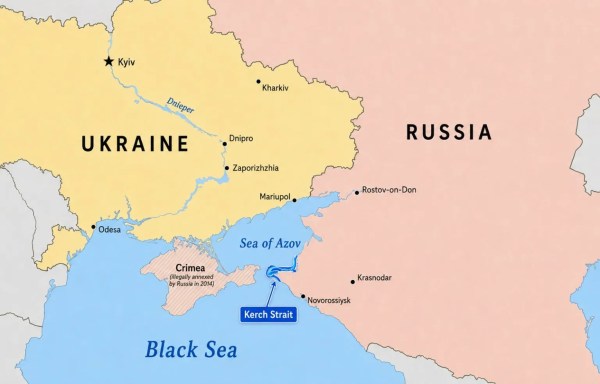 The Kerch Strait connects the Sea of Azov to the Black Sea. (Map generated using AI)
— Russia has, likewise, targeted Ukrainian port facilities and vessel operations around the Greater Odesa region. This shipping hub on the Black Sea coast — comprising three deep-water ports of Odesa, Chornomorsk and Pivdennyi (formerly Yuzhny) — handles some 90% of Ukraine’s agricultural exports.
— The intensification of hostilities between Russia and Ukraine over the last month comes on top of excessive heat and dry weather in the European Union (EU). The US Department of Agriculture (USDA) has projected EU’s wheat production to fall by 7.5% from 145.1 mt in 2025-26 to 134.2 mt in this marketing year, while its output of corn (maize) is expected to dip from 56.8 mt to 50.2 mt (a nearly two-decade low), barley from 56.4 mt to 52.3 mt, oats from 8.9 mt to 8 mt and rye from 7.7 mt to 7.2 mt.
— All this is beginning to impact food prices. The United Nations’ Food and Agriculture Organization’s (FAO) benchmark food price index touched a three-and-a-half year high in July. The latest Ukrainian hit on Novorossiysk — followed by Russia’s on Ukraine’s largest Danube port of Izmail in southwestern Odesa, bordering Romania across the river — have driven up prices of corn and wheat at the Chicago Board of Trade exchange by 4-5% since Tuesday.
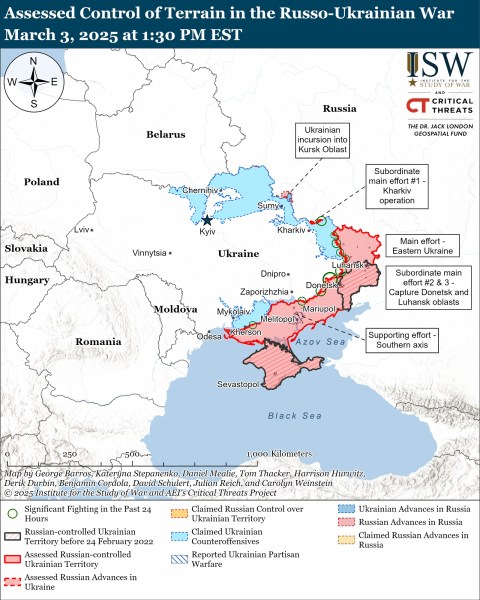 Map showing Russian-controlled territories in Ukraine, and counteroffensive by Ukraine as of March 3, 2025. (Picture courtesy: Institute for Study of War)
Do You Know:
— Ukraine declared independence from the Soviet Union in 1991. It shares its borders with Russia in the east, Belarus in the north, and Poland, Slovakia, Hungary, Romania and Moldova in the west. To its south, lies the Black Sea. As per USDA data, Russia and Ukraine had a combined 27.4% share of global wheat exports in 2025-26, while accounting for 15.8%, 12.5% and 61.5% of the shipments of barley, corn and sunflower oil respectively.
— While there is no shortage of production of grain or sunflower seed in either country, the crisis is about shipping out the produce, as the intensified cross-border missile and drone strikes leads to increased shipowner and crew reluctance, soaring insurance premiums and reduced vessel calls at ports.
Other Important Articles Covering the same topic:
📍Kerch Strait warning, a call for vigilance
📍What Russia means to Ukraine: A long complicated history
📍Four years on, India must realise: On Russia-Ukraine war, a hands-off strategy is not ideal
Previous year UPSC Prelims Question Covering similar theme:
(4) Consider the following countries:
1. Bulgaria
2. Czech Republic
3. Hungary
4. Latvia
5. Lithuania
6. Romania
How many of the above-mentioned countries share a land border with Ukraine?
(a) Only two
(b) Only three
(c) Only four
(d) Only five
Photo recci missions, Airborne imagery was key in Kargil, an remains crucial
Syllabus:
Preliminary Examination: Current events of national and international importance.
Mains Examination: General Studies II: Various Security Forces and Agencies and their Mandate.
What’s the ongoing story: Operation Safed Sagar — the acclaimed Netflix series based on real events from the air operations conducted by the Indian Air Force (IAF) during the 1999 Kargil war — highlights the photo reconnaissance (photo-recce) missions executed by the No. 17 ‘Golden Arrows’ squadron during that time. What are photo-reconnaissance missions, why are they critical and how have they evolved over the years with the acquisition of drones and satellites?
— What is photo-reconnaissance?
— Identify differences between strike mission, air-defence mission and routine surveillance?
— What is Imagery Intelligence (IMINT)? How does it differ from Human Intelligence (HUMINT), Signals Intelligence (SIGINT) and Geospatial Intelligence (GEOINT)?
— Know about Battle Damage Assessment (BDA)? Why is imagery important after a strike?
— Understand the role of IAF in aerial defence, air superiority, tactical air operations, reconnaissance, airlift etc.
— What are the major roles performed by the IAF during wartime?
— What is the difference between a fighter, interceptor, bomber, transport aircraft and reconnaissance aircraft?
— Learn about airborne early warning and control (AEW&C) aircraft
— What are the major air-defence systems deployed by India?
Key Takeaways:
— A fighter aircraft photo-recce mission is one in which a fighter or fighter-derived aircraft is tasked with collecting the imagery of an area, installation or activity for intelligence purposes, rather than attacking the target.
— It is different from a strike and an air defence missions, which are meant, respectively, for destroying a decided target, and for locating and engaging one. An aircraft on a photo-recce role may fly into or close to a hostile location, capture images and return.
— They are typically used to map enemy positions, identify and locate targets for subsequent strike missions, assess damage after an air strike, monitor military activity, and update intelligence on enemy deployments and defensive positions.
— They can also be used to conduct terrain or route reconnaissance, particularly around difficult or contested areas, assist in battle-damage assessment after an operation and provide imagery for mission planning, including routes, target coordinates and changes to the battlefield.
Do You Know:
— The Kargil War officially ended on July 26, 1999, with the eviction of the last remaining Pakistani troops and infiltrators from positions on the Indian side of the Line of Control (LoC).
— The conflict was triggered when infiltrators from Pakistan crossed the LoC and occupied high positions in Ladakh’s Kargil district. First reported to the Indian Army on May 3, the infiltrators were initially thought to be jihadis. But over the next few weeks, as the sheer scale of the invasion came to light, the role of the Pakistani state became undeniable.
Other Important Articles Covering the same topic:
📍Kargil Vijay Diwas: Remembering how India conquered Kargil Heights by battling terrain and climate
📍Operation Safed Sagar review: Netflix series soars with zero jingoism, perfect I-Day watch
Previous year UPSC Prelims Questions Covering similar theme:
(5) Consider the following aircraft: (UPSC CSE, 2024)
1. Rafael
2. MiG-29
3. Tejas MK-I
How many of the above are considered fifth generation fighter aircraft?
a) Only one
b) Only two
c) All three
d) None
(6) What is the common characteristic of the chemical substances generally known as CL-20, HMX and LLM-105, which are sometimes talked about in media? (UPSC CSE, 2025)
a)These are alternatives to hydro-fluorocarbon refrigerants
b) These are explosives in military weapons
c) These are high-energy fuels for cruise missiles
d) These are fuels for rocket propulsion
In US plan to back hacking, parallels with China and Russia
Syllabus:
Preliminary Examination: Current events of national and international importance.
Mains Examination: General Studies II: Effect of Policies and Politics of Developed and Developing Countries on India’s interests. General Studies III: Role of External State and Non-state Actors in creating challenges to Internal Security.
What’s the ongoing story: The Donald Trump administration has opened a significant new front in the US’s cyber strategy, allowing private American companies to participate in government-authorised hacking operations against criminal groups operating overseas. This includes operations that could secretly enter, disable, or even destroy their computer systems.
— What is cybersecurity?
— How is it different from cybercrime, cyber warfare, cyber terrorism and cyber espionage?
— Understand malware, ransomware, phishing, DDoS attacks, spyware, supply-chain attacks, zero-day exploits and data breaches.
— Know about “cyber effects” operations.
— What is a “hack back”? How can allowing private entities to independently retaliate against hackers create serious legal and security risks?
— What is the difference between offensive cybersecurity and defensive cybersecurity?
— Identify the major state and non-state actors in cyberspace.
— How can non-state actors become instruments of state power?
— What are the advantages of public-private partnerships in cybersecurity?
— How does the State–private actor nexus complicate attribution of cyberattacks?
— Evaluate the risks of involving private companies in state-authorised hacking.
Key Takeaways:
— According to a national security presidential memorandum signed by Trump, vetted private American companies can carry out “cyber surveillance” and “cyber effects” operations against foreign cyber-enabled transnational criminal organisations. Unlike a conventional “hack back”, however, companies cannot independently decide whom to attack: every operation is meant to be carried out on behalf of, and under the supervision of, the US government.
— “By partnering with vetted United States companies…we will enhance our ability to counter TCO threats and combat transnational cybercrime, fraud, and other predatory schemes against American citizens,” the memorandum said.
— Companies seeking to participate will have to sign contracts with either department and pass checks covering their technical abilities, previous cyber operations, personnel, reliability, and physical security. Both large technology companies and smaller specialist cyber firms are meant to be eligible.
— The approach has a striking parallel with a model Washington has repeatedly accused China and Russia of using — that is, mobilising private or nominally independent hackers to extend the state’s cyber capabilities.
Do You Know:
— Transnational Criminal Organisations (TCOs) are organised criminal networks whose activities extend across national borders, often using jurisdictions outside of a country to target another’s citizens, companies or infrastructure.
— In the context of Trump’s new cyber programme, the term refers specifically to foreign-based criminal organisations using digital systems to carry out crimes against US persons or interests, including ransomware, fraud, extortion, and attacks on computer networks.
Other Important Articles Covering the same topic:
📍Your battery is watching: The cybersecurity warning for India in stalled e-rickshaws
📍After incidents involving AI agents, are companies facing a new kind of cybersecurity threat?
Previous year UPSC Prelims Question Covering similar theme:
(7) In India, it is legally mandatory for which of the following to report on cyber security incidents?
1. Service providers
2. Data centers
3. Body corporate
Select the correct answer using the codes given below:
(a) 1 only
(b) 1 and 2 only
(c) 3 only
(d) 1, 2 and 3
Previous year UPSC Mains Questions Covering similar theme:
(1) Discuss the potential threats of cyber-attack and the security framework to prevent it. (UPSC CSE, 2017)
(2) What are the different elements of cyber security? Keeping in view the challenges in cyber security, examine the extent to which India has successfully developed a comprehensive National Cyber Security Strategy. (UPSC CSE, 2022)
ECONOMY
Foreign nuclear tech company must have its design certified in country of origin
Syllabus:
Preliminary Examination: Current events of national and international importance.
Mains Examination: General Studies III: Indigenization of Technology and Developing New Technology.
What’s the ongoing story: Foreign nuclear technology sourced for a nuclear power plant or reactor must have its design certified or approved by the regulatory body in its country of origin and must already be operational there or in another foreign country, according to the draft rules of the Sustainable Harnessing and Advancement of Nuclear Energy for Transforming India (SHANTI) Act, released by the Department of Atomic Energy on Friday.
— What is nuclear fission and how is electricity generated from it?
— What is the difference between nuclear fission and nuclear fusion?
— Why did India adopt a three-stage nuclear power programme?
— What is the role of Fast Breeder Reactors in India’s transition from uranium-based nuclear power to a thorium-based nuclear economy?
— What does the SHANTI Act actually change?
— Why is private-sector participation significant in nuclear energy?
— What activities can private entities undertake under the new framework?
— Why is high-level radioactive waste difficult to manage?
— What is spent-fuel reprocessing and why is it important to India?
— How can India balance private participation and foreign technology acquisition with strategic autonomy and nuclear security?
— Understand how nuclear science and technology can contribute to sectors beyond electricity generation, such as healthcare, agriculture, water and industry.
Key Takeaways:
— “The technology intended to be imported or acquired domestically does not adversely affect the interest of India, does not constitute an unreasonable risk to public health and safety and is in conformity with the national policies framed under the Act,” the rules read. The rules define “the country of origin” as those countries which are self-reliant in nuclear reactor design and supply chain ecosystem whose regulatory approvals are trusted globally.
— As per the rules, technology providers shall ensure availability of design support and all necessary permissions and supporting documents from original technology developer unless there has been a complete transfer of technology.
— “Provided also that the person sourcing the technology shall ensure that all related Intellectual Property Rights vests with the technology developer,” it added. The draft rules provide for a single composite licence for building, owning, operating and decommissioning a nuclear power plant or reactor.
— The rules also recognise captive nuclear power, including its use by energy intensive industries such as aluminium and cement, as well as data centres, semiconductor manufacturing and AI applications.
Do You Know:
— The draft comes after Parliament enacted the SHANTI Act, 2025, which received presidential assent on December 21, 2025 and enables wider participation of private entities in nuclear power and other permitted nuclear activities under regulatory oversight. India has set a target of achieving 100 GW of nuclear power capacity by 2047.
— The law allows public and private companies to set up nuclear power plants and undertake activities related to the transport, storage, import and export of nuclear fuel, technology, equipment and minerals.
— The law also retains exclusive central government control over certain critical and sensitive activities. These include the enrichment and isotopic separation of radioactive substances, the management and reprocessing of spent fuel and high-level radioactive waste, and the production and upgradation of heavy water, among others.
Other Important Articles Covering the same topic:
📍SHANTI Bill: How India is overhauling its nuclear power sector
📍Shanti law in, US nuclear ‘mission’ on its way to tap new tie-ups
Previous year UPSC Prelims Questions Covering similar theme:
(8) Which is /are the consequence / consequences of becoming a member of the ‘Nuclear supplier Group’? (UPSC CSE, 2018)
1. It will have access to the latest and most effective nuclear technologies.
2. It automatically becomes a member of The Treaty of non- proliferation of Nuclear weapons(NPT)
Which of the statements given below is/ are correct?
a) 1 only
b) 2 only
c) Both 1 and 2
d) Neither 1 nor 2
(9) In India, why are some nuclear reactors kept under “IAEA safeguards” while others are not? (UPSC CSE, 2020)
a) Some use uranium and others use thorium
b) Some use imported uranium and others use domestic supplies
c) Some are operated by foreign enterprises and others are operated by domestic enterprises
d) Some are State-owned and others are privately-owned
$52 billion in– FCNR(B) window closes early
Syllabus:
Preliminary Examination: Current events of national and international importance.
Mains Examination: General Studies III: Indian Economy and issues relating to Planning, Mobilization of Resources.
What’s the ongoing story: The Reserve Bank of India (RBI) on Friday said that it has decided to close its special forex swap facility for fresh Foreign Currency Non-Resident (Bank), or FCNR(B) deposits, prematurely on August 31, following an “encouraging response” that has brought in $52.3 billion through this route.
— What is an FCNR(B) deposit? What does Foreign Currency Non-Resident (Bank) mean?
— Who can open an FCNR(B) account?
— Distinguish between NRIs and Persons of Indian Origin (PIOs) and understand their eligibility.
— In which currency are FCNR(B) deposits maintained?
— How are they different from ordinary NRE/NRO deposits?
— Are FCNR(B) deposits repatriable? Are they taxable in India?
— Where does banking activity fit within India’s financial system?
— Understand difference between the money market, capital market, banking system and foreign-exchange market.
— Know about the role of RBI in regulating money market.
— Who regulates capital market?
— Understand India’s market-determined exchange-rate regime. How does RBI intervene?
— Learn about a dollar-rupee forex swap.
— How does the RBI’s swap with banks work?
— How does the scheme help bring foreign currency into India?
— How can NRI deposits help strengthen India’s external-sector position?
Key Takeaways:
— The swaps against FCNR(B) deposits mobilised under the facility, however, can be undertaken with the RBI till September 11, the central bank said. The schemes for External Commercial Borrowings (ECBs) and Overseas Foreign Currency Borrowings (OFCBs) will continue to remain open until December 31, 2026.
— The RBI had introduced the special US dollar-rupee forex swap facility on June 8, allowing banks to mobilise fresh three-to-five-year FCNR(B) deposits and swap these deposits with the central bank at a concessional rate. The facility effectively covered the entire hedging cost for banks.
— The latest data reported by authorised dealer banks show that the three components of the special forex facility have attracted a total of $56.846 billion in foreign currency inflows till August 13. FCNR(B) deposits accounted for the overwhelming majority at $52.3 billion, followed by OFCBs at $2.805 billion and ECBs at $1.741 billion.
— The scale of FCNR(B) mobilisation is significantly higher than the amount raised in the initial weeks of the scheme. At that stage, bankers expected the inflows to accelerate in August and September. Non-resident Indians and persons of Indian origin can open FCNR(B) deposits. It’s fully repatriable and exempt from tax in India.
Do You Know:
— RBI, through its circular dated 8 June 2026, introduced a US Dollar-Rupee forex swap facility for fresh FCNR(B) deposits mobilised for three- to five-year terms until September 2026. It permitted them to swap these deposits with the RBI at a concessional rate, effectively covering the entire hedging cost. By absorbing the hedging burden, the RBI has made FCNR(B) deposits a more attractive source of overseas funding for lenders.
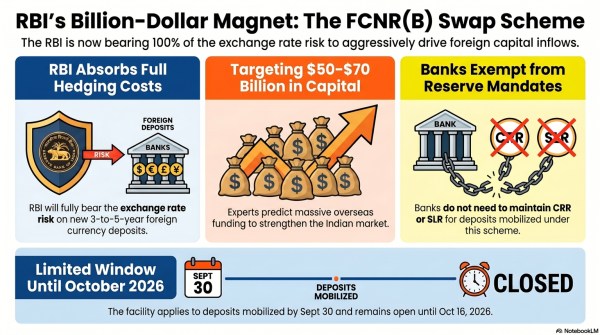 Infographics by NotebookLM
— FCNR (B) are fixed-term deposits designed for Non-Resident Indians, Persons of Indian Origin (PIO), and Overseas Citizens of India (OCI). Such deposits allow account holders to park their earnings abroad in freely convertible foreign currencies without having to convert them into rupees.
— These deposits allow overseas Indians to maintain their savings in designated foreign currencies such as the US dollar, pound sterling, euro, Japanese yen, Australian dollar, and Canadian dollar, rather than converting their funds into Indian rupees.
Other Important Articles Covering the same topic:
📍Knowledge Nugget: What are FCNR (B) deposits and swap scheme?
📍Why $49 billion in foreign inflows, led by FCNR(B) deposits, haven’t lifted the rupee
📍FCNR(B) deposits: Why higher interest rates may be needed to bring in NRI dollars
Previous year UPSC Prelims/Mains Question Covering similar theme:
(10) Consider the following: (UPSC CSE, 2021)
1) Foreign currency convertible bonds.
2) Foreign institutional investment with certain conditions
3) Global depository receipts
4) Non-resident external deposits
Which of the above can be included in Foreign Direct Investments?
a) 1, 2 and 3
b) 3 only
c) 2 and 4
d) 1 and 4
ALSO IN NEWS
Iran president to visit India for BRIC summit
IN HIS first visit to India in the wake of the conflict with the US since February, Iran President Masoud Pezeshkian will travel to New Delhi next month to attend the 18th BRICS Summit, Iranian sources have confirmed to The Indian Express.
During his visit, the finer details of which are still being worked out, besides attending the summit, Pezeshkian will hold bilateral talks with Prime Minister Narendra Modi, with a focus on strengthening India-Iran ties, status of the Chabahar port, and the latest developments in West Asia. The Indian side is also expected to broach the issue of safety of Indian seafarers in the Strait of Hormuz, with several having lost their lives due to strikes by either side.
PRELIMS ANSWER KEY
1.(d) 2.(b) 3.(b) 4.(b) 5.(b) 6.(b) 7.(d) 8.(a) 9.(b) 10.(a)
For any queries and feedback, contact raveenabaneta@indianexpress.com
Subscribe to our UPSC newsletter. Stay updated with the latest UPSC articles by joining our Telegram channel – IndianExpress UPSC Hub, and follow us on Instagram and X.