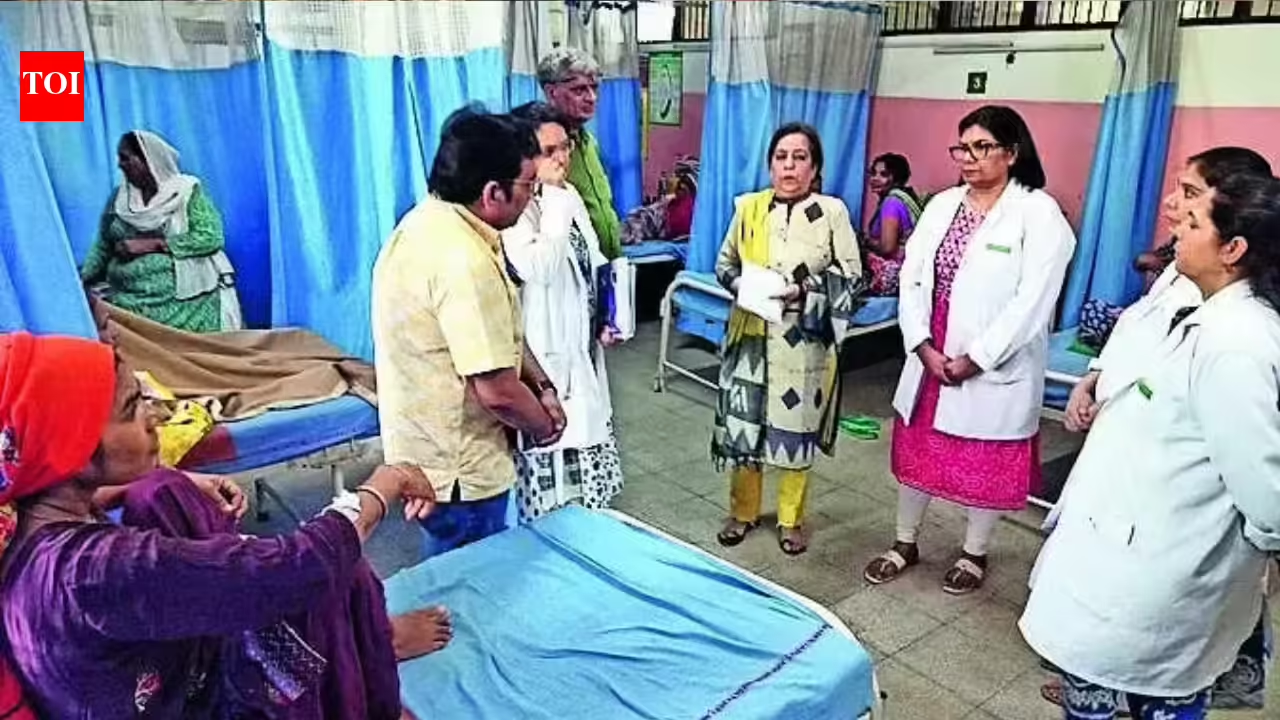










Women-led environmental movements, including a campaign against oil drilling in England, efforts to protect endangered bats from human induced wildfires in Nigeria, and a range of environmental activism in India, underline their key role in environmental protection and regeneration movements.
Recently, six female activists received the Goldman Environmental Award for the year 2026. Also referred to as the Green Nobel Prize, established in 1990, the six winners have a distinct story of climate activism, raising different issues and employing diverse campaigns.
While women have often been at the forefront of environmental activism, this also requires an understanding of the relationships between women and the environment.
Green Nobel for six women
The six winners of the Green Nobel prize are: Nigerian tropical ecologist and conservationist Iroro Tanshi, South Korean climate activist Borim Kim, British climate activist Sarah Finch, American indigenous climate activist Alannah Acaq Hurley, Colombian youth climate activist Yuvelis Morales Blanco, and Theonila Roka Matbob, a Papua New Guinean politician who campaigned to end mining devastation.
Each of these winners has a distinct story of climate activism. For instance, the British climate activist Sarah Finch led a campaign against oil drilling in England, resulting in a landmark ruling by the UK Supreme Court asking authorities to consider all emissions arising from the drill and from burning the fuel.
The Nigerian tropical ecologist and conservationist Iroro Tanshi launched a successful community-led campaign to protect endangered bats from human induced wildfires. However, what makes these stories important is the way they connect local environmental concerns to broader global consequences through grassroots activism.
Story continues below this ad
Local climate movements
Local climate movements have been part of both the Global North and the Global South’s recent political and developmental models. While the larger global environmental and climate change movements are often a heterogeneous network of formal organisations, informal groups, and individuals, local movements often emerge from the immediate lived experiences of environmental degradation.
For instance, in the Global North, the proposed expansion of Heathrow Airport in the UK raised various concerns, including aviation emissions that would have made the airport the single largest greenhouse gas emitter in the country. As a result, national organisations and local community groups came together to oppose the approval of the airport’s expansion.
In the Global South, Chile provides an example of how grassroots movements address larger inequalities. The Constitution of Chile says that water is a privatised commodity. Rivers and water rights have been auctioned off to private bidders, leading to water emergencies as well as unequal distribution of something as basic as water.
In addition, avocado, a prime agricultural crop in the country, requires huge amounts of water. This has further added to inequalities in resource distribution. As a result, grassroots movements in Chile have focused on defending the rights of farmers, workers, and local people.
Story continues below this ad
Major grassroots movements in India
In India, major grassroots and regional movements for environmental causes include:
The Bishnoi movement – A movement led by the Bishnoi community in Rajasthan nearly 300 years ago against the felling of khejri trees in Khejarli village. Amrita Devi Bishnoi of Khejarli village and her three daughters, and hundreds of members of the Bishnoi community, were killed while hugging trees. The sacrifice later inspired the Chipko Movement in the 1970s.
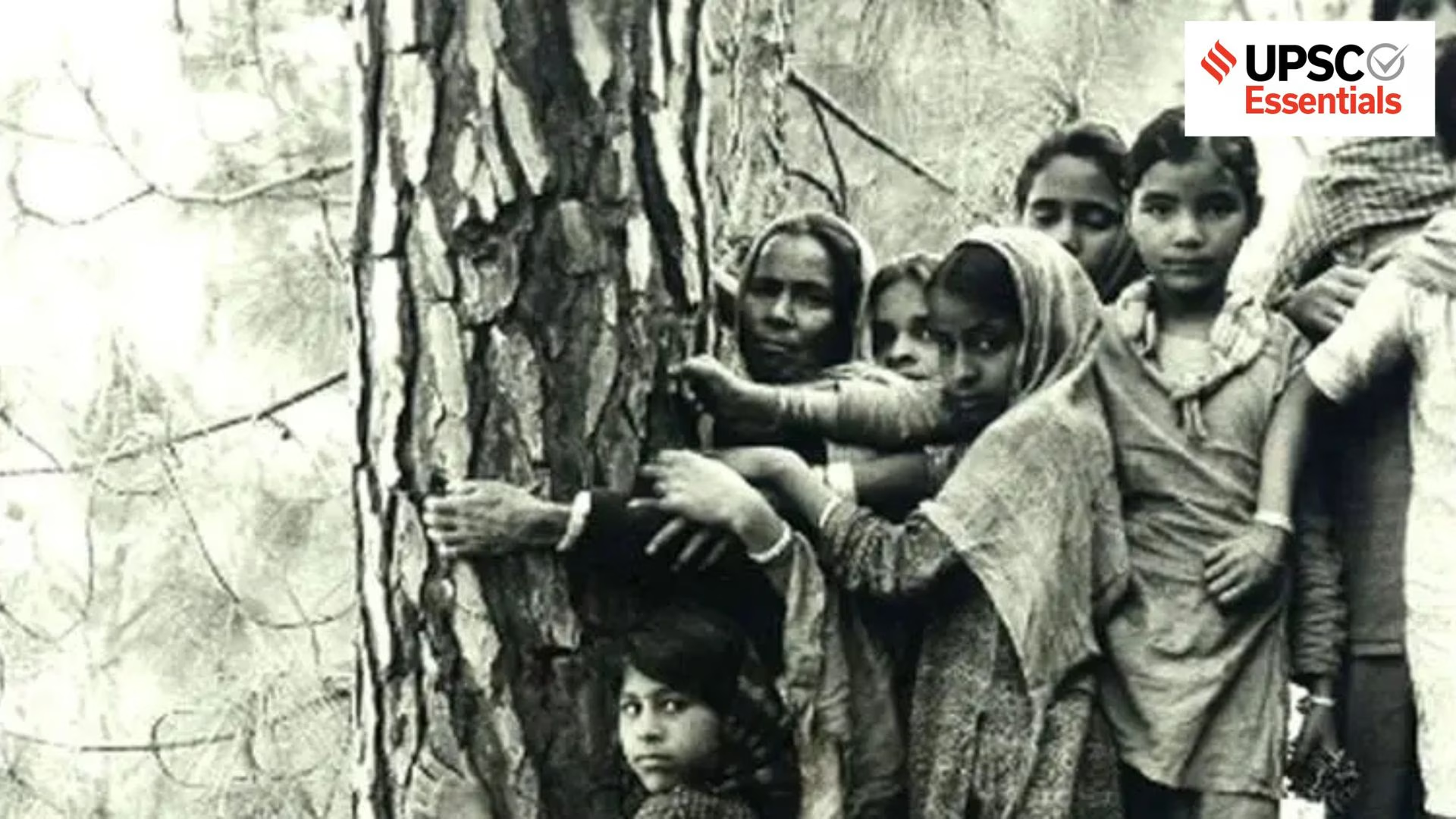
The Chipko movement – A women’s movement against the felling of trees and maintaining the ecological balance in Uttar Pradesh’s Chamoli district (now Uttarakhand) in 1973. The name of the movement ‘Chipko’ comes from the word ’embrace’, as the villagers hugged the trees and encircled them to prevent being hacked.
Appiko movement – Appiko, which in the local language meant ‘to hug’, was a method inspired by the Chipko movement to revolt against the agricultural practice of monoculture in Karnataka. It entailed the growing of a single tree in large areas.
Story continues below this ad
The Silent Valley – In 1977, the Kerala government’s plan to build a hydroelectric project across the river Kunthi that flows through Silent Valley, the evergreen rainforest in the Palakkad region, led to an environmentalist Social Movement.
The Narmada Bachao Andolan – Started in 1985 against the construction of a huge dam on the Narmada River. Later, the Narmada agitation grew into a protest against big dams and the right of the displaced to rehabilitation. It emerged as a new social movement over concerns of how development projects can have different meanings for different groups of people.
Thus, the women’s movement of the 1970s, dalit movement, tribal movements, farmer movements, and environmental action groups resisting development projects are examples of such “new social movements.”
Women have played active roles in these environmental protection and regeneration movements. From the Chipko movement to the spring regeneration intervention by women in the Western Himalayas, a dominant narrative has emerged that emphasises a special relationship between women and the environment. Against this broader backdrop, ecofeminism emerged as a framework to understand the interconnected oppression of women and nature.
Story continues below this ad
Women and nature
Emerging in the early 1970s, coincident with a significant upturn in the contemporary women’s and environmental movements, ecofeminism focuses its attention on the exploitation of natural resources and women. It contends that women are closer to “nature” and men are closer to “culture”; the domination of nature and the domination of women happen together.
Ecofeminists argue that the feminist movement and the environmental movement share a commitment to egalitarian and non-hierarchical systems and, therefore, should work together.
In the Indian context, ecofeminism has been strongly associated with the ideas of environmental activist Vandana Shiva, who argues that the violence against women and nature is connected materially. By giving the example of how women in rural India draw sustenance from nature (by collecting water, food, wood, etc), she explains that the destruction of nature implies the destruction of women’s sources of sustenance.
However, feminist economist Bina Agarwal has critiqued this way of looking at women and the environment. According to Agarwal, ecofeminists often generalise the experiences of northwestern Indian women with the experiences of all rural women in the developing world.
Story continues below this ad
She also argues that social identities like caste and class also determine the relationship between women and the environment. Therefore, Agarwal proposes the term “feminist environmentalism” instead to explain how human relationships with the environment are rooted in material realities.
Impact of environmental degradation
Research also suggests that women tend to express greater concern about climate change as a political issue. This is partly because climate change disproportionately affects various marginalised groups. Agarwal noted six major ways in which environmental degradation affects women: time, income, nutrition, health, social survival networks, and indigenous knowledge.
Environmental degradation often increases women’s labour burden. For example, recent research in Bangladesh indicates that climate change, environmental degradation, and resource scarcity, alongside male migration, increase the amount of time women spend on collecting fuel, fetching water, and other care work. This may result in women spending less time in agricultural production, thereby lowering household income.
Environmental degradation also has implications for women’s health and nutritional intake. The decline of forests and village commons also reduces access to food and essential resources for poor households. Rural women and children are often adversely affected, especially due to unequal intra-household distribution of food and other resources.
Story continues below this ad
Strengthening women’s role in environmental governance
A recent United Nations study further finds that women are the worst affected when the debt burden in developing countries increases. When governments reduce public spending as a result of a debt crisis, women overrepresented in sectors like education and care are often more likely to lose their jobs. This is also true for climate debt-burdens that developing countries face today, pushing women to extreme poverty and leading to a rise in their unpaid care and domestic work.
As such, it is important to understand how the relationship between women and the environment is shaped. Women frequently emerge as frontline actors in environmental protection movements because of the disproportionate ways in which they are affected by environmental degradation and because of their lived realities.
Consequently, women are key stakeholders in environmental governance and sustainability, which can be achieved through strengthening women’s land and property rights, improving access to clean energy, water, healthcare, and climate-resilient livelihoods, and ensuring women’s participation in local decision-making institutions.
Post read questions
Discuss the role of women in grassroots environmental movements in India with suitable examples.
Story continues below this ad
Examine ecofeminism as a framework for understanding the relationship between women and nature. Discuss the significance of the Chipko Movement as an example of ecofeminism.
Examine the role of grassroots movements in shaping environmental consciousness in India and the Global South.
Environmental degradation disproportionately affects women. Examine this statement in the context of developing countries.
How can women’s participation strengthen environmental sustainability and climate adaptation policies?
(Ritwika Patgiri is a doctoral candidate at the Faculty of Economics, South Asian University.)
Share your thoughts and ideas on UPSC Special articles with ashiya.parveen@indianexpress.com.
Gear up for UPSC Prelims 2026—Practice smarter, revise faster, and succeed with our Special Quiz Magazine. (Click Here)
Click Here to read the UPSC Essentials magazine for May 2026. Subscribe to our UPSC newsletter and stay updated with the news cues from the past week.
Stay updated with the latest UPSC articles by joining our Telegram channel – IndianExpress UPSC Hub, and follow us on Instagram and X.