






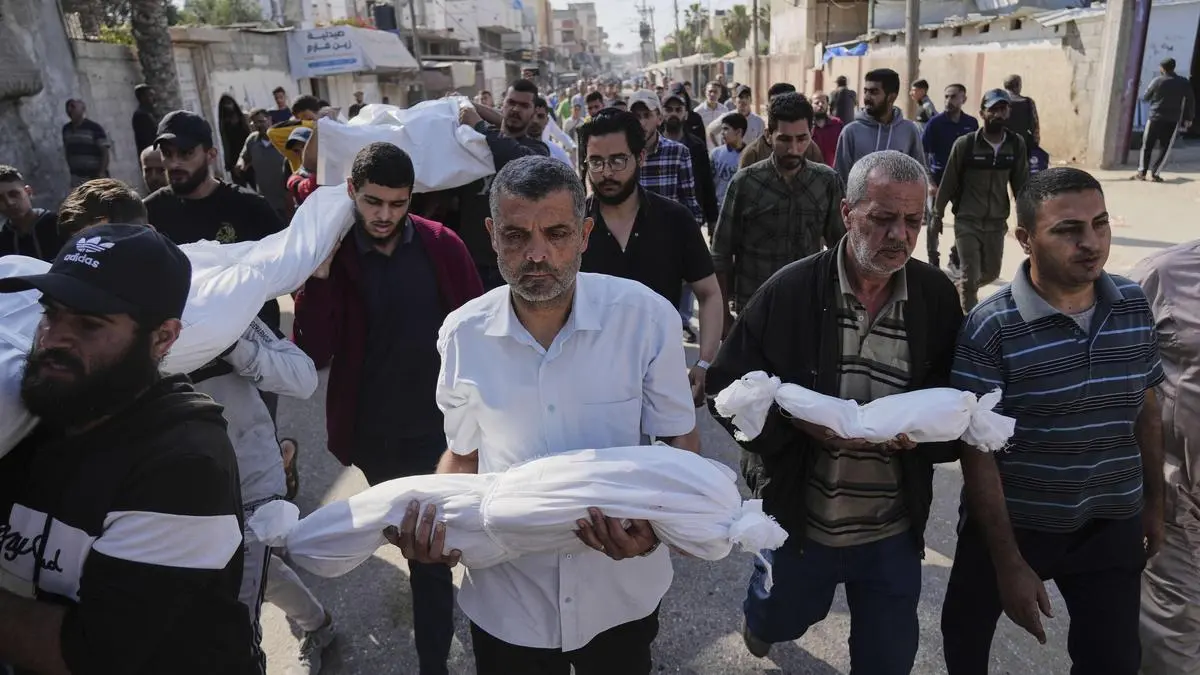
A 5-year-old girl trapped in a car beside the bodies of her dead relatives. Two brothers, aged 9 and 10, killed while collecting firewood for their disabled father.
A teenager carrying a white flag shot while obeying an evacuation order. Children undergoing amputations without anaesthesia. More than 20,000 Palestinian children reported killed and tens of thousands injured.
These are among the cases documented in a United Nations investigation led by former Chief Justice of the Orissa High Court Justice S. Muralidhar, which delivers one of the most detailed examinations yet of the impact of Israel’s military campaign on Palestinian children.
Released by the Independent International Commission of Inquiry on the Occupied Palestinian Territory, including East Jerusalem, and Israel, the 100-page report paints a devastating picture of childhood in Gaza since October 2023.
Its title reads like an indictment: “The essence of childhood has been destroyed.”
According to the commission, at least 20,179 Palestinian children were killed and more than 44,000 injured during the period under review, with thousands more believed to remain buried under the rubble or unaccounted for.
Presenting the report in Geneva, Justice Muralidhar described the findings in stark terms.
“Today, the Commission has released a 100-page report documenting violations and crimes committed by Israel against Palestinian children in the occupied Palestinian territory since October 7, 2023, until March 31, 2026,” he said.
The report arrives at a politically sensitive moment. Israel faces increasing diplomatic pressure in Europe, growing calls for sanctions and accountability measures, and continuing scrutiny before international judicial bodies.
The International Criminal Court’s investigations continue to cast a shadow over Israeli leaders, while the International Court of Justice has already delivered opinions challenging aspects of Israel’s occupation policies. Several European governments that once offered unqualified support to Israel have faced growing domestic pressure over Gaza.
At the same time, visible strains have emerged between Washington and Tel Aviv. Differences over the conduct of the war, humanitarian access, and the future political architecture of Gaza have produced one of the most difficult phases in recent US-Israel relations. Against this backdrop, the commission’s report is likely to become part of a broader international debate over accountability.
A unique investigation
Unlike many previous investigations that focussed on military operations or diplomatic developments, this report examines the lived experiences of Palestinian children. It seeks to document not only how children died, but how an entire system of childhood has been dismantled.
The commission argues that Palestinian children have endured severe physical injuries, psychological trauma, repeated displacement, starvation, orphanhood, family separation, and the collapse of essential services. Together, these experiences have created conditions whose effects may persist for generations.
“The evidence shows that Palestinian children have been deliberately targeted and killed by the Israeli security forces,” Justice Muralidhar told journalists.

Justice Muralidhar said, “The protection, care, and survival of Palestinian children are inseparable from the Palestinian people’s right to self-determination.”
| Photo Credit:
R.V. MOORTHY
“Children are being killed mainly in two ways. One, through airstrikes using high-yield explosives with wide area effects. And second, using quadcopters, drones, and sniper rifles that specifically target and kill children. To their head and upper body.”
The report’s conclusions are based on interviews with victims and witnesses, forensic examinations, satellite imagery, medical records, audio and video evidence, and thousands of verified open-source materials. Investigators also consulted independent forensic pathologists and specialists to assess evidence relating to child casualties.
The commission notes that it repeatedly sought cooperation from Israeli authorities. Since October 2023, it has sent numerous requests for information and access to the Government of Israel. While Palestinian authorities and Gaza’s Health Ministry provided information, Israel did not respond to the Commission’s requests.
The commission itself occupies a unique place within the United Nations system. Established by the UN Human Rights Council in 2021, it was given an open-ended mandate to investigate alleged violations of international humanitarian law and international human rights law in Israel and the occupied Palestinian territories. Unlike earlier fact-finding missions tied to specific conflicts, the commission was tasked with examining broader patterns, root causes, and accountability mechanisms.
Justice Muralidhar assumed leadership of the commission at a time when international attention was increasingly focussed on Gaza. Widely respected in India’s legal circles, he served as Chief Justice of the Orissa High Court and earlier as a judge of the Delhi High Court and the Punjab and Haryana High Court.
He is best known for judgments involving constitutional rights, civil liberties, and the protection of vulnerable communities. His appointment placed an Indian jurist at the head of one of the United Nations’ most politically consequential investigations.
The targeting of children
One of the report’s most disturbing findings concerns what it describes as the deliberate targeting of children. The commission examined numerous incidents in which children were allegedly shot while evacuating, seeking food, collecting firewood, or sheltering in locations that should have offered protection. Investigators concluded that these incidents reflected a broader pattern rather than isolated tragedies.
Among the cases highlighted is the killing of Hind Rajab, whose desperate pleas for help captured international attention. Trapped in a vehicle surrounded by the bodies of family members, she remained in contact with rescuers for hours before contact was lost.

Palestinian children carry banners during a march demanding an end to the war and famine, in Rafah, on March 6, 2024.
| Photo Credit:
Ahmad Hasaballah/Getty Images
After examining satellite imagery, audio recordings, and forensic evidence, the commission concluded that Israeli forces deliberately targeted the family vehicle despite knowing children were inside. It further found that rescue efforts by paramedics were obstructed and that the ambulance sent to assist was itself attacked.
Another case cited by investigators occurred after the October 2025 ceasefire agreement. The commission documented the deaths of two young brothers who were collecting firewood for their wheelchair-bound father near a newly established Israeli-controlled zone. Israeli forces reportedly described the children as “suspects”.
The commission rejected that characterisation, concluding that the boys posed no immediate threat and should never have been treated as military targets.
Amputations and lasting injury
The report also devotes significant attention to injuries suffered by children. Medical personnel interviewed by investigators described cases of extreme trauma, including severe burns, brain injuries, spinal damage, blindness, and hearing loss. Many children suffered multiple injuries affecting several parts of the body simultaneously. The destruction of hospitals and medical infrastructure often left doctors unable to provide adequate treatment.
Some of the most harrowing accounts concern amputations. The commission cites evidence that hundreds of children lost limbs during the conflict. In many cases, surgeries were performed under extraordinarily difficult conditions because of shortages of equipment, medicine, and anaesthesia.
The long-term consequences are likely to be profound. Thousands of children are expected to require lifelong medical care, rehabilitation, and psychological support. Yet the very institutions needed to provide such care have themselves been devastated.
The report argues that attacks on healthcare facilities have gone beyond immediate battlefield consequences. Maternity wards, neonatal units, and reproductive health services have been damaged or destroyed, affecting not only newborn survival rates but also the broader reproductive future of Palestinian society.
Similarly, the destruction of schools and educational facilities has interrupted learning for an entire generation. According to the commission, the impact extends beyond academic setbacks. Schools function as social spaces where children develop emotionally, cognitively, and psychologically. Their destruction, the commission argues, affects every dimension of childhood development.
The inquiry also examines the plight of Palestinian children in detention. It documents allegations of arbitrary arrests, ill-treatment, torture, and sexual violence. Investigators argue that these practices form part of a broader pattern of domination and control affecting Palestinian children across generations.
A generation under siege
Equally alarming is the report’s assessment of mental health. Children interviewed by investigators described living under constant fear of airstrikes, displacement, and death. Many had lost parents, siblings, or entire families. Others had witnessed traumatic events that experts believe will have lifelong consequences.
The commission concludes that Palestinian children have been stripped of any meaningful sense of safety, stability, or future.
Commissioner Chris Sidoti, presenting some of the findings, recounted cases that illustrate the human dimension behind the statistics.
In one incident, five teenagers who sought refuge at a beach on October 7 were killed during violence that erupted there. In another case, a 14-year-old Palestinian boy who had been shot lay bleeding for nearly an hour while Israeli soldiers remained nearby. According to the Commission, attempts by his mother to reach him were met with gunfire.
“There can be no doubt in anyone who reads today’s report that every international legal norm has been violated by the actions of the Israeli authorities towards Palestinian children, and they need to be held accountable,” Sidoti said.
The language of the report is unusually direct for a UN document. The commission argues that the cumulative impact of killings, injuries, starvation, displacement, and institutional destruction amounts to an assault on the very foundations of Palestinian society. It concludes that attacks on children cannot be viewed merely as collateral consequences of war but must be understood within a broader framework of rights, identity, and collective survival.

Palestinian children walk through the site of an Israeli military strike on structures and tents housing displaced families that killed ten Palestinians in Gaza on May 28, 2026.
| Photo Credit:
OMAR AL-QATTAA/AFP
For Justice Muralidhar, the consequences extend well beyond the current conflict.
“Even if the bombs and guns fall silent in Gaza and the West Bank, Palestinian children will not simply recover overnight,” he warned.
“The destruction of their health, education, and development is irreversible.”
The report repeatedly returns to a central idea: that the protection of children is inseparable from the future of a people.
“The protection, care, and survival of Palestinian children are inseparable from the Palestinian people’s right to self-determination,” Muralidhar said.
“By targeting children, Israel is attacking the very capacity of the Palestinian people to exist and to determine their future.”
This framing gives the report significance beyond humanitarian concerns. It situates the condition of Palestinian children within larger debates about occupation, national identity, and collective rights. The commission argues that the destruction of childhood is not only a human tragedy but also a political and legal issue with implications for the future of Palestinian society.
Whether accountability follows
Whether these findings lead to meaningful action remains uncertain. The history of international investigations into the Israeli-Palestinian conflict is crowded with reports that generated outrage but produced few tangible consequences. Yet the political environment surrounding this report is different from many that came before it.
Growing criticism within Europe, continuing legal scrutiny before international institutions, and signs of unease among some of Israel’s traditional allies have created a context in which calls for accountability can no longer be easily dismissed.
The commission’s recommendations include demands for an end to violations against Palestinian children, accountability for those responsible, and greater international engagement in protecting civilian populations. It also calls on member states to uphold their obligations under international law and to ensure access to justice for victims.
For Justice Muralidhar and his colleagues, however, the report’s central message is ultimately not about geopolitics or diplomacy. It is about a generation.
Behind the casualty figures, legal findings, and political controversies lies a simple conclusion: Gaza’s children have paid the highest price of the conflict. Many have lost parents, homes, schools, limbs, health, and any sense of a normal childhood.
The commission’s report stands as an attempt to record that reality in meticulous detail. Whether it becomes a catalyst for accountability or merely another entry in the long archive of the conflict remains to be seen. But its warning is unmistakable.
What is being lost in Gaza, the report argues, is not only lives. It is an entire generation’s future.
Also Read | Mothers of Gaza, mothers of Maryam & Son
Also Read | War’s cruel curriculum for the world’s children