




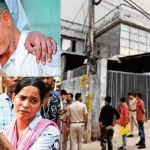



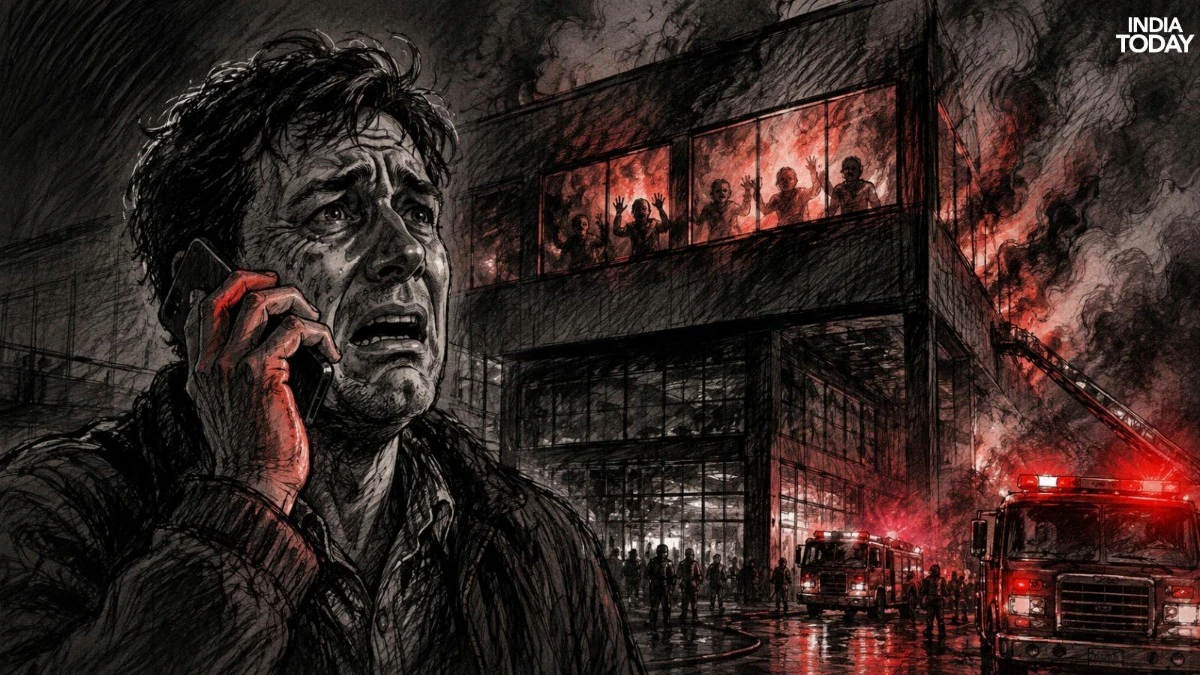
“Save me please, papa,” cried the voice on the other side of the phone on Monday. The desperate cry for help was from one of the 15 young people who were killed in the fire at a building in Lucknow that housed an animation studio. Fifteen people who went to the building to build a future never came out alive.
While the receiver of the call stood helpless, the administration could have helped. But like in the case of the fire in Delhi that killed 21 people on June 3, the nexus of the local administration, the police, businesses, and bureaucrats was the real reason why the people were killed in Lucknow.
Why do preventable accidents end up killing thousands every year? Is India casual about human lives? Does it hold the value of a citizen’s life less than other countries do? Is there a quantifiable metric to understand how much Indians value lives?
First, let us compare where India stands when it comes to preventable accidents.
When it comes to preventable deaths outside the realm of disease, road accidents stand in a category of their own. They kill far more Indians every year than fires, industrial accidents, building collapses, railway mishaps, or even many natural disasters. Together, these incidents claim thousands of lives annually, but road crashes alone account for nearly 1.77 lakh deaths, making them India’s largest man-made public safety crisis.
The recklessness and the value we attach to our lives are most visible on Indian roads. On average, 485 people were killed in road accidents in India every day in 2024. It was a 2.3% increase over the previous year. The number is lower per 1,00,000 of the population compared to some Brics nations and the US, but in absolute terms, at 1.77 lakh deaths a year, it is huge.
Though dozens of other countries were listed by the OECD, we couldn’t find data for India on how it performed on mortality from preventable causes or mortality from treatable causes.
India’s disaster toll has risen sharply in recent years. According to the Ministry of Statistics and Programme Implementation’s EnviStats India report, deaths from extreme natural events increased from 2,616 in 2023–24 to 3,080 in 2024–25, an 18% rise and the highest level in over a decade, while preliminary data shows more than 1,600 deaths from hydro-meteorological disasters by July–August 2025.
National Crime Records Bureau’s (NCRB) Accidental Deaths and Suicides in India (ADSI) data also shows deaths due to “forces of nature” rising from 6,444 in 2023 to 7,903 in 2024. Lightning remained the biggest killer, while heatstroke has more than doubled during the period.
To study the value placed on an individual’s life in India, we also need to compare its Human Development Index (HDI) ranking, which shows how it is performing on longevity, access to education, income, and living standards.
India ranked 130 out of 193 countries on the Human Development Index (HDI), according to the 2025 report released by the United Nations.
Life expectancy is another good parameter to understand the value given to human life in every country because it depends on multiple factors like access to quality food and healthcare, and environmental conditions. However, genetics, too, plays a role in it. The global average is 71, according to the World Health Organization (WHO).
The most interesting component to study here is the Value of Statistical Life (VSL). This is an economic metric measuring how much a group of people is willing to pay to reduce the risk of premature death.
While no human life can be assigned a literal price, economists measure its value indirectly through the resources a society is willing to devote to preventing premature deaths. Whether through safer roads, stricter building codes, better healthcare, or compensation mechanisms, these choices reveal how much a community is prepared to pay to reduce the risk of losing a life. This concept is known as the Value of a Statistical Life (VSL).
India has made much progress in reducing infant mortality and improving life expectancy and other HDI factors, but the above data indicate there’s much progress to be made. It is evident that India is making concerted efforts, but does the big demographic size somehow reduce the value of an individual’s life?
There is nothing to suggest that. China’s population is almost identical to India’s, yet it has a higher life expectancy and better HDI score. That suggests the population alone cannot explain outcomes.
It isn’t that large populations make lives cheaper. But when institutions fail to scale with the population, preventable deaths become more common.
That is why it wasn’t just the father who stood helpless as his child died, pleading for help in the fire in Lucknow. It was the state that appeared helpless. It was a governmental failure at all levels.
In India, individual acts of recklessness, institutional failures, and rampant corruption lead to tragedies that are preventable. And that is why individual lives appear less protected by the state than in scores of other countries.
– Ends