







From altering recommended doses to shifting vial sizes, US-based pharma major Merck & Co (MSD) has taken several steps to maximise returns from its best-selling cancer drug Keytruda but most of them, experts in India say, have driven up the cost of cancer care and resulted in patients receiving significantly more of the drug than required.
The Indian Express spoke to leading specialist oncologists across the country as part of its investigation in association with the International Consortium of Investigative Journalists (ICIJ) into how a company mandate for standardised high dosing and a opaque multi-layered access for patients have led to a growing multi-city counterfeit racket in Keytruda.

Many of the specialists were not willing to be named, but all of them agreed that with Keytruda’s generic competition expected only by 2028, the way forward for patients is a combination of reduced dosing, shorter treatment duration, vial sharing and pooled procurement.
Keytruda was first approved by the US Food and Drug Administration (FDA) in 2014 for metastatic skin cancer and is now used across a host of cancers, raking in $29.5 billion in 2024. Last year, it was added as a first-line treatment for metastatic non-small cell lung cancer, cervical cancer and colorectal cancer to WHO’s model list of essential medicines — a list used by countries to ensure availability of key medicines at public health facilities and guide government procurement and insurance reimbursement.
The high cost, however, means that low and middle-income countries like India cannot afford to make it widely available. The committee that proposed adding the drug to the essential medicines list acknowledged as much: “…immune checkpoint inhibitors are likely not acceptable treatment options for the proposed indications to most countries… due to high price, the need for companion diagnostics, and the risk of eroding the financial viability of health systems and diverting resources at the expense of other essential medicines.”
Dr Atul Batra, additional professor of oncology at AIIMS, Delhi, describes this as “financial toxicity”, where the “high prices of such cancer therapies drive it out of reach for most patients”.
Red flag: High, fixed doses
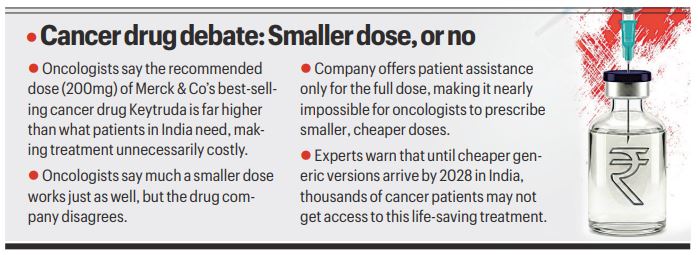
When Keytruda was first approved in 2014, the recommended dosage was 2mg/kg every three weeks. By 2016, when it was approved for metastatic non-small cell lung cancer, this mark had shifted to a flat 200mg every three weeks for all patients, regardless of body weight. With most Indians weighing between 55 and 65kg, a weight-based dosing would mean much less drug needed per patient than the flat 200 mg.
Story continues below this ad
According to experts, this flat dose has resulted in patients shelling out far more than necessary, particularly in India. Dr Batra explained: “This high, flat dose was determined based on studies conducted by the company that looked at maximum tolerated dose — a practice followed while developing chemotherapy drugs. But the mechanisms of action of both the drugs are inherently different.”
Chemotherapy directly kills cancer cells, requiring a careful balance between efficacy and toxicity. Immunotherapy works by attaching to receptors on cancer cells or immune cells allowing abnormal cells to be recognised and destroyed by the immune system, Dr Batra said. “A higher dose does not mean more cancer cells are killed. Once all the receptors are saturated, any additional dose is of no use. This is the reason we have to look for a biologically effective dose when it comes to immunotherapies,” he said.
A 2017 article on personalised versus fixed dosing noted that the drug’s phase I clinical trial found “complete target engagement with full saturation at a dose of 1 mg/kg, which was durable for at least 21 days”. Further trials by MSD found no difference in drug effectiveness between 3mg and 10mg per kg doses. Yet, the fixed 200mg dose used in the drug’s Keynote-024 trial, which is a randomised, open-label, phase 3 trial, became the basis of the 2016 FDA approval — and the number stayed.
The WHO expert committee noted that weight-based dosing “was shown to maintain treatment effectiveness while reducing treatment costs for non-small cell lung cancer in two retrospective cohort studies and have been implemented in several countries”.
Way out: Low-dose therapy works
In India, the drug is not a part of the essential medicines list, which was last revised in 2022, but a set of guidelines on the treatment of lung cancers released by the Directorate General of Health Services recommended the use of lower-dose pembrolizumab “when the standard dose (200 mg) is unaffordable or unavailable”.
Story continues below this ad
Dr Batra conducted a study at AIIMS to test whether patients can benefit from a dose far lower than even the original recommendation. His team collected data on 157 women with triple negative breast cancer (TNBC), an aggressive form resistant to hormone therapy. Patients received either standard chemotherapy or chemotherapy alongside a flat 50mg dose of Keytruda every six weeks — one-eighth of the recommended 200mg dose.
The results were striking, he said: Invasive cancer was not detected in 53.8% of patients given Keytruda alongside chemotherapy, compared to 40.5% given chemotherapy alone. Among those who also underwent surgery, 56.7% showed no invasive cancer, against 41% in the chemotherapy-only group.
“We have now demonstrated that the low 50mg dose every six weeks can be as effective as the full 200mg dose every three weeks. There is no trial that compares the low-dose and full-dose versions of the drug head-to-head. Who will fund the trial?” said Dr Batra.
Key hurdle: Bigger vials reduce access
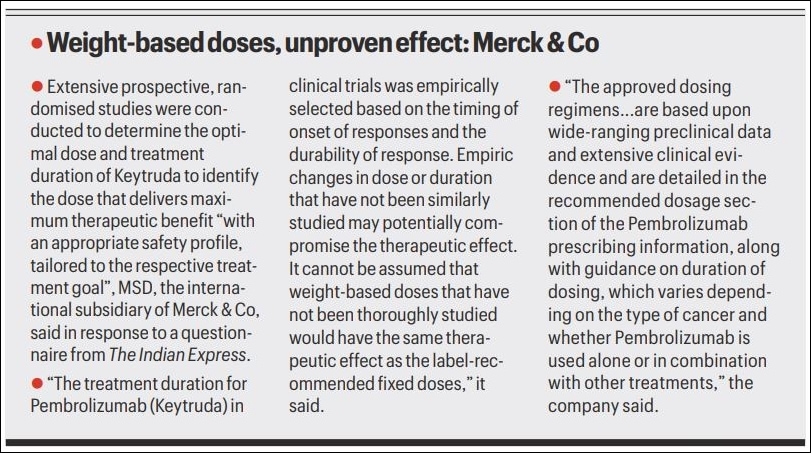
Despite these findings, two obstacles prevent widespread adoption of low-dose treatment. First, patients on a 50 mg prescription cannot access Kiran, the company’s patient assistance programme, which only covers the approved 200mg dose. This makes the lower dose financially impractical for most.
Story continues below this ad
Second, Keytruda is marketed only in 100mg vials since the company withdrew its 50mg formulation. A letter from Merck to the US FDA in June 2018 stated: “This product presentation has not been marketed in the United States since 2015, when the current 100mg liquid formulation became available…. This decision to discontinue marketing/distribution of Keytruda 50mg Lyophilized formulation was made for business reasons only, and not because of any quality or safety concerns.”
Dr Amol Akhade, oncologist at Mumbai’s Nair Hospital, put it plainly: “The company only approves patient assistance for their approved treatment as they do not acknowledge that the weight-based dose treatment works. That is wrong… They do not acknowledge that weight-based dose works because their commercial interest is affected. If they acknowledge that it works then it raises the question of why you are giving a fixed dose for so many years.”
Gesturing toward the outpatient hallway, Dr Akhade said: “In the crowd of 100 patients that you see outside this ward right now, nearly 70 patients with solid tumors could have significantly benefited from Keytruda. However, right now we are unable to even discuss this treatment option with them because it is simply unviable for them…”
Another constraint, experts point out, is vial size. The drug is sold in 100mg vials, making it difficult to administer smaller doses without wastage. “If we prescribe the 200mg dose to a patient to ensure that they can get it through the access programme, we cannot administer a 50mg dose because we cannot store the open vial,” said a Delhi-based oncologist.