
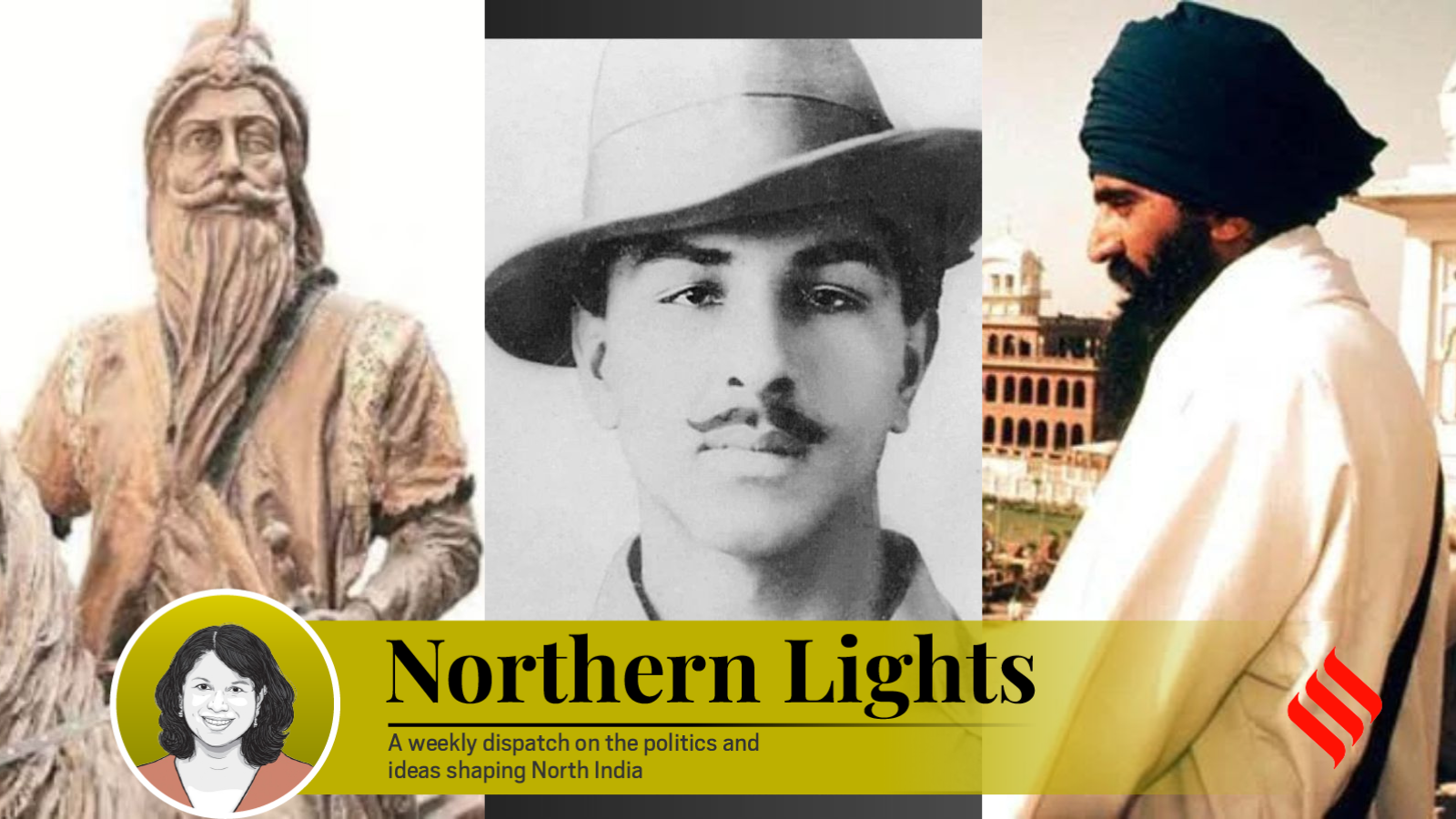
It is strange that Punjab’s politics continues to be defined by just a handful of men. One is the most famous Sikh ruler who ruled over the largest trans-regional empire in the north. Another is a freedom fighter, an extraordinarily brave, bright, and uncompromising young revolutionary who gave up his life for India’s freedom. The third is a deeply contentious figure, a separatist ideologue who perished during Operation Blue Star but remains a visible face on vehicles, in gurdwaras, and across social media in Punjab.
These three diametrically different personalities offer a window into Punjab and Punjabis. Maharaja Ranjit Singh, the one-eyed, pockmarked ruler who never formally anointed himself a maharaja, remains a near-universal favourite. He is admired for his just rule, his large-hearted administration that was religion-blind, and his forward-looking outlook that led him to recruit the best military experts and weaponry from Europe. For many Punjabis, he embodies the ideal Punjabi: devout yet secular, brave yet compassionate, adventurous yet rooted.

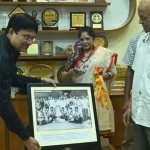
Little wonder that Punjab’s political parties repeatedly invoke his legacy. The Shiromani Akali Dal under Parkash Singh Badal, the five-time chief minister who was also a Dhillon like the maharaja, frequently referred to his rule, presenting itself as custodian of Ranjit Singh’s Sarkar-e-Khalsa. More recently, newly appointed BJP Punjab president Kewal Singh Dhillon unveiled a portrait of the Maharaja and promised a return to those golden years.
Then there is Shaheed-e-Azam Bhagat Singh, whom the Aam Aadmi Party (AAP) government led by Bhagwant Mann repeatedly invokes. The CM often recounts his frequent pilgrimages to Bhagat Singh’s ancestral village of Khatkar Kalan even before he joined politics: once when he bought his first car, another time to found a new short-lived political outfit. It came as no surprise then that the AAP government was also sworn in near the martyr’s village in 2022 and continues to unveil some of its flagship programmes there.
For Punjabis, Bhagat Singh, who is forever 23 in public memory, evokes an intensely emotional response. Young and old adore him. His portraits adorn barber shops, college campuses, kabaddi tournament banners, and roadside eateries. Ever since the AAP came to power on promises of badlav (change), often presented interchangeably with inquilab (revolution), his image has also found pride of place in government offices. To the common Punjabi, Bhagat Singh represents selfless courage and integrity. Some of the criticism Mahatma Gandhi continues to face in Punjab stems from the belief that he failed to save Bhagat Singh from the gallows. Ironically, increasingly, his image is being appropriated by gangsters and student organisations alike. Lawrence Bishnoi once appeared in a Chandigarh court wearing a T-shirt bearing the revolutionary’s image.
A polarising figure
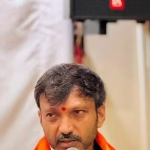
And then there is Jarnail Singh Bhindranwale. When the AAP government came to power, there was an order to remove his posters from Punjab state roadways buses, but it was quickly rolled back. More recently, there was outrage in several sections when Maharashtra minister Girish Mahajan attended a function organised by the Damdami Taksal, the seminary once headed by Bhindranwale, to commemorate Operation Blue Star on June 7. Its present chief, Harnam Singh Dhumma, has openly supported Prime Minister Narendra Modi, yet it was Bhindranwale’s portrait in the backdrop that triggered the controversy. But as former CM Amarinder Singh observed, to someone unfamiliar with Punjab, everyone displaying Bhindranwale’s image may appear to be a Khalistani. But the reality is more complex.
Bhindranwale, who died during Operation Blue Star in June 1984, remains one of the most polarising figures in Punjab’s history. He shot to prominence through his amrit prachar (baptism) campaigns and provocative speeches during a turbulent period when Punjab’s grievances against the Centre had crystallised into the Dharam Yudh Morcha. Many Punjabis, including Sikhs, remain very uncomfortable with his divisive rhetoric and the violence that engulfed the state in the 1980s, often called the dark decade when militancy wracked Punjab. Yet one simple reason why Bhindranwale has endured is that he died fighting. Reportedly given the option to surrender, he chose to stay and resist. Had he survived and faced trial, he might have met a different fate. His death instead made him a symbol of resistance to the perceived excesses of the then Dilli Sarkar in the fight for Punjab’s rights.
As Punjab heads towards the Assembly elections in early 2027, these three figures offer a telling insight into the many threads that make up the state’s political and cultural psyche. Punjab is deeply nationalistic yet fiercely parochial; often agitated by perceived or real injustice and always inclined to rally behind those who stand up to any form of “dhakka (injustice)”.
But the recurring presence of these long-dead men in the collective consciousness points to something deeper: a profound leadership vacuum, and the consequent tendency to seek answers in the past. Punjab continues its search for a statesman extraordinaire, capable of embodying its aspirations, anxieties, and sense of self, while steering it towards a prosperous and peaceful future. It’s this void that the parties should aim to fill.
(Manraj Grewal Sharma is Resident Editor of The Indian Express in Chandigarh)