





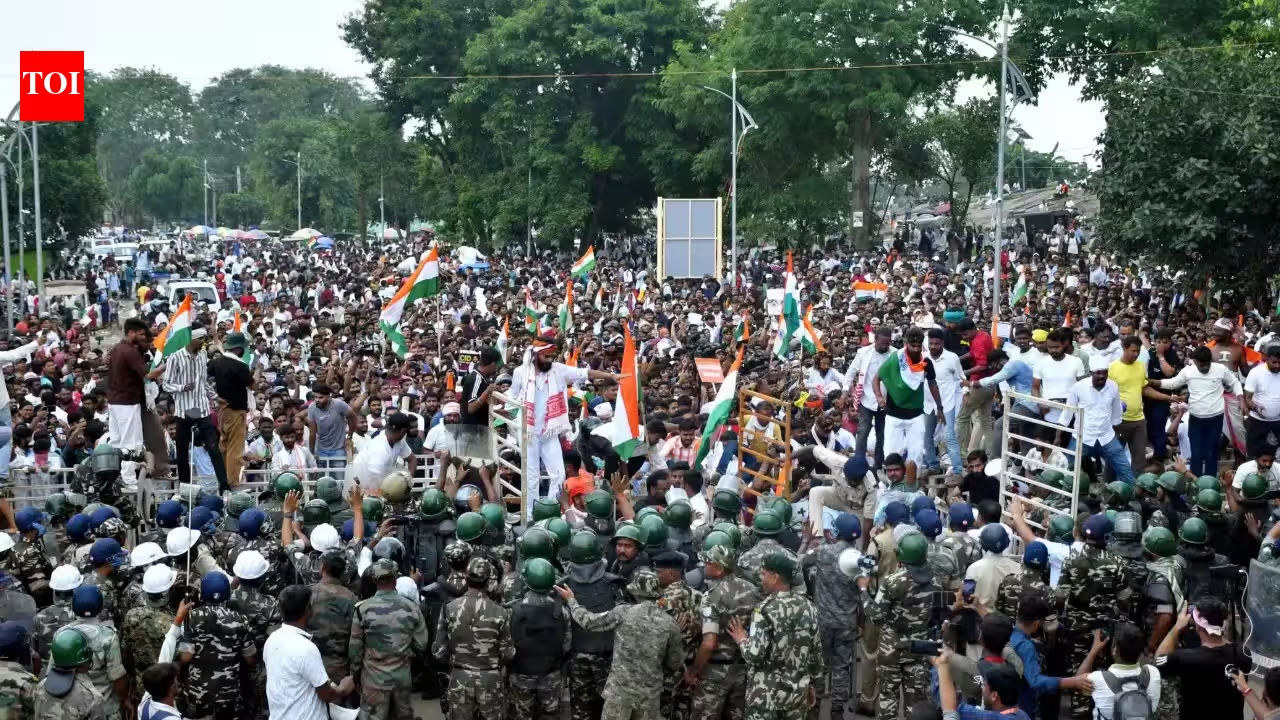
RANCHI: On a protest site in Ranchi, students have been on strike for 19 days (as of August 12). Two factions are protesting against alleged irregularities in government-led examinations, with Devendra Nath Mahto leading one faction and sitting on a hunger strike for 11 days.Apart from Mahto, seven other students are on hunger strike. Three of them, including Mahto, have been admitted to hospital, while the remaining students continue their protest at the site, tired and weak but determined to fight for their rights.Their health is failing. They complain of headaches and weakness. They said medicines promised by a government medical team took an entire night to arrive.They are not asking for money or for a job to be handed to them. They want the chief minister to walk up to them for five minutes.“We do not want discussions behind closed doors. We want the chief minister to come to us. We are his children and the people of the state,” student Rahul Kranti said. “Does he consider us terrorists that he cannot come among us?”The protest over alleged irregularities in Jharkhand’s recruitment examinations has been going on for weeks.The government and student representatives have already held multiple rounds of talks, but without a breakthrough and eventually stalled.The core demands have remained unchanged. Students want the 14th Jharkhand Public Service Commission (JPSC) cancelled. They are also seeking an independent probe by the CBI or a panel of retired high court judges from outside the state.For an aspirant who has spent years preparing for a government job, the exam is supposed to be the final step.In Jharkhand, it has become the reason to sit outside on the streets—vulnerable—and refuse food.
The years before the protest
The anger on the streets did not begin with this year’s postponements. It began much earlier, with aspirants watching exam dates move for years.“Since 2016, the application process has been delayed, and the date is being extended. The govt does nothing. It only extends the date and never conducts the exam,” Arunesh Kumar, a JSSC CGL aspirant from Palamu, said during an earlier protest over clashing exam dates.“In the same way, our age is also increasing. Those who have been preparing for seven to eight years will not be able to take the exam. There will be no relaxation in the age limit from the govt, so who takes responsibility for this?” he said.
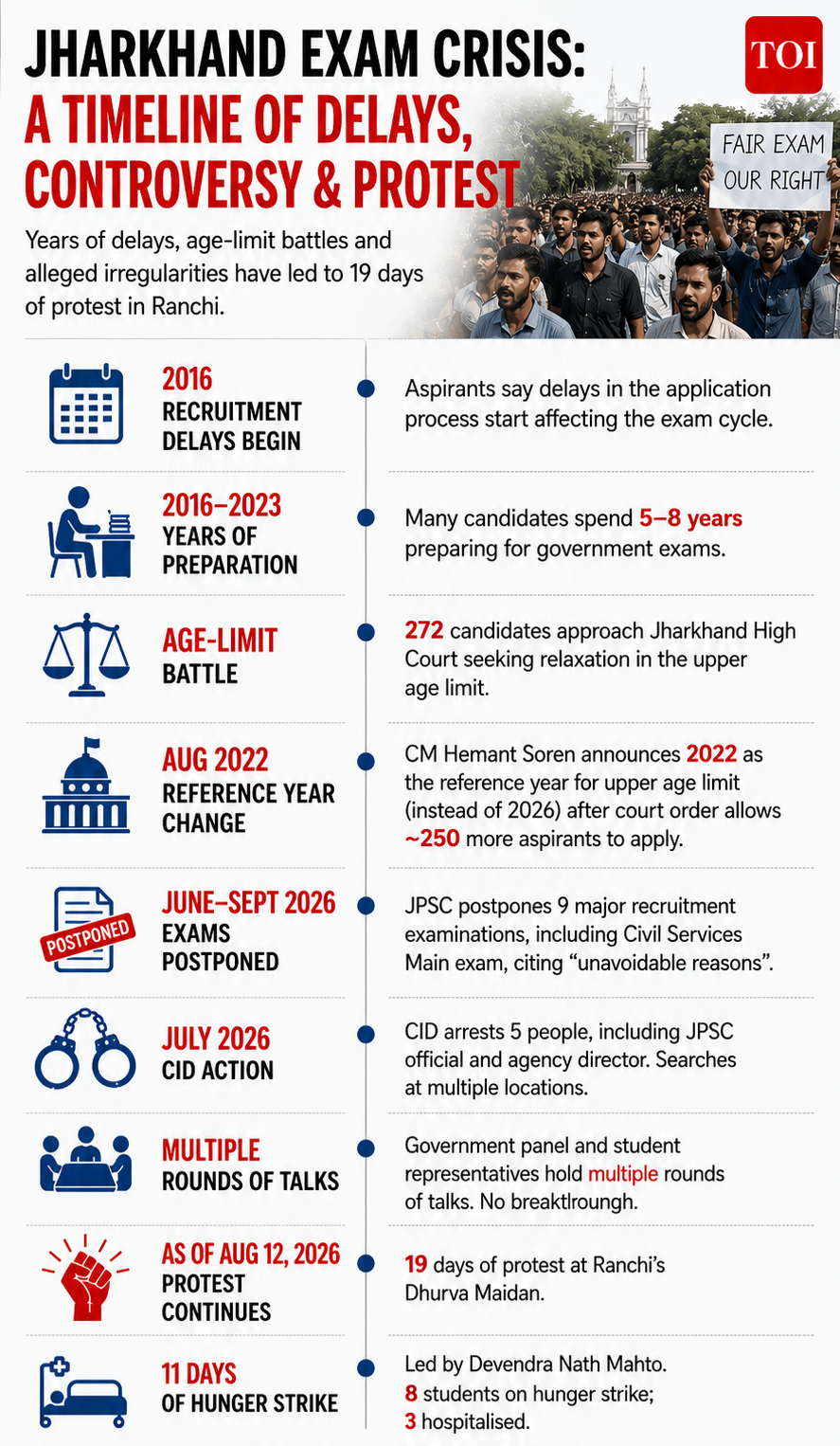
Timeline of the Jharkhand exam crisis, from delays to protests and hunger strike
That is the quieter cost behind every headline about a leak or postponement.Aspirants can spend years of their 20s preparing for one government job. There is still no guarantee that the exam will be held on schedule.
When age itself becomes the enemy
Delay creates a specific problem for government job aspirants. It can make them ineligible altogether as the calendar moves forward.As many as 272 candidates approached the Jharkhand high court seeking relaxation in the upper age limit for the 14th JPSC civil services exam.The commission had earlier fixed the upper age limit with 2017 as the reference year for one set of exams. It later fixed August 1, 2026, as the reference date for the present examination.The petitioners argued that the commission had failed to conduct exams every year as required under its rules. They said they were losing their chance simply because they had grown older while waiting.The court, under Justice Ananda Sen, directed JPSC to accept their applications. It did not decide the larger question of which cut-off year was fair.Months later, chief minister Hemant Soren announced in the state assembly that 2022, instead of 2026, would be treated as the reference year for the upper age limit. The decision came after a court order allowed roughly 250 more aspirants to apply.It was still not enough for many candidates.“Tens of thousands would be deprived of taking the exam. We request the state govt to declare 2018 as the cut-off date, keeping in view the principle of equity,” said Satyanarayan Shukla, president of the Jharkhand State Students’ Association.He called the decision unsatisfactory.The lesson is repeated across the story. When a recruitment cycle stalls, time stops being neutral.It becomes a wall that some aspirants simply age out of.
Then the exam itself became the problem
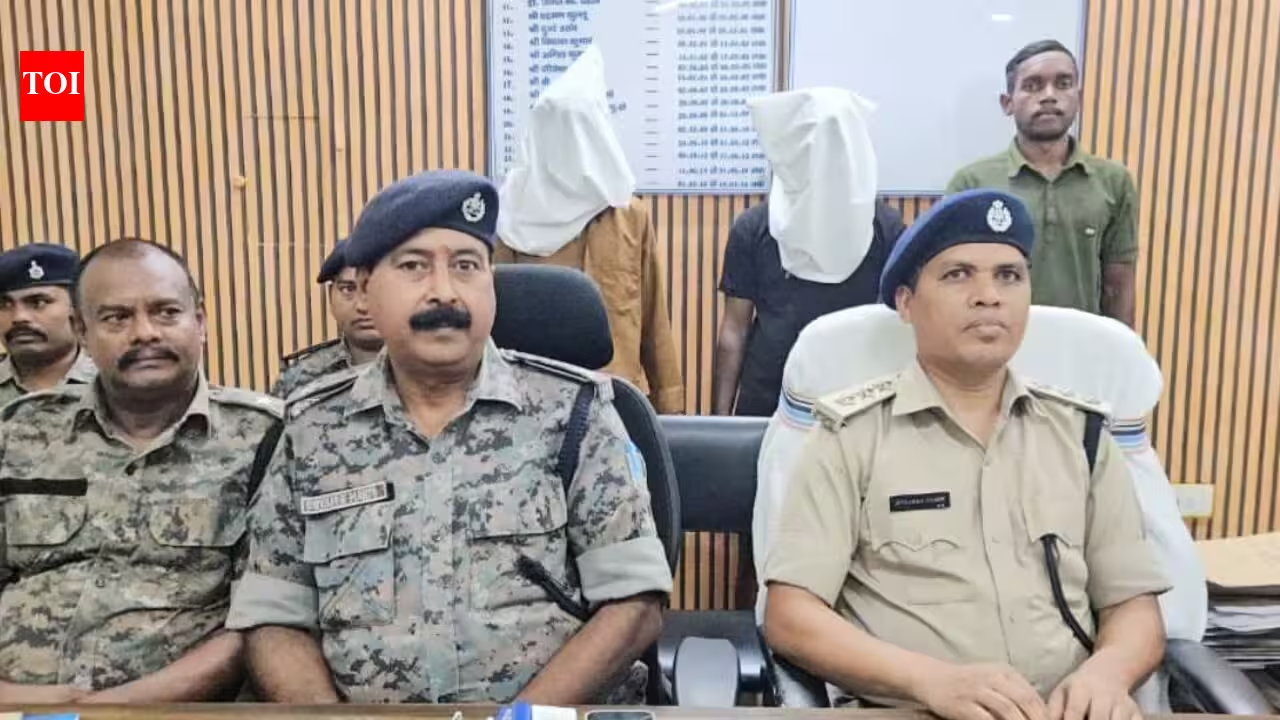
If delay and age limits were the slow costs, what happened in July in Jharkhand was more immediate.JPSC postponed nine major recruitment examinations scheduled between July and September. These included the much-awaited Civil Services Main exam. The commission cited “unavoidable reasons”.The postponement came days after the CID arrested five people. Those arrested included JPSC’s deputy examination controller Shweta Gupta and Ramvir Singh, director of TSR Data Processing Private Limited.The outsourced agency helps conduct the commission’s exams. The arrests followed raids linked to alleged irregularities.Jharkhand governor Santosh Kumar Gangwar separately wrote to JPSC seeking a “detailed investigation”.His letter cited errors in question papers for the assistant conservator of forests exam and the state civil services prelims. It also referred to mistakes in the provisional answer key and lapses that forced the cancellation of the Jharkhand Eligibility Test at two centres.CID searches followed at the JPSC office, officials’ residences and the home of former JPSC chairman L Khiyangte.At least seven people were detained.Aspirants were not reassured. They also began questioning the investigation.
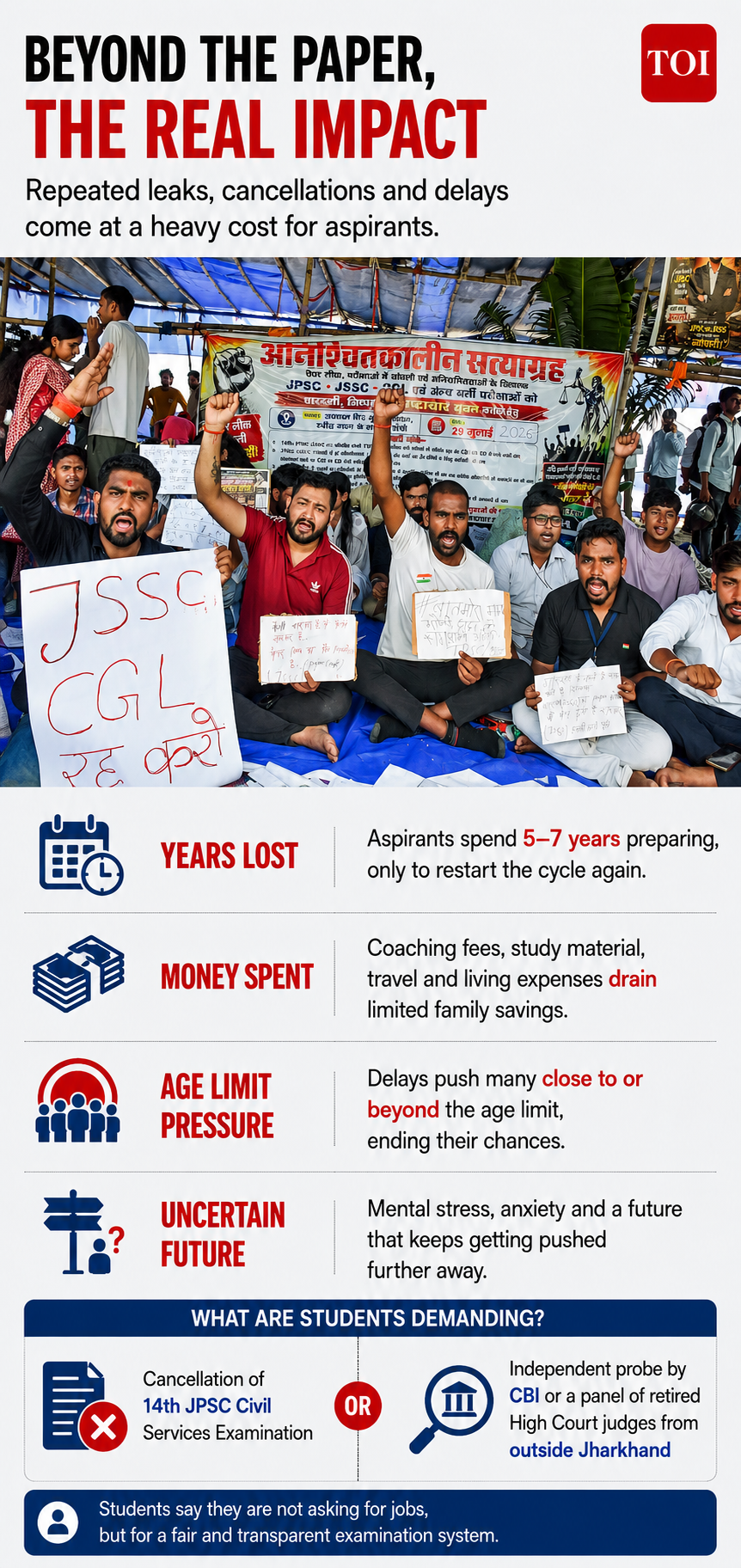
The real impact of exam delays, leaks and cancellations on aspirants’ time, money and future
Student leader Kunal asked why the CID had not made its findings public or named an alleged mastermind months into its probe. He also sought a review of every JPSC exam conducted with TSR Data Processing’s involvement.Ranchi MP Sanjay Seth backed the demand for a CBI probe. He questioned how an agency previously blacklisted in Uttar Pradesh had been entrusted with Jharkhand’s exams.That is where the hunger strike, the multiple round of talks and the demand to cancel the 14th JPSC exam connect.Prepare. Wait. Get a date. Watch the date turn into uncertainty. Watch that uncertainty become an investigation. Then wait again for the investigation to end.
Jharkhand isn’t alone
Aspirants elsewhere in the country have experienced versions of the same story. Each case shows a different point where the recruitment system can fail.In Bihar, the 70th Bihar Public Service Commission (BPSC) prelims became a flashpoint after candidates alleged a paper leak and mismanagement at the Bapu Examination Centre in Patna.Question papers reportedly arrived late. Some were found torn. Patna’s DM Chandrashekhar Singh eventually slapped a protesting candidate before police intervened.BPSC leadership denied any leak. Chairman Parmar Ravi Manubhai called the allegations “completely false”.The protests grew anyway. They spread to Ara, Darbhanga, Begusarai, Bettiah and other places.FIRs were filed against 350 protesters. Trains were halted. A delegation eventually met Bihar’s chief secretary.Educator Faizal Khan, popularly known as ‘Khan Sir’, joined the aspirants’ demand for a re-exam. He was briefly detained. Police later clarified that he was not arrested.His involvement became one sign of how a complaint about one examination centre grew into a wider movement.Aspirants demanded structural changes, including a single-shift, single-paper format. They argued that this would end the unfair normalisation of scores across different shifts.In Maharashtra, the vulnerability appeared even before the paper reached the exam hall.The Maharashtra Public Service Commission (MPSC) aspirants received calls offering the question paper for Rs 40 lakh. Police arrested three men, though investigators said they found no evidence that the paper had actually leaked.A separate and more serious breach hit the Teachers’ Eligibility Test (TET). A Delhi-based gang was allegedly selling TET question paper sets for Rs 1.5 crore.Bhiwandi police intercepted the papers. The state examinations council later verified that they matched the actual exam paper.The trail led to a printing press in Agra. It also led investigators to alleged “interstate examination mafia” figure Bijendra Kumar Gupta.He had reportedly been active for nearly 25 years and was wanted in Bihar, Uttar Pradesh, Madhya Pradesh and Odisha.Gupta was arrested in Patna after a month on the run. The total number of arrests in that case rose to 15.In a separate controversy, allegations of a leaked drug inspector exam paper prompted MPSC chairman Vivek Bhimanwar to issue a detailed rebuttal. He claimed that the original complainant later admitted to fabricating doubts after failing the exam himself.The Bombay high court has since designated 23 additional fast-track courts across the state to try paper-leak and malpractice cases within three months.Railway recruitment showed how examination fraud can damage an entire process.A CBI probe into a 2021 Western Railway exam found that a private computer company hired to conduct the test had allegedly supplied questions and answers to candidates. Experts were also allegedly made available at a Surat hotel.Candidates reportedly paid between Rs 2 lakh and Rs 5 lakh. Results were allegedly shared over WhatsApp before the official declaration.15 people, including railway employees, were booked.In Uttarakhand, aspirants experienced perhaps the most literal version of paying twice.The Uttarakhand Subordinate Service Selection Commission (UKSSSC) graduate-level exam had attracted more than a lakh candidates for 416 posts. It was cancelled after a judicial panel confirmed a leak from a Haridwar centre.The leak was allegedly traced to a candidate who hid a phone in his socks. He photographed the questions and had them solved and circulated within minutes by an assistant professor.An eight-day protest by the Berozgar Sangh in Dehradun ended after chief minister Pushkar Singh Dhami agreed to recommend a CBI probe. He also promised a re-exam within three months.It was Uttarakhand’s second such scandal in three years. The first, in 2022, led to the state getting a dedicated anti-malpractice law.Not every allegation, however, becomes a confirmed leak.
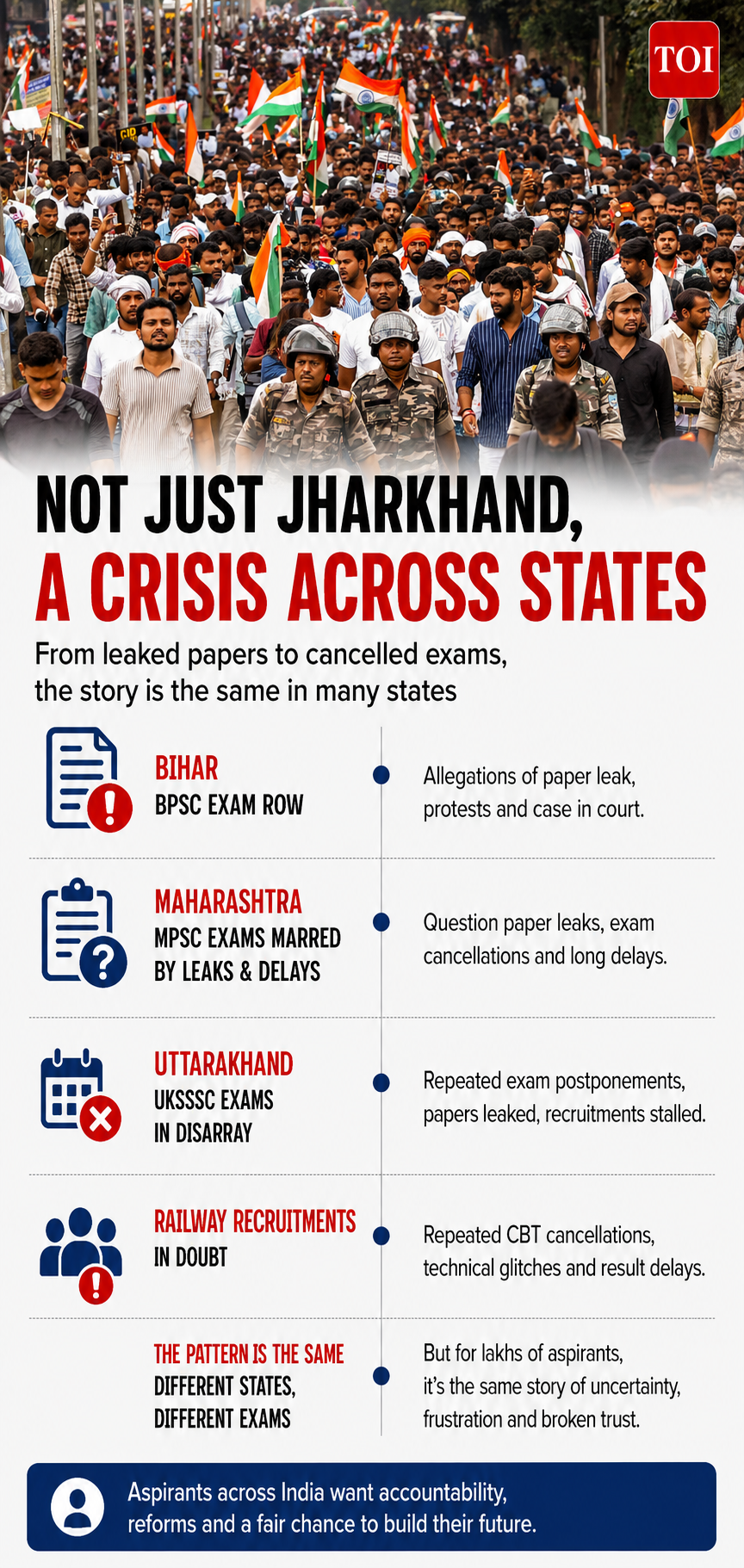
Exam aspirants across states face uncertainty over leaks, delays and cancellations
The Union government has told Parliament that no instance of paper leakage occurred in recruitment exams conducted by UPSC, SSC, the Railway Recruitment Board or IBPS over a two-year period.For aspirants, however, the damage does not end with a cancelled examination or a delayed recruitment cycle. It can affect their career choices and confidence, said Vivek Velankar, a career counsellor.“Students prepare for 14-15 hours a day for years for these competitive exams. When controversies or exam manipulation emerge, they can virtually break down because the preparation they have put in is not useful elsewhere. They lose precious time, alternate career opportunities and, in some cases, even hope of success,” he said.Velankar further added, “This can lead to they becoming patients of depression and in extreme case suicide attempts are possible.”
Back in Ranchi
None of this makes Jharkhand’s protest smaller. If anything, it makes the demand on the streets there part of a much larger question.What happens to a candidate’s future when the exam meant to secure it keeps slipping? What happens when it is postponed, investigated, contested and delayed again?Prince Mishra, a UPSC and state PSC aspirant said, “After spending years preparing for government exams, repeated paper leaks, cancellations and irregularities sometimes make me question how long I can continue. It is frustrating to put in years of hard work and sacrifice, only to see the process become uncertain. I haven’t completely given up, but I am seriously considering other career options alongside my preparation.”The eight students on hunger strike in Ranchi are not protesting a single postponed date.They are protesting years already spent. They are protesting an age limit that nearly excluded them. They are protesting an examination whose credibility they no longer trust.Multiply that across aspirants in Jharkhand, Bihar, Maharashtra, Uttarakhand and elsewhere, and the real cost of a government exam is no longer about one paper, one date or one alleged leak.Yet, for some, the dream of a government job remains intact.Harsh Pandey, who aspires to pursue a government job, said, “Government jobs are seen as a secure and respected career, especially in middle-class and poor families. Students spend five to seven years preparing, giving up many things and investing significant amounts of money. When papers are leaked, exams cancelled or recruitments delayed, that hard work feels wasted.”But despite the uncertainty, Harsh said he still wanted to believe in the system.“I still want to believe in the system. We are not asking for an easy job. We are only asking for a fair chance,” Harsh added.It becomes a question of how many times a young person can be asked to start over.Prepare again. Wait again. Protest again.At some point, a government examination stops being a promise of a future. It becomes the reason that the future keeps getting pushed further away.