






On May 4, even as serious allegations were being made regarding the counting process in many constituencies across West Bengal, Suvendu Adhikari, who led the BJP’s campaign and is now the State’s Chief Minister, thanked the CPI(M) for helping him defeat Trinamool leader and outgoing Chief Minister Mamata Banerjee. “The CPI(M) had 13,000 votes in Bhabanipur, and at least 10,000 of them were transferred to me. I also express gratitude to the CPI(M) voters there,” he was quoted as saying to the media.
This may sound totally bizarre and unbelievable, but this relationship is quite widely recognised among people who live in West Bengal and those who follow its political developments. The CPI(M)’s vote share has been declining since the 2009 Lok Sabha election, when it polled 33 per cent of the votes. It fell to 30 per cent in the 2011 Assembly election and went further down to 23 per cent in 2014 as a result of the erosion of its base. And that base may never return to the party.
However, what Adhikari was referring to is different. These voters are still CPI(M) supporters. The tendency among CPI(M) voters to shift en masse to the BJP was first noted during the 2018 panchayat election and then in the 2019 Lok Sabha election. This was cemented during the subsequent Assembly election in 2021, when the slogan being spoken in murmurs was “ekushe Ram, chhabbishe Baam” (Ram in 2021, Left in 2026).
Indeed, no less a person than CPI(M) general secretary Sitaram Yechury admitted this after the 2019 election, although he claimed that “no party member would vote for the BJP”. In accordance with the line of the West Bengal CPI(M), he stated that “the Left support base”, who were “victims of intense terror and repression” under Trinamool rule, had opted to vote for the BJP.
During the 2021 Assembly election campaign, in early February that year, former Tripura Chief Minister Manik Sarkar had strongly advised against taking any “foolhardy decision” like voting the BJP into power. He cited the experience of Tripura, stating that ordinary people there had realised that they had made a big mistake.
It is certainly true that there has been a big shift among CPI(M) voters to the BJP, especially from around 2014, and it is a phenomenon that deserves closer study. For instance, the senior journalist Monobina Gupta, during her field research, was repeatedly confronted by this puzzling phenomenon of people who were proud of their CPI(M) lineage but felt that the time had come for Hindus to assert themselves by voting for the BJP.
She cited the instance of a key RSS functionary who told her that his family on the mother’s side was connected to the Left movement. “My mother, who was with the undivided communist party, became part of the CPI(M) after the split in 1964.” Politically, his father too supported the Left. It was his mother, he claimed, who eventually awakened the Hindu in him.
This was not an isolated instance. What was striking, Gupta observed, was the way the popular base of the Left parties rapidly switched allegiances on the ground.
One of the people Gupta interviewed was full of admiration for Marxist icons such as Hare Krishna Konar, Promode Dasgupta, and Jyoti Basu, but the moment the conversation shifted to the present, just before the 2021 election, he revealed another self: “I will support the BJP only on one point, and that is because BJP is a Hindubadi (pro-Hindu) party. They will not appease the Muslims. For this issue alone, I will unhesitatingly support them.”
Such sudden shifts from the Left to the Right have been noticed throughout the history of the rise of fascism and, more recently, the New Right in Europe, and need to be studied more closely.
At one level, such phenomena signal what the philosopher Antonio Gramsci called the “crisis of hegemony” of the ruling bloc, where sudden and massive shifts of political allegiance to forces new and untested—“men of destiny”—take place. But at another level, the context and the specific formation of “hegemony” becomes crucial. However, that discussion is not possible in the scope of this article.
Party’s role
Unfortunately, however, this story does not tell the whole truth, and to shift the entire blame of this huge swing solely to the Left’s support base and not the party itself would not be honest. Take, for instance, a message that was circulating in the party’s WhatsApp groups in some districts. It is a long message of which I only cite the opening lines: “If the Bharatiya Janata Party comes to power in 2026, possibilities will open up for the Left Front’s return to power in 2031. Keeping this reality in mind I am requesting the lower-level activists, please do not waste your vote. Vote against the Trinamool Congress.”
The message thereafter goes on to explain that this is politics, where there are no permanent enemies or friends. “Remember, your ideological opposition to the BJP has always been there and will remain in future as well,” it added.
The substance of this message corresponds very closely to the stance taken by the State party leadership, especially in identifying the Trinamool as the main enemy that needs to be defeated at all costs, even if that means the BJP’s ascent to power. The massive social media debates around the supposed “equivalence” of the two forces and around the greater and lesser evils are evidence of that position.
One can have no quarrel with the identification of the Trinamool as the Left’s main adversary in the State, especially since the former dislodged the latter from power in 2011. But the strange thing is that this particular discourse has continued unabated from 2011 (when there was no BJP threat on the horizon) until well after 2016, when the BJP’s designs on West Bengal first became absolutely clear. The Left’s position on who the chief enemy is has not shifted.
Anyone observing West Bengal knows that since 2014, and more aggressively after 2016, the BJP/RSS in West Bengal have increasingly organised Ram Navami rallies where participants, including children, with swords and tridents, violently raise slogans exhorting Hindus to unite against jihadis.
For the BJP, West Bengal has the great advantage of having undergone Partition, where the terror of Partition-time violence can be very easily stoked to serve the purpose of the RSS’ communally divisive politics.
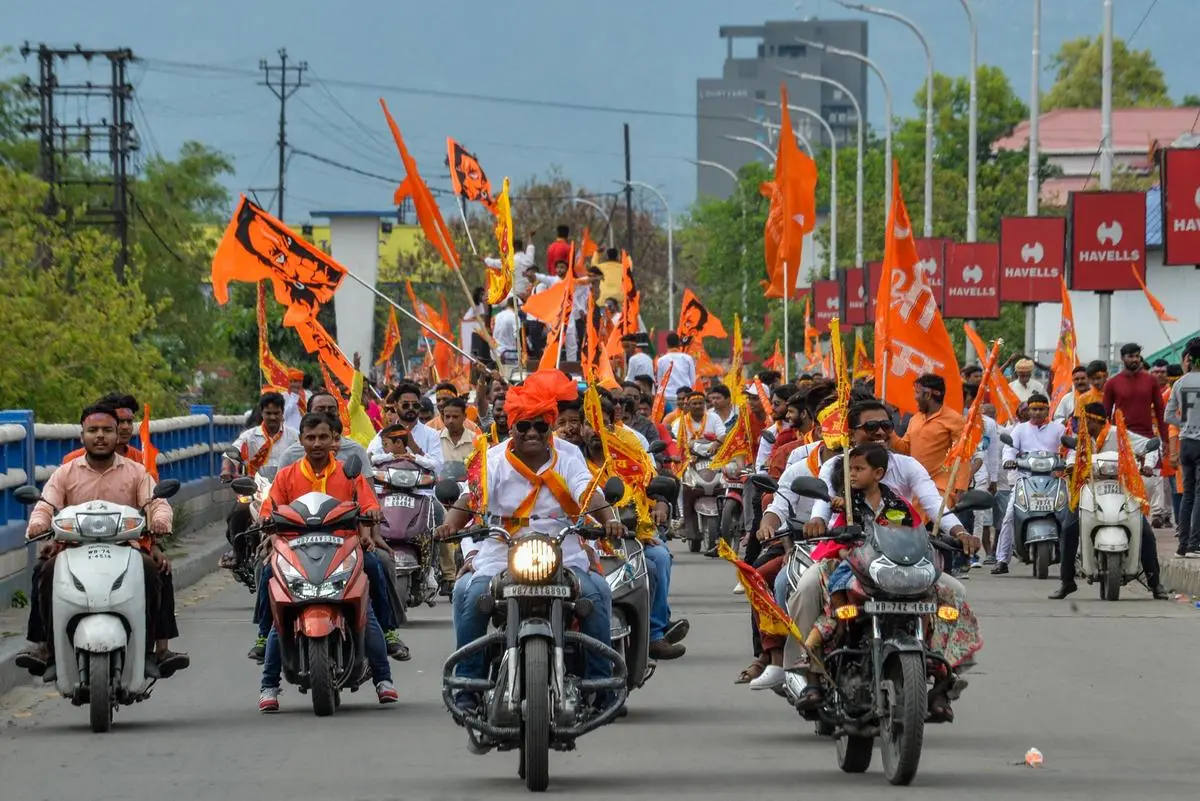
During a “Ram Navami” procession in Siliguri on April 14, 2019. The BJP/RSS have been organising such rallies in West Bengal for a decade now.
| Photo Credit:
DIPTENDU DUTTA/AFP
Foolhardy notions
None of this has changed the West Bengal CPI(M)’s perception of either the BJP or the Trinamool and what its implications could be for its electoral-political strategy. If anything, slogans such as “ekushe Ram, chhabbishe Baam” in 2021 and “ebar Ram pore Baam” (First Ram, then Left) during the 2026 election indicate that it continues to see the emergence of the BJP as a godsend that will help liberate its offices from Trinamool control. Thus, even after it became clear that the BJP wanted to drastically change Bengali life—their diet, their deities, even their language—the Left’s hope that the BJP would deliver them from “Trinamool terror” continued undiminished.
The one and only aim behind this perversity, it seems, was to take revenge on the Trinamool for dislodging the CPI(M) from power. It is difficult to escape the conclusion that what happens to the State, its Muslim minorities, its language, and culture matters little to them. They have finally taken revenge.
Even after more than 27 lakh people were not allowed to vote by the Election Commission of India (ECI) in an election that saw the physical takeover of the State by Central paramilitary forces and Central officers, the CPI(M) did not challenge or criticise the process in any significant way.
Instead, the statement of State secretary Mohammad Salim, immediately after the results were declared, opened with the observation that “the results of the West Bengal Legislative Assembly elections make it clear that the people have voted against Trinamool’s boundless corruption and authoritarian rule. The people of the State wanted the fall of the Trinamool Congress government. The BJP has taken advantage of this anger.” This endorsed the flagrant Central intervention and turned a blind eye to the fact that the State was captured and the election was conducted in violation of every known protocol.
The State CPI(M) leadership, in fact, has barely concealed its glee at the overthrow of the Mamata Banerjee government, conducted under the watchful, day-to-day guidance of Home Minister Amit Shah, who decided that the West Bengal election was more important than attending to Manipur, which was yet again on fire.
Whenever the party’s State leaders are challenged about their stance, they accuse the Trinamool of having committed the “original sin” of ushering the BJP into West Bengal in 1999. From that they develop a full-fledged theory of a continued “understanding” and “setting” between the two parties, calling the Trinamool the BJP’s B team, which is captured in the term “Bijemul”, coined before the 2021 election.
It is a fact that it was in the 1999 parliamentary election, when the Trinamool was part of the Atal Bihari Vajpayee-led National Democratic Alliance (NDA) government, that the BJP opened its electoral account in West Bengal.
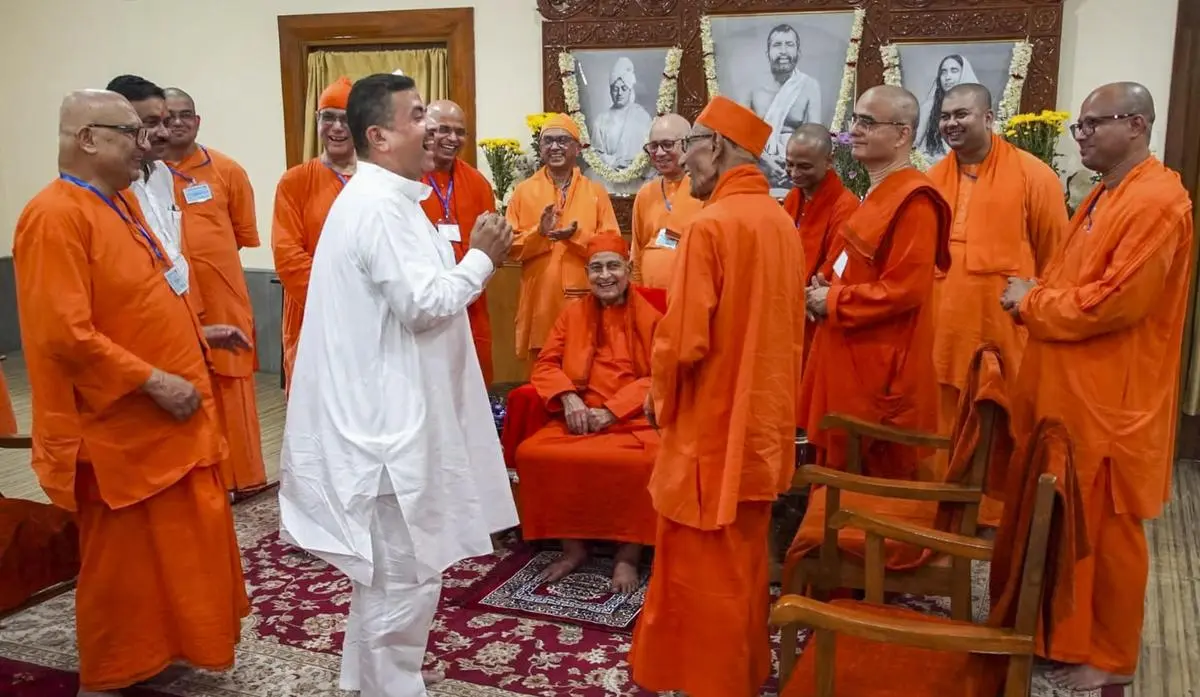
Chief Minister Suvendu Adhikari greets monks during a visit to Belur Math, in Howrah district on May 21.
| Photo Credit:
PTI
In her fight against the Left Front and the CPI(M) (which also made a murderous attack on her in 1990), Mamata gave the call for a “Mahajot”, or Grand Alliance. The BJP won two Lok Sabha seats and netted a little over 11 per cent of the votes. One must note, however, that this was the same percentage the BJP had polled in 1991, 13 years into Left Front rule. In other words, the BJP had already “entered” the State then.
Opportunistic alliances
Of course, Mamata’s alliance with the BJP in 1999 could be considered opportunistic. If that was wrong, how is it any different from what the CPI(M) is doing now? Both were/are trying to dislodge the party in power by taking the BJP’s help. In fact, it can be argued, that at least when the Trinamool allied with the BJP, the threat to Bengal and its minorities was nowhere near what it is now. Mamata helped the BJP at best to win two seats, but in 2026, the CPI(M) has helped the saffron party capture the entire State under the delusion that in 2031, it will be able to throw the BJP out.
A point that CPI(M) leaders bring up repeatedly relates to what they call “TMC terror”, a prime example of which is the supposed capture of hundreds of CPI(M) offices by the Trinamool after the 2011 election. While this merits a longer discussion, suffice it to note that until 2006–07, that is, the aftermath of the Singur and Nandigram struggles against land acquisition, rural West Bengal was an impenetrable fortress of the CPI(M). No party dared enter and challenge its dominance.
It is on record in various accounts, journalistic and academic, that the dominance was maintained not through ideological hegemony but a quiet, deep terror. Not allowing opponents to file nominations in panchayat elections, for example, was often reported in the media.
In the initial years, panchayats were important instruments of transformation of rural power equations, but by the 1990s, they had already become instruments of domination and suppression of dissent. Often, the party had to be given a “tax” for every small transaction one made.
For instance, in 2009, a farmer of Birbhum district told Tehelka reporters: “We had to pay a tax before growing and harvesting.” Even social occasions like weddings in villages were not free of CPI(M) control. The same farmer said that for his daughter’s wedding, he had to pay “Rs.750 to the CPM to throw a feast”.
In addition, party offices became venues where local party leaders would adjudicate local disputes in what was known as salisi, or arbitration. The resolution of dispute would usually be a compromise that suited the party’s interests.
Therefore, when the party began to lose its iron grip over the State after its defeat in the 2009 Lok Sabha election and then the 2011 State election, popular anger burst forth. In the face of the changing power balance, local CPI(M) strongmen and goons shifted allegiance to the Trinamool overnight, giving it the entry into rural West Bengal it never had until then.
Certainly, in some places, there was violent capture of CPI(M) offices, but in many places it was the same personnel, only the flags changed. Many of these offices have now been liberated with the BJP’s help, but the question that few ask is how the once-invincible machine of the CPI(M) came to be reduced to such helplessness before the Trinamool. It could only be because the strongmen it had once commanded shifted allegiance.
The State CPI(M)’s current stance and its convergence of interests with the BJP can only be understood if one looks at this dynamic of changing power equations, which is a far cry from the “ideological” stance that defines the Left in some other parts of the country, even if that ideology has frayed to a very large extent.
Yet, as long as a party has any claim to being “Left” in any way, a crucial question will have to be asked about why it seems to have learnt no lesson from the disastrous experience of the rise of Nazism in Germany in the late 1920s and earlier, when the communists directed their ire at the Social Democrats, whom they considered to be more dangerous than the Nazis.
Aditya Nigam, formerly professor at the Centre for the Study of Developing Societies, is a political theorist based in Delhi.
Also Read | Why the BJP’s big win in West Bengal is not a surprise
Also Read | The satrap falls