







There are biographies that faithfully assemble facts yet somehow fail to animate the life they seek to capture and present. And then there are rare works that persuade us that buildings, too, have biographies; that walls remember, corridors converse, and architecture itself becomes an archive of a nation’s moral and political journey. Housing the Republic belongs to that rare tradition.
Through it, Sobhana K. Nair has written far more than the history of a remarkable building. She has written the life story of the Indian Republic as seen through the institution that has housed its grandest aspirations, fiercest contestations, moments of courage and episodes of frailty. With the precision of a journalist, the patience of a historian and the imagination of a literary craftsman, she presents Parliament not merely as the stage upon which democracy performs, but as one of its principal protagonists.
All of us have read books that narrate history, and there are books that quietly ask what history is for. Housing the Republic belongs unmistakably to the latter category. Ostensibly a biography of India’s Parliament, it is in truth an inquiry into a more unsettling question: can a republic survive merely by preserving its institutions, or must it continually renew the ethical imagination that gave birth to them?

In this book, Parliament is not simply an architectural creation but a witness. It has absorbed both the eloquence of statesmanship and the noise of political expediency.
Housing the Republic: A Biography of the Indian Parliament
By Sobhana K. Nair
Bloomsbury India
Pages: 256
Price: Rs. 699
Housing the Republic begins with what the author herself calls “anticipatory grief”. She mourns a building before it disappears. That opening gesture is deeply philosophical because the grief here is not for stone or mortar. It is for the possibility that when societies replace their physical symbols, they also risk rewriting their moral memories. Parliament, in Nair’s telling, is not simply an architectural creation but a witness. Like an ageing philosopher, it has observed empires collapse, constitutions emerge, governments rise and fall, ideals flourish and decay. It has absorbed both the eloquence of statesmanship and the noise of political expediency.
This is the book’s greatest achievement—it refuses to reduce architecture to engineering or institutions to constitutional mechanics. Buildings acquire biographies because they accumulate human intention. Long before Martin Heidegger reflected on dwelling as fundamental to human existence, architecture had already become humanity’s most enduring conversation with time. A Parliament is therefore not merely the place where laws are enacted; it is where a civilisation repeatedly answers the question of how it wishes to live together.
A living organism
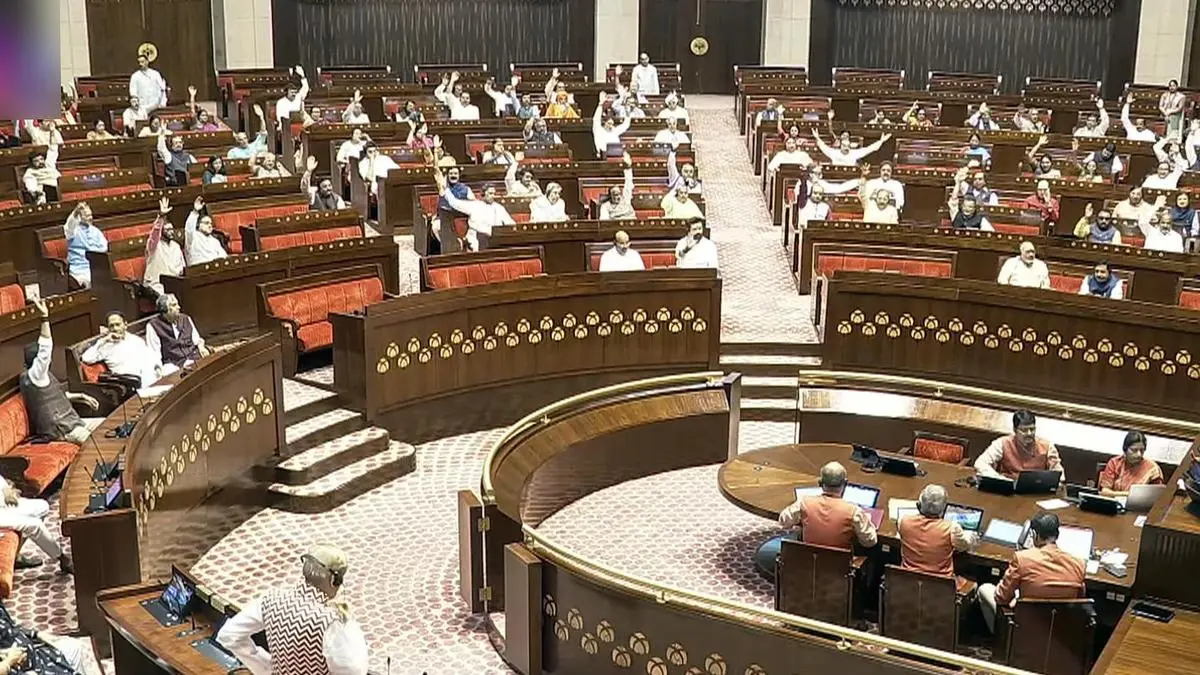
In this book, Parliament is neither monument nor museum but a living organism that breathes through debates, anxieties, interruptions, compromises and moments of extraordinary moral courage. Corridors become repositories of forgotten conversations, committee rooms become workshops of democratic negotiation, and the Central Hall emerges as a theatre where history has often unfolded with quiet rather than dramatic grandeur. In her hands, the institution acquires both texture and temperament.

The Parliament building in 1963.
| Photo Credit:
Wikimedia Commons
Equally compelling is the book’s meditation on memory because modern political life often mistakes novelty for progress. Democracies become impatient with inheritance, assuming that legitimacy can always be manufactured anew. The book gently resists this temptation. Institutions, the author reminds us, derive authority not merely from constitutional provisions but from accumulated public trust. Their legitimacy grows through continuity, through rituals repeated across generations, through the shared understanding that certain spaces embody commitments larger than any government of the day. The old Parliament mattered not because it was architecturally irreplaceable, but because generations of Indians had invested it with democratic meaning.
In this respect, the book recalls Hannah Arendt’s distinction between power and violence. Power arises when people act together in pursuit of shared purposes; violence enters when that shared power begins to erode. Institutions exist to preserve the space within which collective action remains possible and their architecture merely gives permanence to an ethical aspiration. Parliament therefore matters not because of its domes or columns but because it embodies the possibility of public reasoning over political domination.
Running through the narrative is another philosophical tension: permanence and impermanence. Every political order imagines itself enduring; while history reminds us that none is. Buildings decay, capitals evolve and symbols acquire new meanings. The British built New Delhi believing that imperial authority would last indefinitely. Independent India transformed the same architectural landscape into the home of popular sovereignty. The irony is profound because stone remains while meanings migrate.
This transformation recalls the ancient philosophical paradox of the Ship of Theseus whereby every plank may eventually be replaced, every occupant may change, new procedures may evolve, and yet citizens continue to recognise the institution as the same because its constitutional purpose survives. The author demonstrates that the identity of Parliament has never resided exclusively in architecture. It resides in the democratic imagination that continually renews the institution through debate, accountability and with adherence to constitutional values.
The prose deserves equal admiration because the author combines the discipline of a seasoned journalist with the patience of a historian. Archival research, political anecdote, architectural history and institutional memory are woven into an elegant narrative that remains accessible without sacrificing intellectual seriousness. Nair has that rare ability to humanise institutions. Parliament appears neither as an abstract constitutional entity nor as an untouchable national monument, but as a place inhabited by flawed, ambitious, principled and contradictory human beings. In doing so, she rescues democratic history from sterile constitutionalism and restores its human drama.
What distinguishes this work from conventional political histories is its moral imagination because it neither romanticises Parliament nor succumbs to fashionable cynicism about democracy. At a time when democratic institutions across the world face declining public trust, the book reminds us that criticism and affection are not opposites. We criticise institutions most passionately because we believe they remain worth preserving.
Every biography, however expansive, is ultimately shaped by the perspective it adopts. Housing the Republic consciously tells the story of Parliament from within its walls. Consequently, the democratic energies that have continually animated the institution from outside; social movements, public protests, popular struggles and civic mobilisations—remain somewhat in the background. Yet this is less a limitation than an acknowledgment that no single work can encompass the entire life of a republic. Nair has chosen to illuminate the institution through which those voices sought recognition, leaving readers to appreciate that Parliament has always drawn its vitality from a democracy that extends well beyond its chambers.
Ultimately, Housing the Republic is not about a building that stood for nearly a century but it is about the fragile architecture of constitutional democracy itself. By the final page, one realises that the true protagonist of the book is neither the old Parliament nor the new one. It is the Republic itself, restless, unfinished and forever under construction.
Sobhana K. Nair has given that Republic an elegant, humane and intellectually rich biography. It deserves to be read not merely by parliamentarians, historians or students of architecture, but by every citizen who believes that democracies are sustained as much by memory and imagination as by elections and law. Buildings may shelter institutions, institutions may safeguard constitutions, but only citizens sustain republics. Housing the Republic is, in the end, a reminder that architecture may preserve democratic memory, yet democracy itself survives only when that memory is transformed into public responsibility.
Manoj Kumar Jha is a member of the Rajya Sabha from the Rashtriya Janata Dal.
Also Read | Gen Z and the remaking of democracy
Also Read | The fight for the idea of India