


Union Minister for Ports, Shipping and Waterways Sarbananda Sonowal on identity politics in Assam, the Maritime Amrit Kaal Vision 2047 and ensuring repatriation of Indian seafarers in conflict zones. He was in conversation with Vikas Pathak, Deputy Associate Editor, The Indian Express.
Vikas Pathak: In the past, it was the splitting of the Bengali-speaking Muslim votes that brought the BJP into an important position but in the 2024 Lok Sabha polls, the Bengali-speaking Muslims significantly shifted towards the Congress. As far as the Muslim population in Assam is concerned, it was around 34 per cent in the 2011 Census. It might well be around 40 per cent in the present Census and a large chunk of that is Bengali-speaking Muslims. If the consolidation stays on in favour of the Congress, do you think the Congress’s prospects will improve in these elections?

The people of Assam are concerned about illegal Bangladeshi Muslims settled by previous Congress regimes to create a vote bank. While the All India United Democratic Front (AIUDF) emerged to protect these interests after the IMDT Act repeal, the public now trusts only the BJP to protect their land and identity. Our electoral victories across all levels stem from this trust, reinforced by actions like evicting suspected illegal migrants from Kaziranga National Park and redistributing that land to indigenous people.
The people of Assam are particularly concerned about the presence of large numbers of illegal Bangladeshi Muslims because they have been brought and had been given the settlement by Congress. Their intention was to create a sustainable vote bank, so that in the future they could always be there in case something happens. Ultimately, the AIUDF came as a saviour for the Muslims but the Congress always plays the dual role, isn’t it?
The AIUDF was formed specifically to protect illegal migrants’ interests after legal protections were removed in 2005. However, diverse Indian communities in Assam, including Marwaris, Biharis and Nepalis, have found credibility in the BJP. Prime Ministerial support for institutions like AIIMS and IIT, alongside infrastructure growth, has created immense optimism among the youth for a bright future.
Vikas Pathak: Recently, over 3.5 lakh tea garden households in Assam began receiving land pattas (titles) under Mission Basundhara, granting legal ownership of residential land to workers in nearly 707 tea gardens. But the Tea Association of India flagged some concerns: that the land is collateral when they take bank loans and that they have been responsible till now for the habitation of the workers. So if the workers get the land pattas, will it change the relation between the tea garden owners and the workers?
This won’t harm relations; it is the due share for labourers who served for 200 years to make Assam tea a global brand. Giving them rights over their small company quarters provides minimum security and allows them to access government benefits like Pradhan Mantri Ujjwala Yojana and Pradhan Mantri Awas Yojana. We are correcting the betrayal by the Congress, which used them for votes but never granted them land rights.
Story continues below this ad
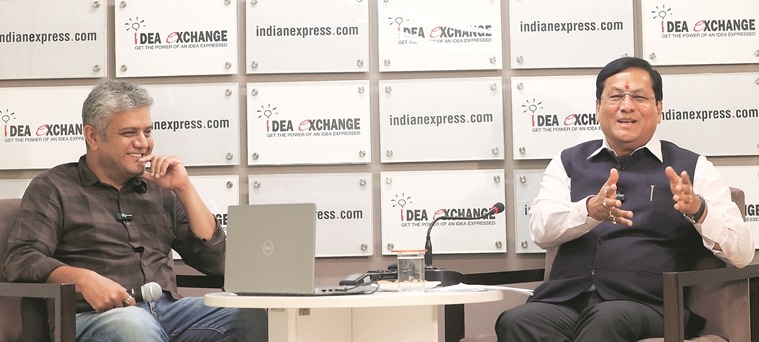 Union Minister for Ports, Shipping and Waterways Sarbananda Sonowal (right) in conversation with Vikas Pathak, Deputy Associate Editor, The Indian Express.
Vikas Pathak: In Assam, the two most prominent politicians of the BJP are you and chief minister Himanta Biswa Sarma. There’s a perception that while you have been measured in your tone, the CM has courted controversy quite often. He had used the word ‘miya’ Muslim for the Bengali-speaking Muslims. There was also an AI-generated video put up by the Assam state BJP, which was later deleted, where he was shown pointing a gun towards people wearing skull caps. He also said that if a ‘miya’ Muslim rickshaw puller deserves Rs 5, give him four. What is your take on such controversies?
Our clear policy is to fight against illegal Bangladeshi Muslims until Assam is foreigner-free. We campaigned for Amar mati, amar adhikar (Our land, our rights) to ensure foreign infiltrators have no place. The Chief Minister’s remarks reflect this unified party agenda, which is openly stated in our manifesto.
On identity and political trust | The people of Assam are concerned about illegal Bangladeshi Muslims settled by previous Congress regimes to create a vote bank.
They now trust only the BJP to protect their land and identity
Vikas Pathak: Because of the blockade on the Strait of Hormuz, there is danger to Indian seafarers on commercial vehicles. Is there a standard operating procedure that has been put into place regarding their safety? What is to be done the moment a vessel comes under attack?
The Directorate General of Shipping maintains a control room and helplines to support seafarers and their families. We view these seafarers as national soldiers risking their lives for energy security. We have repatriated nearly 2,700 people through coordinated help from the Ministry of External Affairs and an empowered group of secretaries to handle emergencies. They are soldiers of our country and we always consider them to be an integral part of our family. We will never let them feel lonely under any circumstances.
Story continues below this ad
Liz Mathew: Why did the government bring the Women’s Reservation Bill when you knew that there were not enough numbers, and why during elections?
Our intention was to grant women their bonafide rights in a growing population. It is an injustice that women hold only a 16 per cent legislative share. While the BJP supported the UPA on this in 2010, the current Opposition unfortunately chose to link this vital issue to politics.
This has no connection with the elections. We are fighting elections but we have big ambitions with the Bill. The timing relates to our ambitions for women’s empowerment, not the election cycle. We believe this recognition should not be delayed any further.
Vikas Pathak: There was one technical confusion in this particular Bill that failed. The government was saying that each state will gain 50 per cent seats. But the bill said that it would be on the basis of the latest census figures when the Delimitation Commission is constituted. That would mean 2011 figures. As per Article 81 (2) (a) of the Constitution, the proportion of the seats allocated to states has to be the same as the ratio of the population of those states. That means, as per the Constitution, the relative share of states would have changed unless Article 81 — the ‘one person, one vote, one value’ principle — was amended. You did not try to amend that particular Article but verbally it was said there would be a 50 per cent increase across states, which basically means the 1971 figures as per Article 81. How do you explain this contradiction?
Story continues below this ad
The Home Minister explained this transparently in the House and offered to provide these assurances in writing. There should be no doubt about our commitment to this cause.
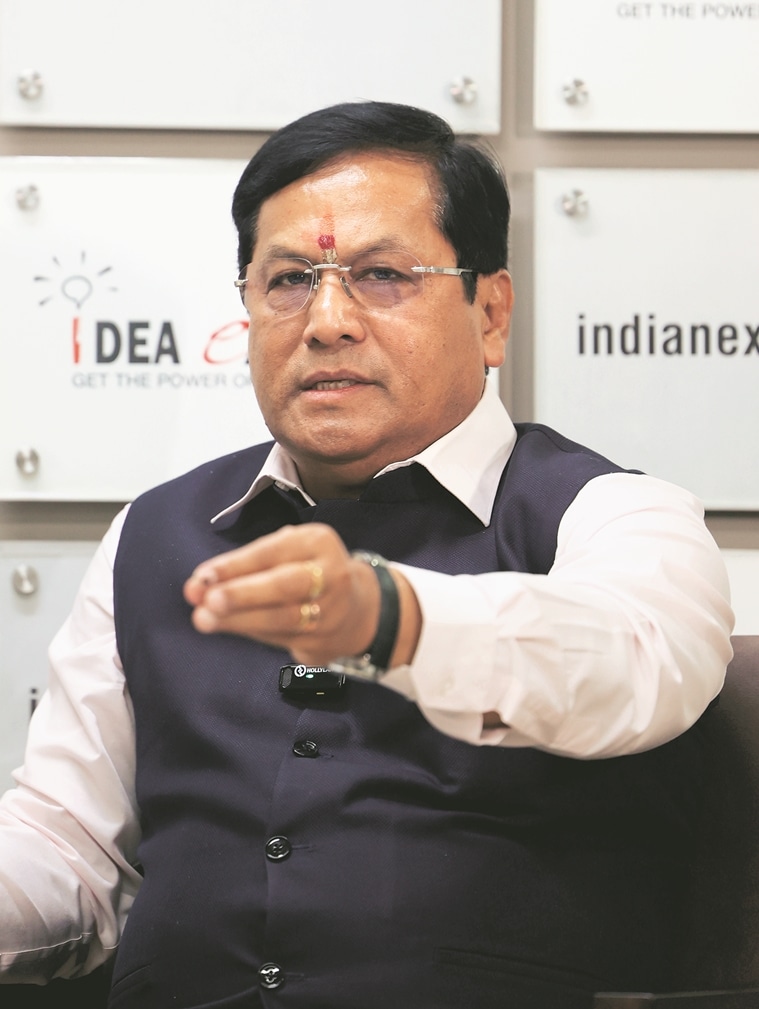 Union Minister for Ports, Shipping and Waterways Sarbananda Sonowal.
Liz Mathew: In these 10 years under the BJP, the Assam State GDP has grown, law and order has been relatively fine and there has been infrastructural development. You also spoke about an ‘ecosystem.’ What is this ecosystem? What do you feel will be the impact of this ‘ecosystem’ on the minorities in yours as well as other states?
We are committed to the security of all Indian citizens, including Indian Muslims. However, we remain firm against illegal Bangladeshi Muslims as their presence threatens the nation’s existence.
On women’s reservation bill | Our intention was to grant women their bonafide rights. The Opposition chose to link this vital issue to politics. The timing relates to our ambitions for women’s empowerment, not the election cycle
Story continues below this ad
Jatin Anand: There have been a lot of new entries into your party recently, including Pradyut Bordoloi. Do you not think that the overstepping of this ideological line for leaders from other parties to come into the BJP has an effect on the state cadre and their ideological moorings? Given that the BJP views every worker as having the same value and everybody can rise through the ranks, do you not think this is a setback for those who have been with the party for long?
New members are welcome but they must follow the BJP’s rules and principles from the day they join. Regardless of their past, they must function according to our standards.
Vikas Pathak: There’s also a joke doing the rounds that BJP has now become ‘CongJP’.
While people may talk, the reality is that the party maintains its integrity by ensuring everyone works based on the BJP policies.
Story continues below this ad
Sukalp Sharma: Considering we have been fairly successful in moving our ships from the Persian Gulf, two ships came under Iranian fire last Saturday. Could you provide some clarity on what happened based on talks with the Iranians or within the government?
Two ships were attacked, resulting in minor external damage but there was no harm to the seafarers. We expressed strong concerns to the Iranian authorities through the Indian Ambassador, demanding restraint and prioritising seafarer safety.
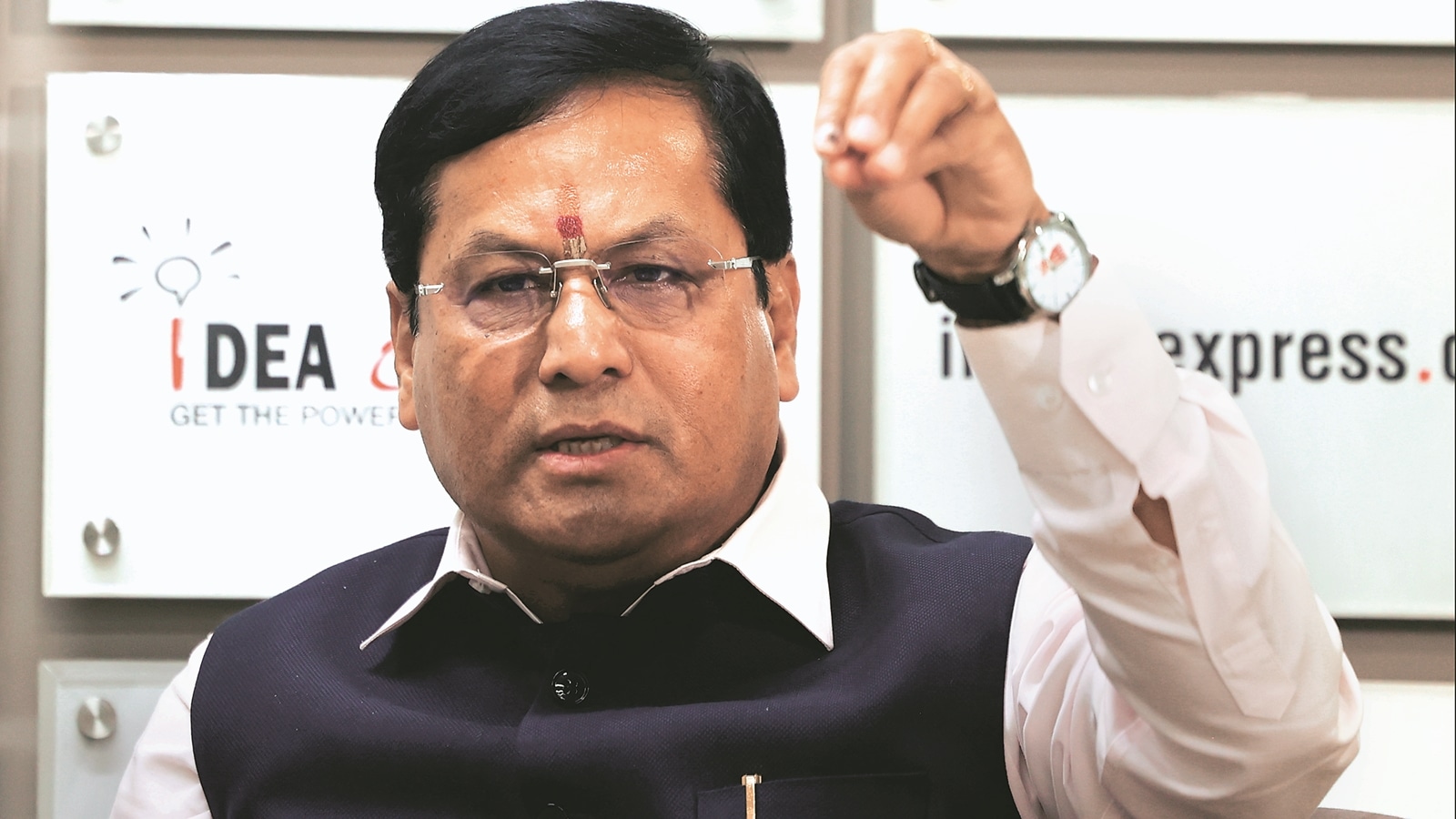 Union Minister for Ports, Shipping and Waterways Sarbananda Sonowal.
Sukalp Sharma: Did they provide any explanation regarding why this happened? Since that incident, no Indian-flagged vessels have moved. In fact, the vessels that were trying to leave on Saturday have now gone deeper back into the Persian Gulf. Is there any update on when they might move?
Our agencies work as ‘Team India’ to address these concerns through diplomatic channels. One vessel — the Desh Garima — has returned, and we are working to ensure the safety of the rest.
Story continues below this ad
Sukalp Sharma: About two-and-a-half years ago, there were talks about the India-Middle East-Europe Economic Corridor (IMEC). Because of this war, there are now two views: One, that the IMEC and similar corridors should be expedited and a contrary view, saying that any overland infrastructure in West Asia is now a target.
India will not stop. Our ships will keep moving to secure essentials like energy and fertilisers. We are actively discovering new routes for future operations.
We remain highly committed and are in frequent dialogue with partner nations to translate the IMEC vision into action. Paradoxically, our transshipment volume has increased as ships use Indian ports instead of West Asia, turning an economic challenge into an advantage.
On maritime strategy amid global crises | ‘Our ships will keep securing energy and fertilisers. We are actively discovering new routes for future operations. Our transshipment volume has increased as ships use Indian ports instead of West Asia’
Sukalp Sharma: Do you have an update regarding the timeline for the Great Nicobar Galathea Bay transshipment port, which will be the next major port for India?
Story continues below this ad
Work on Galathea Bay is moving forward significantly after the environmental issues were settled. That and Vadhavan Port are the most critical projects for India’s maritime future.
Ravi Dutta Mishra: There are certain legacy issues that get accentuated whenever there is a crisis. One is the shortage of containers and the other is our reliance on foreign shipping lines. Exporters are worried that they are being ‘strong-armed’ into accepting higher freight rates. What could be the solution to these two problems?
We allocated Rs 10,000 crore to manufacture 7.7 million containers over a decade for self-sufficiency. For shipping lines, we are focusing on shipbuilding clusters in five states and aim to be among the top five ship-building nations by 2047, saving the Rs 6 lakh crore currently paid to foreign lines. We are also adding 40 vessels to the Shipping Corporation of India to enhance capacity and national power.
Anil Sasi: To what extent is the Chennai-Vladivostok Eastern Maritime Corridor (EMC) now being used for handling Russian crude and what percentage was earlier going through the Mumbai route?
The Chennai-Vladivostok corridor is highly successful, reducing transit to 24 days compared to 40 days through the Mumbai route, making it economically superior.
Harikishan Sharma: The Chabahar Port in Iran was an important pillar of the IMEC project. Right now, reports are coming in that in view of the West Asia crisis and the US sanctions, India might divest its stake in Chabahar Port to some Iranian local company.
Chabahar is ours. The partnership remains intact. Our vision is to build ports globally, becoming a leading maritimenation with self-sufficient transshipment hubs to end dependence on Sri Lank and Singapore.
Harikishan Sharma: Recently, you highlighted the significance of inland waterways and the role of the Brahmaputra river in taking Assam’s products to the whole world. When this ministry was with (Nitin) Gadkari ji, he used to talk about how a Delhi to Agra cruise would run and the developments that would happen in waterways. Later, the Delhi government signed an MoU to run a cruise on the Yamuna. Will this ever be a reality?
The Yamuna project will be inaugurated this May, running 4 km from Sonia Vihar. We have also brought waterways to the mountains, introducing electric vessels on the Jhelum in Kashmir.
Pratyush Deep: During your first tenure as Chief Minister, the major crisis that happened was the NRC-CAA protest in December 2019. Looking back, how do you see those protests being handled by your Home Minister?
The people’s mandates in subsequent elections showed that they accepted our approach despite the anti-CAA (Citizenship Amendment Act) movement.
Pratyush Deep: Looking back at 1990, when you were the President of the Student Union, Himanta Biswa Sarma was also in the All Assam Students’ Union (AASU). What was it like to work with him?
Himanta was a hardworking leader at Cotton College (Guwahati). We shared a productive working relationship during our years in AASU.
Shyamlal Yadav: In the Hindi heartland, the BJP has traditionally always made its original members Chief Ministers. What is the reason behind choosing an outsider in Bihar this time?
Whoever has become Bihar’s Chief Minister (Samrat Choudhary), they are very capable, successful and competent, and they will contribute in a big way to move Bihar forward.

