






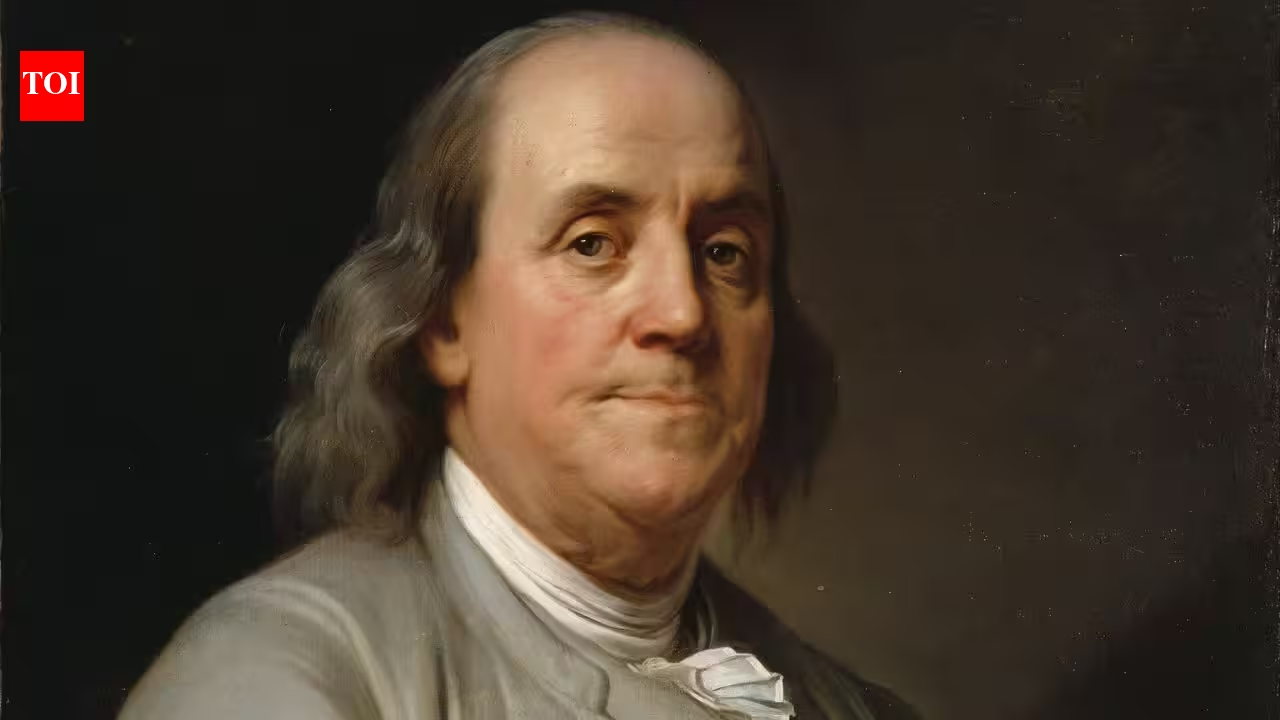
Two people can spend a lifetime accumulating whatever they consider valuable and end up with completely different kinds of wealth to show for it. One collects money, property, and possessions, each one clearly priced, each one able to be counted. The other spends that same effort building something that resists being priced at all, and often turns out to be worth more precisely because it can’t be. Benjamin Franklin, printer, inventor, diplomat, and one of the American founders, laid out that hierarchy directly in one of his almanacks. “What is more valuable than gold? Diamonds. Than diamonds? Virtue,” he wrote, building his own ladder of worth and placing something unpurchasable at the very top of it.
Quote of the day by Benjamin Franklin
“What is more valuable than gold? Diamonds. Than diamonds? Virtue.”
What Benjamin Franklin actually meant
He was not dismissing the value of money or material success, both of which he pursued and achieved substantially over his own lifetime. His point was narrower and more deliberate than that. Franklin built his short saying like a ladder, each rung more valuable and, not coincidentally, more scarce than the one below it. Gold is valuable, but diamonds are rarer still, and virtue, in his ranking, sits above even that, precisely because it cannot be mined, purchased, or inherited the way the other two can.Two people can rank their own priorities differently and end up building very different lives, because one treats wealth as the top of the ladder, the thing everything else is ultimately in service of, while the other treats it as somewhere in the middle, useful but subordinate to something considered more fundamentally valuable. Franklin was not arguing that gold and diamonds were worthless. He was making the more specific claim that scarcity and unpurchasability, not mere market price, determine what actually belongs at the top.
Written by a printer who turned character into a career
What gives this line extra weight is that Franklin wrote it inside Poor Richard’s Almanack, the annual publication he produced under a pen name starting in 1732, which combined practical almanack information, weather, planting schedules, with a running stream of proverbs and observations about thrift, industry, and personal conduct. The almanack became enormously popular throughout the American colonies, and the character and self-discipline it preached were not separable, in Franklin’s own life, from the material success that followed.Franklin had risen from working as a printer’s apprentice with little formal education to becoming one of the most respected and successful men in colonial America, a path he attributed in his own later writings largely to a deliberate, lifelong project of self-improvement, including his famous personal list of thirteen virtues he tracked and worked on systematically for years. He went on to become a leading scientist, diplomat, and statesman, eventually helping negotiate the peace treaty that ended the American Revolutionary War. For Franklin, virtue was never presented as an abstract ideal disconnected from the concerns of an ambitious life. It was, in his own telling, the actual foundation the rest of his success had been built on.
Why this idea keeps coming back
The basic claim in this quote, that character and integrity hold value that material wealth cannot replace or substitute for, echoes across a long tradition of thought reaching back well before Franklin, from ancient Stoic writers who argued virtue was the only true good, to modern research on trust and reputation, which consistently finds that perceived integrity predicts long-term relationships and opportunities better than wealth or status alone.Franklin was restating, in the compact, quotable style of an almanack writer, something moral philosophers had argued for centuries and that social science would later study more formally. That overlap is a large part of why the line still gets quoted well outside colonial history. It is not describing a quaint eighteenth-century value. It is describing a ranking that keeps reasserting itself: material wealth can be lost, copied, or taken, while a reputation for genuine integrity, once built, tends to keep generating value on its own.
A simple way to actually use this idea in daily life
The useful move here is treating character as an asset actively worth building, the way Franklin treated his own list of virtues, rather than as a fixed trait a person either has or doesn’t.A fair test is to ask, when weighing a shortcut that would gain something material at the cost of trust or integrity, whether the trade actually favours the more valuable thing on Franklin’s ladder. That question won’t make every difficult decision easy. It usually clarifies which of the two things actually being traded is harder to replace.
Other famous quotes by Benjamin Franklin
- “An investment in knowledge pays the best interest.”
- “By failing to prepare, you are preparing to fail.”
- “Well done is better than well said.”