







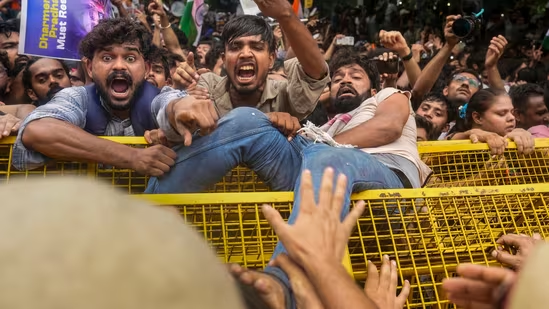
The “cockroaches” have left Jantar Mantar after the resignation of Dharmendra Pradhan, the education minister. Their successful movement brought back memories of vintage Indian youth politics where students weren’t mere voters but also the first line of resistance against injustice and oppression. These youngsters have shown that they aren’t a crowd but a wave that has the capacity to bring about huge change.
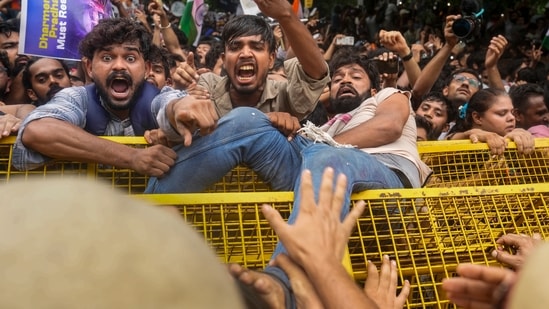
What’s the permanent solution to the pressing issue riling the youth? There are no easy answers. The problem is buried under impenetrable layers of difficulties.
“It was the beginning of summer in 1975…”
Let me take you five decades earlier to make my point clearer. It was the beginning of summer in 1975. I reached the examination centre at an Inter College in Mainpuri, Uttar Pradesh, to appear for the Class X board exams. I saw about a dozen boys trying to break bricks into small pieces right outside the room where I was to give my examination. They stuffed their pant pockets with those broken brick pieces and entered the room. As soon as the question papers were distributed, they tied theirs to those brick pieces and threw these outside. After some time, the same pieces landed back in the college premises. The papers attached to them contained the answers to the question paper — an example of the mass copying “movement”.
Also read | Dharmendra Pradhan resigns as education minister amid massive paper leak protests
Students, teachers, administration, parents and anti-social elements were all involved in it. In the absence of modern communication tools, those who wanted to cheat and their facilitators had to work very hard. Some years later, the emergence of photostat machines made such operations easier. The paper would leak at one centre and quickly spread across the city. Organised leak rackets trace their roots here.
With technological development, leaks became year round business, without needing brick pieces. Any corrupt teacher, education board officer or anyone in the system could leak question papers around the state within minutes. The cheaters also got help from question “solvers” across the country. Operators of colleges that had mushroomed away from the district headquarters started minting money, deepening the roots of the copying mafia.
Also read | Dharmendra Pradhan and Yvette Berry: Two education ministers, two contrasting resignations in two days
Internet, social media and messaging apps gave wings to this mafia. Many education boards, universities and commissions started organising exams. The new communication mediums had been expected to help increase the secrecy and integrity of the exam process. But corrupt operators turned it into a money spinning game. The poor can’t afford the “luxury” of such cheating. This is the reason the demonstration in Delhi spread throughout the country. The use of force against demonstrators and the sit-in by Opposition leaders made international media headlines.
The government was not oblivious to the issue. Allegations of mishandling of marking surfaced after the NEET re-test but the papers didn’t leak this time. Prime Minister Narendra Modi declared that the leak culprits will be quickly punished as per the law and fast track courts will be constituted for it. He promised to toughen laws, and the next day the Cabinet cleared a draft bill. Meanwhile, Sonam Wangchuk ended his fast. He dropped his demand for the education minister’s resignation. The demonstrators and the Opposition remained adamant. As a result, Parliament proceedings stalled for a week and the atmosphere at Jantar Mantar remained volatile.
Also read | ‘Resigned to stop anti-national forces’: Dharmendra Pradhan’s reason for resignation as education minister
On Saturday, Dharmendra Pradhan resigned. But the question is since when has a minister’s resignation dealt with the root of the problem?
Lal Bahadur Shastri’s resignation
In November 1956, a terrible rail accident happened in Tamil Nadu’s Ariyalur. A visibly upset railway minister Lal Bahadur Shastri resigned on moral grounds. He became a paragon of morality but did it help in stopping railway accidents?
Data tells us that between 1960 and 2019, the Railways recorded 38,500 accidents that killed thousands of people. It’s clear setting the system straight is more important than a minister’s resignation. The demonstrators should know that they have forcefully made their points in front of the government, politicians and the apex courts. Now is the time for long-term strategy. Removing ministers and punishing the accused don’t deter criminals from perpetrating crime.
Until the government and society work together, social ills can’t be eradicated. Paper leak and cheating is also a social ill. Those who make the question paper public and the cheating mafia may be criminals in the eyes of the government, but who uses their service? We will have to look inward for answers.
The Cockroach Janata Party, which started as a joke and launched a movement, is leaving the rulers and society with a deeper question to mull over.
Shashi Shekhar is editor-in-chief, Hindustan. The views expressed are personal.