






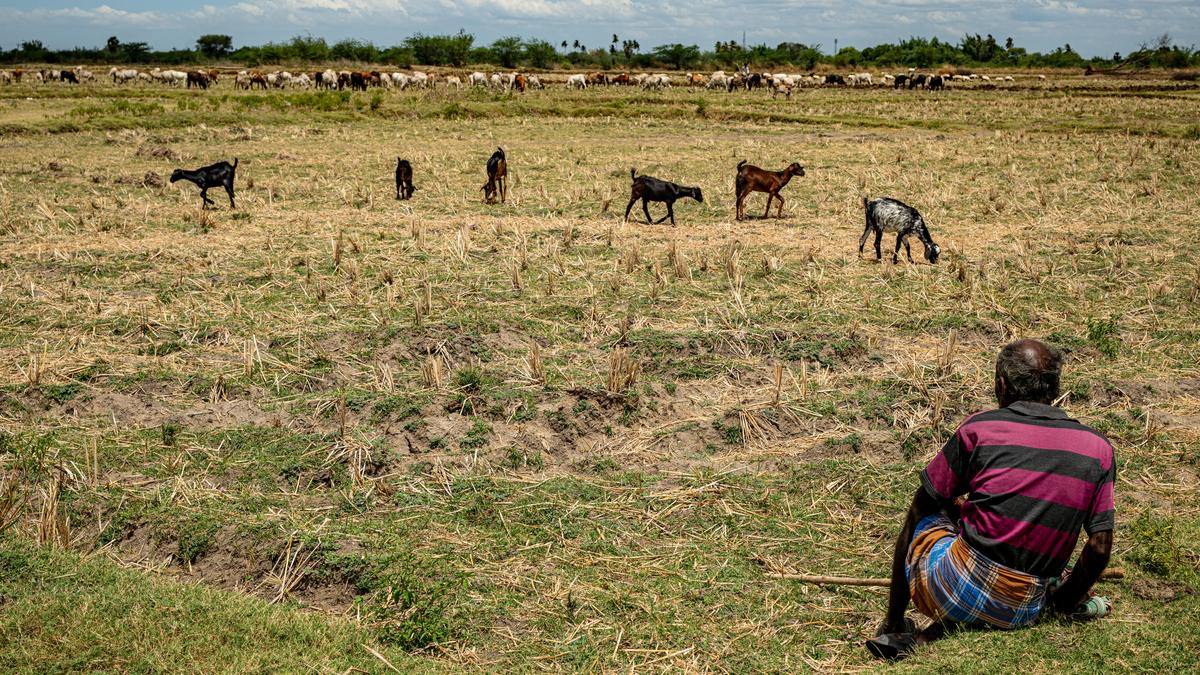
The hot winds sweeping across the ancient Kallanai, which should be brimming with water by now, are raising temperatures across the Cauvery delta this year. A weak southwest monsoon and the vexed inter-State river water sharing dispute with Karnataka have left farmers in the region in distress yet again.
As the Stanley Reservoir at Mettur could not be opened on the customary date of June 12 owing to insufficient storage, a majority of farmers in the delta, for whom the Cauvery is the lifeline, have not been able to cultivate paddy this kuruvai (kharif) season. With the Super El Nino effect looming large, farmers are worried about the prospects of the forthcoming samba crop too.
Over the past few months, the flow into the Mettur dam from Karnataka has been meagre. Tamil Nadu realised just 2.915 thousand million cubic feet (tmc ft) in the Cauvery from Karnataka in June, against the 9.19 tmc ft stipulated for the month by the Cauvery Water Disputes Tribunal and the Supreme Court.
Consequently, after a record coverage in 2025, when kuruvai paddy was raised on over six lakh acres against the normal area of about 4.4 lakh acres, agricultural fields across the delta, irrigated by a network of rivers and canals, are lying fallow. Announcing the kuruvai special package, the State government said the crop could be raised on about 3.55 lakh acres with groundwater. But farmers claim that only 1.5 lakh acres would be covered in the filter point areas in the core delta districts, largely in Thanjavur and Tiruvarur.
The kuruvai cultivation area in Thanjavur has come down to around 89,000 acres this season from around 1,94,000 acres in the previous cultivation year. In Tiruvarur, the coverage area has dwindled to around 64,000 acres from around 1,91,000 acres in 2025-26, say district officials.
A section of farmers who had raised the crop using groundwater is complaining about erratic three-phase power supply. Complaints of withering crops have been reported in a few places in the delta.
Cultivation with groundwater
R. Arivazhagan, a farmer of Olaidevarayanpettai in Thanjavur district, has raised kuruvai paddy on six acres with groundwater. He explains the issues in cultivation with groundwater. Though he has raised the crop, many of his fellow villagers are not able to do so owing to the depletion in the groundwater table as the rivers are dry. “My neighbour is drilling a fresh borewell and the yield from my borewell is going down too. There are disruptions in three-phase power supply owing to voltage drops and other issues. I am not sure whether I will be able to see through my 25-day-old crop over the next three months,” he says.
Several farmers who had taken up summer ploughing in anticipation of water release from the Mettur dam have burnt their fingers. “Many of us had taken up summer ploughing twice by spending at least ₹1,500 an acre each time, expecting water discharge by mid-June. But we could not go in for the kuruvai crop and our lands are lying fallow. Farm labourers have been rendered jobless. The entire rural economy has been badly affected,” says R. Pandidurai, a farmer of Seelathanallur in Tiruvarur.

The riverbed downstream of the Grand Anaicut lies exposed as poor flow in the Cauvery leaves the centuries-old barrage with no water.
| Photo Credit:
R. Vengadesh
Farmers demand that the entire State, especially the delta districts, be declared drought-hit so that they can avail themselves of relief, including compensation under the ‘prevented sowing/planting risk’ (due to adverse weather) clause of the Prime Minister’s Crop Insurance Scheme. “We had kept the fields ready after ploughing, but there was no flow in the Cauvery. Farmers in Nagapattinam district have been hit as we don’t have too many borewells, except in the Thirumarugal area. We hope we will get some compensation under the crop insurance scheme,” says Karunainathan of Vedaranyam.
Mahadhanapuram Rajaram, a veteran farmers’ leader and president of the Cauvery Irrigation Farmers Welfare Association, says, “We estimate that the delta farmers stand to lose about ₹1,125 crore as they have not been able to raise kuruvai crop. It would also trigger fodder shortage in the coming months. If the samba or thaladi crops too were affected by drought or rain at harvest stages, the financial burden on the State would be heavier.”
“We could face a production loss of up to 15 lakh tonnes of paddy this season. More importantly, the loss of the crop could lead to migration of farm labourers as they look for other sources of income,” says Cauvery Dhanapalan, president, Tamil Nadu Vivasaya Sangankalin Kootuiyakkam.
“The inflow and the storage at Mettur are still not encouraging. We doubt whether the government will manage to get water from Karnataka. The prediction of a weak monsoon due to the El Nino effect has cast a shadow over the samba crop too,” Mr. Pandidurai says. The dam had just 38 tmc ft of water against its capacity of 93.47 tmc ft, and the inflow was hovering at 125 cusecs last week. The dam, which was at its full capacity during the same time last year, needs substantial inflows in the coming weeks for the government to decide on water discharge for the samba season.
P.R. Pandian of the Coordination Committee of All Farmers Associations of Tamil Nadu says the lack of Cauvery water has endangered the livelihood of farmers in the delta this year. “The southwest monsoon has been scanty, and is going to end soon. It has been predicted that the State may get less than normal rainfall during the northeast monsoon too. We may go in for the samba crop with direct sowing, pinning our hopes on the monsoon. But the question is whether we will be able to protect the crop through the season. Unless the monsoon comes to our aid, we have a very precarious situation,” he says. “Only if water is released from the Mettur dam by August can farmers safely raise long-duration varieties during the samba season. If the water release is delayed further, they can only go in for medium or short-term varieties,” says Mr. Dhanapalan.
‘Declare delta as drought-hit’
Mr. Pandian says it is time the government declared the delta ‘drought-hit’ and started rolling out relief measures. “It should provide drought relief as was done by the Jayalalithaa government some years ago. The government should provide ₹15,000 an acre as relief for the kuruvai loss,” he says, adding that the government should also support farmers raising the samba crop using groundwater by providing seeds and diesel at subsidised rates.
Farmers organisations say the kuruvai special package, announced by the government, has not been of much help. “Though the government had said farmers would be given the support for two acres, officials here say we will get it only for one acre each as there have been a number of applications. The application process is cumbersome, and we are required to submit several documents such as bills for machine planting, photos of farmers in the field, besides the land records. We have to spend considerable time and effort in submitting these papers for a meagre financial support,” Mr. Arivazhagan says, calling for simplifying the application process.
“The special package is inadequate to meet the requirements of farmers. Since there has been a large number of applications, the allocation should be increased,” says Swamimalai Vimalnathan, secretary, Tamil Nadu Cauvery Farmers Protection Association.
He wants the government to come up with a special samba package too as farmers who were not able to raise the kuruvai crop will plant samba, pinning their hopes on a good monsoon. He suggests that as a special case, the government provide free farm connections to those who have been waiting for long so that more farmers can take up cultivation using groundwater.

The Grand Anaicut Canal lies dry as inadequate flow in the Cauvery delays water release for irrigation in the delta region.
| Photo Credit:
R. Vengadesh
Delta farmers also take a critical view of Food Minister P. Venkataramanan’s reported suggestion that farmers go in for alternative crops in view of the water shortage. “Before making such suggestions, the government should carry out a proper study and identify crops which are suitable for the different soil conditions in the delta region. Such crops should also be able to withstand the monsoon. But there seems to be no plan or effort in this direction,” says Mr. Vimalnathan.
“Karnataka has been releasing only the surplus water and does not agree to the distress-sharing formula. We have not even got half of June’s quota of water and there is no guarantee that Karnataka will release our share in July or August. Tamil Nadu should sanction relief to the farmers and can mobilise funds by claiming compensation from Karnataka for the crop losses,” says V. Jeevakumar, a farmers leader of Budalur.
Running from pillar to post
D. Abraham of Kanarpatti in Tirunelveli district had sold over 7.50 tonnes of paddy to the National Cooperative Consumers’ Federation of India nine months ago. But he is still running from pillar to post to get his payment of ₹1.86 lakh. His family expenses forced him to not only pledge his jewels but also to pay interest for them till date.
The plight of Mr. Abraham, who is the district secretary of the Coordination Committee of Tamil Nadu All Farmers’ Associations, is not unique. The Tamilaga Vettri Kazhagam government’s announcement on waiver of cooperative crop loans came as a jolt to the farmers who pointed to the gap between what the TVK had promised before the election and what it announced after coming to power.
The TVK manifesto had promised a complete loan waiver for small and marginal farmers who own up to 5 acres of land and a 50% waiver for the others. On May 25 this year, the government announced that only loans of up to ₹50,000 would be waived fully for marginal farmers. For loans exceeding ₹50,000, the waiver ranged between ₹5,000 and ₹40,000.
Effectively, a marginal farmer with a loan of over ₹1 lakh would get only ₹5,000 as relief. It was worse for small farmers as only 50% of loans up to ₹50,000 were waived. For the rest, the waiver ranged from ₹5,000 to ₹20,000. This triggered massive protests by farmers across the State.
‘Let down by the TVK government’
“While the poll promise of the TVK spoke only about total loan waiver for all farmers based on their land holdings, the government introduced ceilings. Farmers had voted for the TVK based on its promises, but we feel let down,” says R. Rampandian, of Aruppukottai, a functionary of Southern District Farmers’ Association.
The government blamed the Reserve Bank of India’s Model Operating Procedure, which mandates that States implementing loan waivers must settle the entire amount to co-operative banks within 45 to 60 days. It also blamed the State’s finances.
With all major political parties, including the DMK, the AIADMK, and the BJP, backing the farmers, they vowed to continue their protest till the ruling TVK implemented its poll promise. The government responded by announcing a revised loan waiver scheme on June 16.
It promised total waiver of loans up to ₹75,000 for all farmers irrespective of land holdings. For loans above ₹75,000, the waiver was restricted to ₹35,000 per farmer. But the farmers remain dissatisfied and their protests continue.
Maharashtra model
The Maharashtra government’s announcement that a complete waiver of farm loans up to ₹2 lakh would be sanctioned has further fuelled anger among farmers. “Won’t the RBI norms apply to Maharashtra? Why cannot Tamil Nadu follow suit,” asked N.A. Ramachandra Raja of Tamilaga Vivasayigal Sangam. Of the 600 farmers who had borrowed from the Singarajakottai Primary Agricultural Cooperative Society in Rajapalayam, only 170 will benefit from the waiver, he said.
Why do farmers demand loan waivers? They complain that their occupation has become a gamble amid the adverse impact of climate change. “Each year, several farmers part with their farmland unable to handle the crop loss they face. The government needs to incentivise grain production,” Mr. Ramachandra Raja says.
The farmers point out that farmers in Maharashtra, Telangana, and Andhra Pradesh are being given ₹6,000 to ₹10,000 as incentive to sustain food production. While a farmer sells one quintal of paddy for ₹2,450, he buys a 50-kg bag of complex fertilizer for ₹2,100, Mr. Ramachandra Raja points out.
Mr. Abraham adds, “If the farmer wants to increase the yield, he has to apply potash, costing ₹2,400 [50-kg bag]. And the cost of pesticides has also skyrocketed.”
In addition, the farmers face shortage of workers during peak farming season as the workers prefer MGNREGS work.
“Even after we undergo all these hardships to raise the paddy, the government is in no mood to give us a fair remuneration. In a situation where the farmers cannot fix the price of their produce, we have no other option but to demand crop loan waiver to sustain farming,” he says.
The Swaminathan Committee had recommended that the Minimum Support Price for crops should at least be 50% more than the comprehensive cost of production. “If its recommendation is implemented, we would not need crop loan waiver or fertilizer subsidy. It is now the bounden duty of the government to provide crop loan waiver,” says Mr. Perumbadaiyar of Tamil Nadu Vivasayigal Sangam in Tirunelveli.
(With inputs from V. Venkatasubramanian in Thanjavur, S. Sundar in Madurai, and P. Sudhakar in Tirunelveli)