





Last Updated:
Traditionally, TMC heavyweights have held the reins of the most prestigious ‘Barowari’ (community) Pujas




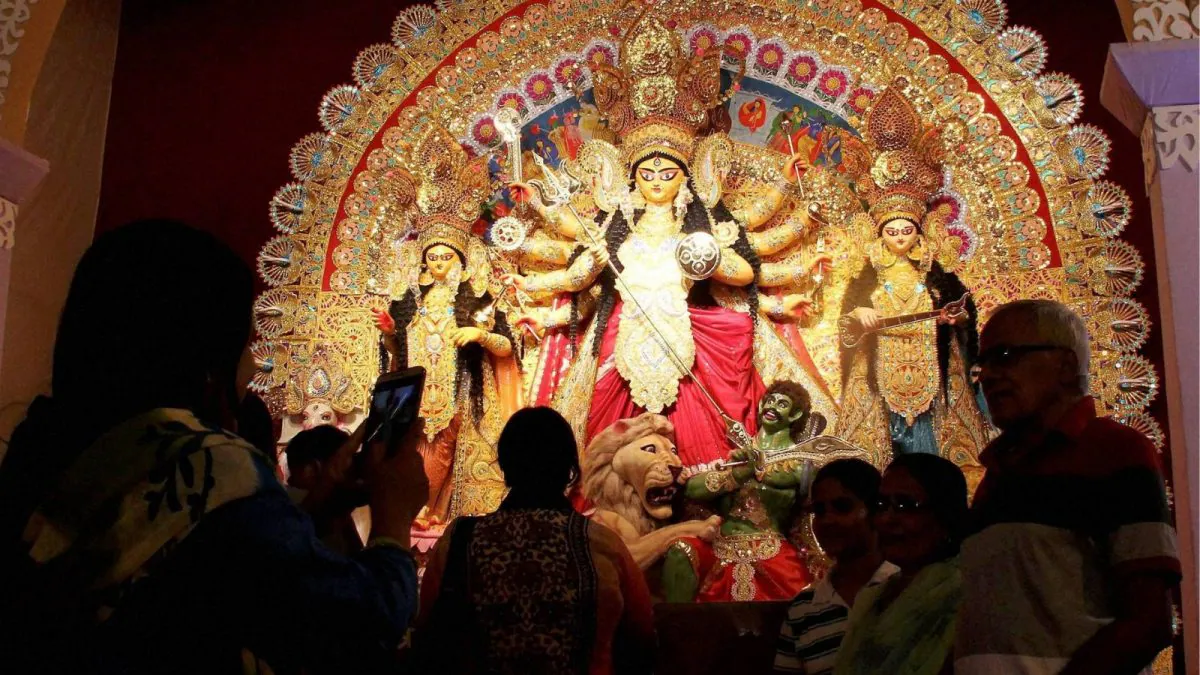
Despite the high-decibel political transformation, Durga Puja remains the single most unifying force in Bengal. (Representational photo)
With the 2026 assembly election results in West Bengal marking a historic metamorphosis for the state’s political map, the immediate ripple effects are expected to extend far beyond the ballot box and into the very heart of Bengali cultural identity: Durga Puja. As the Bharatiya Janata Party (BJP) emerges as the top contender for power, challenging the long-standing “blue and white” aesthetic of the Trinamool Congress (TMC), the management and patronage of the state’s largest festival are set for an unprecedented shift. For decades, Puja committees have served as the grassroots engines of political influence, and with many organisers traditionally aligned with the TMC, the 2026 mandate introduces a new era of “saffronisation” that could redefine the festival’s administrative and symbolic landscape.
Will the shift in power alter the patronage of major Puja committees?
Durga Puja in West Bengal has never been a purely religious affair; it is a massive socio-political theatre where local clubs and committees act as power brokers for the ruling regime. Traditionally, TMC heavyweights have held the reins of the most prestigious “Barowari” (community) Pujas, using these platforms to showcase development work and maintain a direct link with the electorate. However, the BJP’s massive surge in the 2026 polls suggests that the saffron party is now in a position to challenge this monopoly on cultural patronage. As the political soul of the state shifts, many committee members—frequently adept at sensing the direction of the political wind—may begin to distance themselves from a weakened TMC hierarchy, leading to a visible change in the political branding of the marquees.
How might the visual and symbolic themes of the marquees evolve?
The visual language of Durga Puja has always reflected the prevailing political mood, with themes often echoing the slogans and colours of the ruling party. Under the TMC, the “blue and white” colour palette and government-sponsored schemes like “Lakshmir Bhandar” often found their way into marquee designs. Following the 2026 results, there is a strong likelihood of a symbolic transition toward more nationalist and “saffron” themes, aligned with the Prime Minister’s “Viksit Bharat” vision and the BJP’s narrative of total systemic change. We may see a shift from provincial populist motifs to themes highlighting India’s rising global stature, a central pillar of the BJP’s successful 2026 campaign.
What administrative challenges do TMC-aligned organisers face?
For organisers traditionally aligned with the TMC, the 2026 results pose significant administrative and financial hurdles. The state government’s direct grants to Puja committees—a hallmark of the TMC’s cultural outreach—may face intense scrutiny or restructuring as the BJP increases its influence over state mechanisms and municipal bodies. Furthermore, the corporate sponsorships that fuel the multi-crore Puja industry are highly sensitive to political stability. Brands that previously aligned themselves with TMC-backed committees may now diversify their portfolios toward committees showing saffron leanings to stay in the good graces of the rising political power. This could lead to a redistribution of wealth within the festival economy, favouring clubs that embrace the new “Double Engine” narrative.
Can the festival remain a unifying force amid political polarisation?
Despite the high-decibel political transformation, Durga Puja remains the single most unifying force in Bengal. While the 2026 results indicate a fragmented mandate and deep-seated political rivalry, the festival has a historical capacity to absorb and localise nationalistic shifts. The challenge for both the BJP and the TMC will be to navigate this cultural transition without alienating the “aspirational demographic” that is increasingly seeking modern infrastructure alongside traditional values. As the state moves towards the 2027 cycle, the 2026 Puja celebrations will serve as the first major public display of how the “saffron surge” intends to coexist with—or eventually replace—the legacy of the “blue and white” era.
Read More


