




Education is widely regarded as the foundation of social and economic development, but quality education cannot flourish without quality infrastructure. For decades, a large number of government primary and upper primary schools in Uttar Pradesh struggled with inadequate classrooms, broken boundary walls, lack of toilets, unsafe drinking water, poor sanitation, and minimal learning facilities. These deficiencies often discouraged parents from sending their children to government schools, resulting in low enrolment and high dropout rates.Over the last nine years, Uttar Pradesh has achieved remarkable progress in the education sector under the leadership of Chief Minister Yogi Adityanath. The state has focused on expanding access, improving infrastructure, enhancing quality through digital tools and teacher training, and promoting inclusivity, particularly for girls and underprivileged sections. Massive budgetary support, technology integration, and alignment with national initiatives like NEP 2020 and NIPUN Bharat have transformed education from primary to higher levels, yielding better enrollment, learning outcomes, and global recognition.The basic education scenario in Uttar Pradesh presents a fascinating blend of massive scale, substantial government funding, and aggressive digital monitoring. As India’s most populous state, managing basic education here is a mammoth task, currently looking after around over 15 million students in about 1.30 lakh Basic Shiksha Parishad run schools across the state.The Uttar Pradesh government has proposed a massive allocation of Rs 77,622 crore budgetary allocation for the basic education sector for the 2026-27 financial year, continuing its focus on strengthening primary and upper-primary school infrastructure across the state. The financial outlayspecifically targets several key educational initiatives such as Student Welfare, Model Schools, Residential Facilities , Teacher Support and Infrastructure Augmentation.Recognising that a conducive learning environment is essential for improving educational outcomes, the Uttar Pradesh government under Chief Minister Yogi Adityanath launched Operation Kayakalp in June 2018. Conceived as one of the country’s largest school infrastructure rejuvenation programmes, the initiative aimed to transform every government primary and upper primary school into a safe, child-friendly, inclusive, and attractive learning space through inter-departmental convergence.Operation Kayakalp has become a cornerstone of the state’s education reforms, complementing initiatives such as Mission Prerna, NIPUN Bharat, School Chalo Abhiyan, and digital education programmes.
The vision
The government’s approach was simple yet transformative: before improving learning outcomes, schools needed to become places where children would be happy to learn.Instead of relying solely on the education department, Operation Kayakalp adopted a convergence model, bringing together resources from:·Gram Panchayat funds·MNREGA·Jal Jeevan Mission·Urban Local Bodies·District Mineral Foundation funds·Corporate Social Responsibility (CSR) initiatives·Community participationThis integrated funding mechanism enabled infrastructure development on a scale that would have been difficult through education budgets alone.
Fab 19
Operation Kayakalp identified 19 essential infrastructure facilities that every government school should possess. These include:·Functional classrooms·Separate toilets for boys and girls·Divyang-friendly toilets·Safe drinking water·Running water supply·Handwashing stations·Electrification·Classroom furniture·Blackboards·Boundary walls·School gates·Kitchen sheds·Playground facilities·Tiled classrooms·Library space·Green campus·Child-friendly environment·Disability-friendly access·Clean and hygienic surroundingsBy standardising these infrastructure benchmarks, the programme ensured uniform development across urban and rural schools.
The transformation
Operation Kayakalp is among the largest school infrastructure programmes undertaken by any Indian state.According to the Uttar Pradesh government, approximatly 1.30 lakh government schools have been rejuvenated under the initiative through investments exceeding Rs11,000 crore. Infrastructure compliance reportedly improved from around 36–38% in 2017 to over 96% in recent years.Thousands of schools that once lacked even basic facilities now feature:·Bright classrooms·Colourful wall paintings·Functional toilets·Drinking water facilities·Smart classrooms·Digital learning aids·Libraries·Playgrounds·Child-friendly furnitureMany schools have also earned four-star and five-star ratings under the state’s quality assessment framework.
Technology + Transparency
One distinctive feature of Operation Kayakalp has been its emphasis on technology-based monitoring. The government introduced Geo-tagging of school infrastructure, Photo-based verification,Real-time monitoring through the Prerna portal, Online progress tracking,District-level dashboards and Three-tier monitoring mechanisms. These systems enabled officials to verify construction quality and monitor progress without relying solely on paper reports.
Child-friendly schools
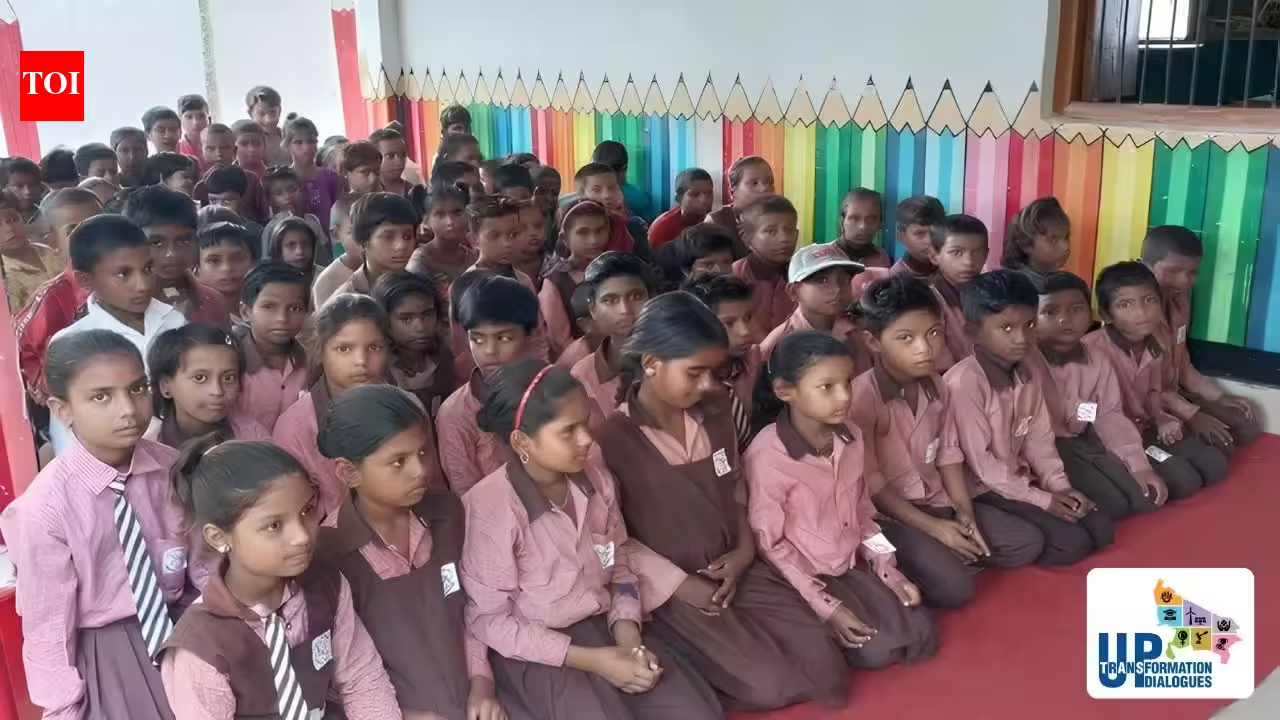
Beyond bricks and mortar, Operation Kayakalp focused on making schools welcoming for children.Many renovated schools now feature Colourful educational murals,Activity-based learning spaces,Bal Vatika sections,Reading corners,Sports facilities,Kitchen gardens,Green landscaping and Attractive entrance gates. The emphasis has been on creating an environment where children enjoy coming to school rather than viewing it as an obligation.
Inclusive education
A significant achievement of Operation Kayakalp has been its attention to accessibility.Schools now increasingly include Ramps,Accessible toilets,Barrier-free pathways and Child-friendly classroom layouts. These improvements help ensure that children with disabilities can participate more effectively in school life.
Hygiene and health
The COVID-19 pandemic highlighted the importance of hygiene in schools. Operation Kayakalp accelerated the creation of Multiple handwashing stations,Running water connections,Improved sanitation,Regular cleaning systems and Functional toilets. These facilities not only helped schools during the pandemic but continue to promote healthier learning environments.Integration with Mission PrernaOperation Kayakalp was never intended as a standalone infrastructure programme.It forms part of a broader educational strategy that includes:·Mission Prerna·NIPUN Bharat·Foundational Literacy and Numeracy initiatives·Teacher capacity building·Digital classrooms·Learning outcome assessmentsThe philosophy has been that better classrooms should support better teaching and learning outcomes rather than merely improving school buildings.
District-level examples
Several districts have showcased notable progress under Operation Kayakalp. Prayagraj has surveyed and reconstructed unsafe and dilapidated school buildings while ensuring that nearly all schools possess basic infrastructure. Shravasti and Balrampur, two aspirational districts historically associated with educational challenges, have achieved infrastructure saturation levels exceeding 90% under the programme. Across districts such as Lucknow, Gorakhpur, Varanasi, Kanpur, Bareilly, Agra, and Meerut, numerous government schools now feature smart classrooms, ICT laboratories, digital libraries, and improved learning spaces as part of the state’s wider education reforms.
Community participation
One of the strengths of Operation Kayakalp has been community involvement. Village heads, School Management Committees, teachers, district officials, engineers, and local residents have contributed to school development. Many villages have treated schools as community assets, encouraging maintenance, cleanliness drives, plantation campaigns, and infrastructure improvement beyond government funding. Environmental Improvements. Several schools have adopted environmentally friendly practices, including Plantation drives,Rainwater harvesting,Solar lighting in selected institutions, Waste management initiatives and Kitchen gardens. These additions provide practical environmental education while improving campus aesthetics.Infrastructure improvements have also influenced public perception of government schools. Parents who once preferred low-cost private schools due to better facilities have increasingly shown confidence in nearby government schools. The government attributes rising enrolment under the School Chalo Abhiyan partly to the improved physical condition of schools.These measures have also positively impacted teachers. Teachers now work in significantly improved environments. Availability of furniture, electricity, digital tools, and better classrooms enables teachers to conduct activity-based learning more effectively. Teacher morale has also improved in many schools following infrastructure upgrades. Operation Kayakalp has attracted attention as a large-scale model of school transformation through convergence of multiple government schemes. The approach has been highlighted in education policy discussions for demonstrating how coordinated funding and monitoring can rapidly improve school infrastructure. Over the last nine years, Operation Kayakalp has emerged as one of Uttar Pradesh’s most ambitious school infrastructure initiatives. From schools lacking toilets, drinking water, and boundary walls to campuses equipped with smart classrooms, libraries, digital facilities, child-friendly spaces, and improved sanitation, the programme has significantly altered the physical landscape of government education.The initiative demonstrates how convergence among multiple departments, technology-driven monitoring, and community participation can transform public institutions at scale. When combined with Mission Prerna, NIPUN Bharat, School Chalo Abhiyan, Bal Vatika, digital education initiatives, and teacher training reforms, Operation Kayakalp represents a broader effort to strengthen foundational education across Uttar Pradesh.As the state continues to modernise its education system, the experience of Operation Kayakalp offers valuable lessons on how infrastructure, governance, technology, and community engagement can work together to create schools that are safer, more inclusive, and better equipped to nurture the aspirations of millions of children.