










Last Updated:
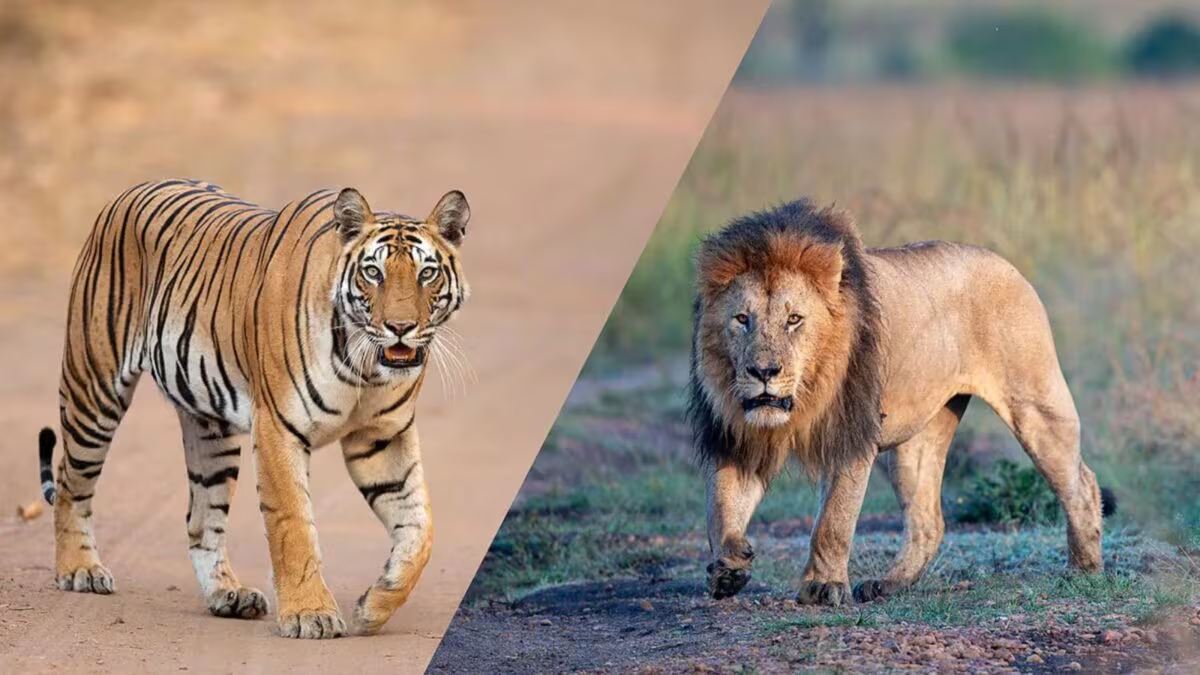
From the dry forests of Gujarat to the jungles of Central India, the country remains the last shared home of two of the world’s most iconic big cats.




News18
There are countries with lions. There are countries with tigers. But only one country on Earth still has both living in the wild naturally: India.
It is a distinction few people realise, especially because the two animals are usually associated with completely different continents and landscapes. Lions are often linked to Africa’s savannahs, while tigers are associated with Asian jungles and rainforests.
Yet India remains the only place where both species continue surviving in free-ranging natural habitats, according to the International Union for Conservation of Nature (IUCN).
The lions belong to a rare subspecies known as the Asiatic lion, found almost entirely inside and around Gujarat’s Gir Forest National Park. According to the Gujarat Forest Department and wildlife conservation reports, the Asiatic lion population fell to dangerously low numbers by the late 19th century after extensive hunting during colonial rule and princely-era sport hunting.
At one point, experts believe barely a few dozen lions remained alive.
The species survived largely because the Nawab of Junagadh imposed hunting restrictions in the Gir region after realising the population was nearing extinction. Over time, conservation efforts by the Indian government and forest authorities gradually stabilised the population.
According to the most recent Gujarat lion census released in 2020, the Asiatic lion population crossed 670 animals spread across Gir and surrounding landscapes.
That recovery is now considered one of India’s major wildlife conservation successes.
The tiger story unfolded differently.
India’s Bengal tiger population once stretched across huge parts of the subcontinent, but hunting, deforestation and habitat destruction caused steep declines during the 20th century. By the early 1970s, tiger numbers had fallen so sharply that the government launched Project Tiger in 1973 under Prime Minister Indira Gandhi.
According to the National Tiger Conservation Authority, India today holds roughly 75 percent of the world’s wild tiger population. Tigers survive across multiple reserves and forests stretching through Madhya Pradesh, Karnataka, Uttarakhand, Maharashtra, Assam and West Bengal among other states.
Unlike Gir’s lions, which are concentrated mainly in one region, India’s tigers occupy a much larger and more varied landscape.
What makes the coexistence remarkable is how different the two species are ecologically.
Asiatic lions live in relatively open dry deciduous forests and scrublands and often move in social groups called prides. Bengal tigers, meanwhile, are largely solitary hunters adapted to dense forests, grasslands, mangroves and riverine habitats.
The two predators rarely overlap geographically in modern India because their habitats differ significantly.
Yet historically, both species once occupied much larger territories across Asia.
Lions ranged from the Mediterranean and Middle East into northern India, while tigers spread across huge parts of Asia from eastern Turkey to Russia and Southeast Asia. Over centuries, hunting and habitat loss erased most of those populations.
Today, India remains the last surviving overlap point of that ancient range.
The distinction has also become symbolically important for Indian conservation.
Gir represents one of the world’s last successful recoveries of an endangered lion population outside Africa. India’s tiger reserves, meanwhile, have become globally important because so much of the species’ remaining wild population now depends on Indian forests.
And perhaps that is what makes the country’s wildlife story so unusual.
In one nation, two of the world’s most legendary predators — animals once spread across continents — still survive in the wild against odds that once seemed almost impossible.
About the Author

A team of writers at News18.com bring you stories on what’s creating the buzz on the Internet while exploring science, cricket, tech, gender, Bollywood, and culture.
Read More