











HYDERABAD: Despite being home to one of India’s largest food and restaurant industries, with an annual turnover exceeding ₹10,000 crore and a reputation as a culinary destination, Hyderabad ranks lowest among metro cities in the adoption of food hygiene ratings.According to data from the Food Safety and Standards Authority of India, only 361 eateries in the city have obtained hygiene ratings. This accounts for less than 2% of the licensed food establishments.Hyderabad has 25,000 licensed eateries, while the total number of outlets is around 75,000.In comparison, several major cities have recorded higher adoption of the hygiene rating system. Bengaluru, often regarded as Hyderabad’s closest competitor in the food sector has 2,200 eateries with hygiene ratings.Delhi leads the country with 3,394 food establishments certified under the hygiene rating programme. Even smaller metro cities such as Ahmedabad and Jaipur have reported much higher adoption levels.
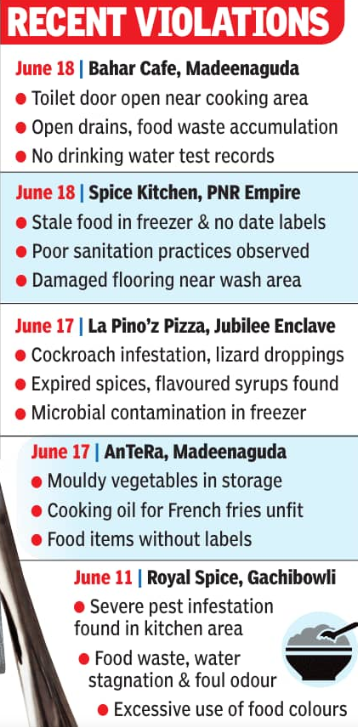
Recent violations
Reluctance among hoteliers
Food safety officials attribute Hyderabad’s poor performance to a lack of interest among hoteliers. Since obtaining a hygiene rating is not mandatory, most of them have not opted.“During our inspections, we encourage hotel owners to obtain hygiene ratings. While the response has been limited, we have intensified Food Safety Training and Certification programmes to strengthen hygiene practices and improve overall food safety,” said a senior official from the food safety wing of the GHMC.The hygiene rating programme, introduced by the FSSAI, evaluates food establishments on parameters such as cleanliness, food handling practices, storage conditions and overall compliance with food safety standards.Establishments meeting the prescribed benchmarks are awarded ratings ranging from one to five stars, which can be displayed for public information.Officials believe wider adoption could improve food safety standards and enhance consumer confidence. However, in the absence of a mandatory requirement, the initiative has failed to gain traction among operators.Although the National Restaurant Association of India, in collaboration with the commissioner of food safety, announced in 2024 that it would promote hygiene ratings, raise awareness about food safety protocols and conduct hygiene audits, the effort failed to gather pace.“We have recently recommended to the GHMC commissioner the formation of area-wise monitoring committees comprising representatives from the NRAI, food safety officials and members of the public. These committees can visit eateries that have not obtained hygiene ratings and identify establishments that are failing to maintain hygiene standards,” said T Sampat, an NRAI member, adding that the govt should consider measures to protect consumers from unsafe food.
TIMES VIEW:
City’s food reputation cannot rest on taste alone; it must be backed by hygiene. Hyderabad, once recognised by UNESCO as a ‘City of Gastronomy’, risks eroding its culinary brand if hygiene compliance continues to lag.Food safety cannot remain optional. Diners deserve transparency, and eateries must treat hygiene ratings as a competitive advantage, not a burden.With sanitation concerns persisting in some outlets, mandatory hygiene ratings should be considered.