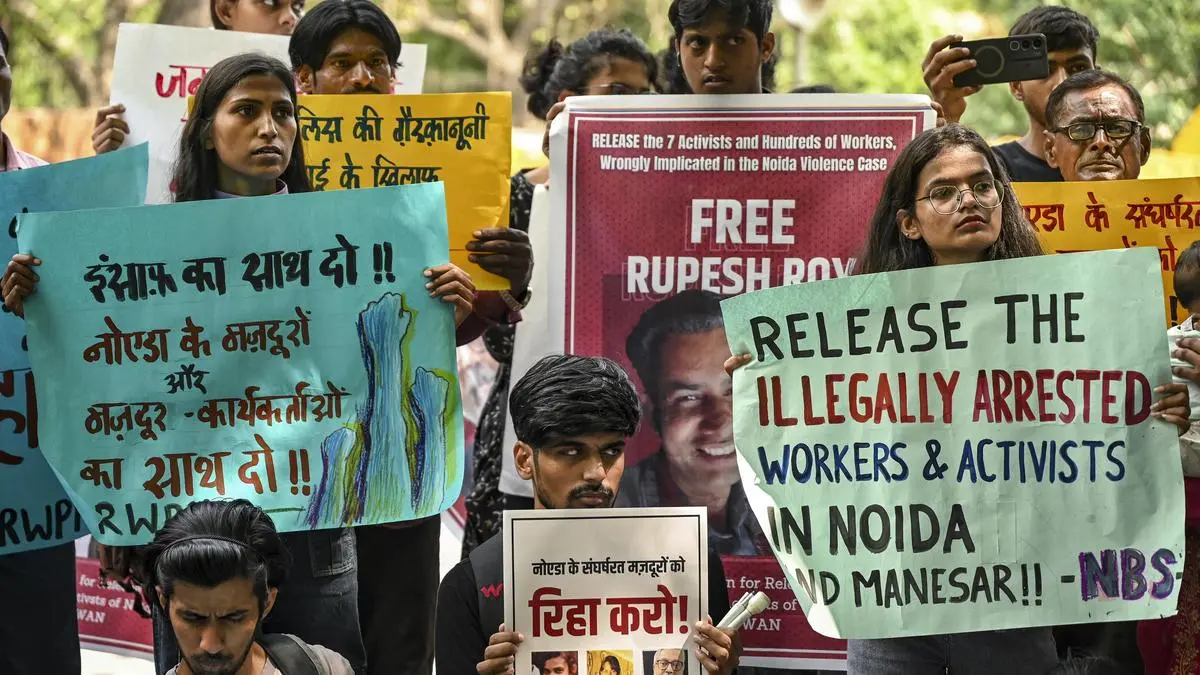
Surender Kumar, a landless peasant from Bahraich in Uttar Pradesh, has not seen his 19-year-old son, Alok, ever since the boy was picked up by the police and bundled off to a jail in GautamBudhha Nagar district three months ago.
Alok was one of several hundred people who were arrested during the labour unrest in the State in mid-April, and for days together, their families did not know where they were. Surender Kumar said: “Alok is a student. He had gone to get some food with two of his friends. The police picked them up and accused them of being involved in the workers’ protest. He had nothing to do with it. He got bail from a lower court but is still inside as there are other cases slapped against him. Now we are waiting for his bail from the Allahabad High Court.”
It took four days for Alok’s family to find out that he had been arrested. Surender Kumar said: “Some boys from the village informed me, but I could not contact my son. The police took away his phone. They shifted him to Luksar jail in Kasna, which is not easy for me to access. I am a daily wager. It has been a big struggle for me, raising money for his bail and visiting him in jail. I am worried about his future. He won’t get any government job now.”
Not an isolated case
Alok’s is not an isolated case. Around 1,200 people were rounded up on April 13 in Noida when the police baton-charged workers of Motherson, a multinational automotive manufacturer and supplier, who had hit the streets. Tear gas was used to disperse the crowd. The prosecution’s case is that some 100-150 workers, armed with deadly intent and weapons, had blocked roads, vandalised vehicles, and threatened factory owners and co-workers.
But the workers deny the allegations. They claim that the protest action had followed four days of peaceful demonstration outside the factory gates and on service roads on April 9, 10, 11, and 12. They allege that the arrests were random: along with protesting workers, passers-by, pushcart vendors, and students were reportedly arrested. At least two people, one of them a woman, was booked under the draconian National Security Act (NSA).
The management of Motherson, the district administration, and the labour department had all failed to respond to the protests demanding wage revision that led up to the April 13 fiasco. Haryana, which borders Uttar Pradesh, has implemented a new wage structure. In Delhi, too, minimum wages for skilled, semi-skilled, and unskilled labour are higher than in adjoining industrial areas of Uttar Pradesh.
The implementation of the four Labour Codes and government propaganda promising that these would be beneficial for the working class had also raised expectations of better incomes.
Also Read | What Noida’s worker strikes tell us about the Labour Codes’ broken promise
For almost a month after the incident, the police were stationed outside the factory gates and inside guardrooms to intimidate workers, the workers alleged. Mukesh Kumar, district president, Centre of Indian Trade Unions, told Frontline: “It was an issue concerning labour rights. The administration converted it into a law and order one.”
The police baton-charging protesters demanding a salary hike, in Noida on April 13.
| Photo Credit:
PTI
Multiple FIRs were filed against eight activists who were arrested. Manik Gupta, an advocate who is representing some of the workers, including the seven alleged “masterminds” of the protest, spoke of the challenges he faced because of the multiple FIRs. “Someone who earns Rs.11,000 a month cannot even afford representation. The alleged ‘masterminds’ have 10 FIRs against each of them, which means I have to file 70 bail applications. The litigation cost goes up,” he said. “The court is acting like a post office, not really applying its mind and accepting whatever the police are claiming. I was able to secure bail for a juvenile who stayed in an adult jail for two months. This is the tragedy we are dealing with. We got the ossification test done at a government hospital and got the Chief Medical Officer to certify it. He was found to be around 16 years old.”
Speaking of the police claim that the NSA (which has provisions for preventive detention without bail) was invoked against a woman because she was likely to get bail, Gupta pointed out that this was a flawed argument because a person cannot be kept in detention on the grounds that she may obtain bail. He said that he had submitted an application to the State government seeking to represent her, but nothing had come of it yet. “The preventive detention will be illegal if she is denied representation,” he said.
The writer Satyam Verma was the other person booked under the NSA. He was picked up from a Lucknow bookshop. Gupta said there was no evidence against him.
When the process becomes the punishment
“When 10 FIRs are filed and the NSA is invoked against ordinary people, the process itself becomes the punishment. It is a message to workers not to raise their voice. That is why they have been arresting children and people who had nothing to do with the protest. Some of those arrested are members of Mazdoor Bigul [an organisation that champions labour issues]. It is our contention that the police themselves instigated the violence. This is our case in the Supreme Court. It has to be investigated now whether the police instigated it or not,” Gupta said.
In a few cases, bail was granted by the Allahabad High Court. GeetaPandey, for instance, was granted bail by the court on June 5 after spending one and a half months in custody. She had been booked under at least 14 sections: Sections 191 (2), 115(2), 121(1), 127(2), 324(4), 124(4), 61(2), 191(3), 125, 132, 195 (2), 285 of the Bharatiya Nyaya Sanhita (BNS); Section 3/4 of the Prevention of Damages to Public Property Act; and Section 7 of the Criminal Law (Amendment) Act.
Her counsel argued that she was not present at the protest site, had no criminal history, and was falsely implicated. The court, which refrained from expressing any opinion on the merits of the case, said it was a “fit case for bail”. Some of those who got arrested were accused of being part of certain WhatsApp and other social media groups.
Random arrests and the harassment that followed
On June 15, the Allahabad High Court granted conditional bail to Shivani, a domestic worker who was booked under nine sections of the BNS after her arrest on April 13. Her arrest and detention are an example of the random nature of the police action.
Golu Kumar and Amit Kumar, who are not Motherson employees, were also arrested. Their counsel argued that neither of them had anything to do with the incidents of April 13: there were no independent witnesses or any CCTV footage or video recordings to show that they were part of the protest. One of them was picked up on May 11 when he was on his way home. His name was apparently added to an FIR that did not originally include it and had anyway been registered after a significant delay. The two of them were granted bail after furnishing sureties and a personal bond.
Police deployment outside Noida’s Motherson facility on April 14, the day after a protest by workers was met with a lathicharge and arrests by the police.
| Photo Credit:
PTI
Guddu, 22, a former employee of the Motherson unit, said that from April 9 to April 12 the protests were peaceful. When the police arrived at the gates of the unit, a letter listing the demands was handed over to a senior officer, who promised to mediate with the management, but no such mediation materialised.
Guddu is not sure how the protest turned violent on April 13. He had gone home for lunch and was not present when the lathicharge took place. When he returned to the factory gate, he was booked and finally released on bail by a lower court on May 19. Now he is jobless, as are close to a hundred others like him who were laid off by the company. “In 95 per cent of the arrests, there is no evidence of wrongdoing. The police are manufacturing evidence. In Kasna jail, workers were crying as many did not want their families to know they had been arrested. Many lost their jobs, and no one wants to re-employ them now,” he said..
A platform called the “Campaign for the release of workers and activists of Noida” has been trying to highlight the excesses of the police crackdown. It claims there is evidence to show that a sub-inspector and another person who works as a police officer’s driver wormed their way into the WhatsApp group of some factory workers and posted inflammatory messages that might have triggered the violence on April 13. The platform also alleges glaring inconsistencies in at least four FIRs regarding the location of the activists at the time and also dates of the arrests.
Workers refuse to be cowed down
Despite the repression, worker protests have refused to die down. In June, workers at the Noida unit of Anmol Industries, a leading biscuit manufacturer, struck work. They wore black badges demanding rolling out of a new wage structure and other agreements arrived at with the management.
Security personnel stand guard at the protest site in Noida on April 13.
| Photo Credit:
PTI
On June 15, close to 750 hospital employees and staff, mostly contractual, at the Government Institute of Medical Sciences, Greater Noida, struck work for a week, demanding regularisation of services. The strikers included paramedical and non-teaching staff. Many of them, Mukesh Kumar said, had worked for almost 15 years but were not regularised. The minimum wages were as low as Rs.11,000 a month, he said.
Senior officers of the administration threatened to invoke the Essential Services Maintenance Act against the strikers. Mukesh Kumar said the police reprisal was brutal and did not spare women protesters. Some of them ended up at the intensive care unit after the police action.
The police, he said, routinely intimidated workers over forming unions. “Whenever there is a labour issue, the administration calls in the police. On July 3, workers at Anmol wore black badges but continued to work. There were unimplemented agreements and some new demands. We demanded a 20 per cent wage hike, social security, enhancement of health insurance cover, ambulance services. The police landed at my house at 2 am. I was not at home. When I confronted them later for barging into my house, they apologised and said they had ‘made a mistake’. I am the president of the Anmol workers’ union. That is why perhaps they were a bit apologetic. Deploying the police in industrial areas is a standard tactic to intimidate workers,” he said.
Also Read | Wages of fury: Noida’s wake-up call
Things were marginally better at the biscuit factory due to the presence of a strong union represented by the regular workers. The union was formed in 2012. For the next few years, workers struggled hard to get their basic demands met, one of which was regularisation. Some of the workers, however, continue to be on contract.
The problem, Mukesh Kumar said, is that the labour departments were totally defunct and ineffective. Labour inspections could not take place as frequently as before as permission had to be sought from the Labour Commissioner in Kanpur. When representations were submitted, he said, labour department staff would complain that they were understaffed. As far as labour rights and labour laws were concerned, the district administration had no rights to take any decisions.
Today, a sense of despondency and apprehension looms over the workers in the industrial belts of the State. But that has not stopped them from raising legitimate demands. If their wages do not keep pace with the rising costs of living and if their legitimate demands remain unmet, future expressions of resentment by the industrial working class cannot be contained simply through the use of brute force.