







“Port in question emerges as a haven for avian diversity.” That sentence appears on page 44 of the National Green Tribunal’s November 26, 2025, order that dismissed an appeal against the Environmental Clearance and Coastal Regulation Zone Clearance granted by the Ministry of Environment, Forest and Climate Change (MoEF&CC) to Gujarat Pipavav Port Limited for the expansion and modernisation of its port in the state’s Amreli district.
This is the operative judicial “finding” by which the Western Zone Bench at Pune—Judicial Member Justice Dinesh Kumar Singh and Expert Member Dr Sujit Kumar Bajpayee—dismissed Appeal No. 604 of 2025 at the admission stage itself.
What is most shocking, however, is that the bench devoted the bulk of the pages preceding that “finding” to simply reproducing the very same reports whose credibility was under challenge. From page 5 to page 43, the order copy-pastes parts of the project proponent’s (the port’s) own Environmental Impact Assessment and other studies it commissioned—the very documents whose findings the appellant had come to the tribunal to challenge—and then treats those reproductions as the basis on which to dismiss the questions raised against them. In other words, the proponent’s defence became the NGT’s reasoning. The challenge was dismissed by regurgitating what was challenged.
Then, when challenged in the Supreme Court, a bench of Chief Justice of India Surya Kant and Justice Joymalya Bagchi declined to set this order aside on May 11 this year. Instead, they chose to send the appellant back to the NGT with liberty to seek review on twelve specific issues the tribunal had not engaged with as stated by the appellant. But the clearance stands.
The most concerning failure of the Supreme Court however is that it did not even bother to take judicial note of the conduct that was highlighted before it. This episode, read with a separate NGT Bench’s conduct in the sensitive Great Nicobar project case—where it deferred to a “High-Powered Committee” headed by the very ministry whose clearance was in issue to look into sensitive ecological questions—reflects rather poorly on those manning this expert tribunal, brings into focus the appointments process, and on the apex court that was given the chance to speak plainly but did not.
A clearance that outran the project
The original environmental clearance for the Pipavav expansion was granted on June 5 2012, valid for seven years. By April 2019, Gujarat Pipavav Port Limited—the listed company promoted by APM Terminals—had not started operations. It sought an extension and was granted so in September 2019 by the MoEF&CC. In doing so, it recorded that the project comprised eighteen activities, of which precisely one had been completed—the construction of a first-aid station and an employees’ rest room—eleven had not been started, and six had been “partly completed”. The cited reason for the failure was macro-economic conditions.
In October 2023, the validity was extended again, to June 4 2024, on substantially the same record. The MoEF&CC’s own letter records that the projected thermal power plants in the hinterland had not come up, and that container, bulk and liquid traffic projections had not been realised.
Then, on July 22 2025, a fresh clearance was issued—for an expansion proposal involving increases across bulk, liquid, container capacity, new berths, reclamation, container-yard development, and capital dredging of approximately 8 million cubic metres.
The appellant, Chetan Kumar Vyas, who is a resident of Bherai in Tehsil Rajula, roughly two kilometres from the project site challenged the clearance before the NGT-Western Zone.
The EIA recorded that endangered species of turtles were not notified in the project region and that marine mammals were not observed there. However, the CSIR-NIO report listed bottle-nosed dolphin, Indo-Pacific humpback dolphin, olive ridley sea turtle, humpback whale, beaked whale and whale shark as reported from the study area.
Vyas also called into question the sediment sampling which he alleged was inadequate for the proposed dredging depth. Disposal-site ecology was unaddressed. The greenbelt proposal implied land acquisition contrary to the project description. The Environmental Monitoring Plan was incomplete. Mangrove restoration was thinly specified. Livelihood impact was also unassessed. Climate analysis too was missing.
That was the substantive core of Vyas’ challenge. Instead of looking into each of these grave allegations, the NGT chose to regurgitate in the port’s favour instead of conducting a merit review as is its mandate under law. All this, around a month after the challenge was mounted.
“A haven for avian diversity”
The NGT order runs into 44 pages but is absolutely devoid of any reasoning. The first few pages contain procedural recital, the project description, and two paragraphs of operative reasoning on points that the appellant’s counsel could not support with law: that a fresh EC was bad in law because an earlier EC had lapsed, and that the public hearing was vitiated because a Sub-Divisional Magistrate had supervised it. On both, the tribunal said the clearance “cannot be assailed”. Pages 5 to 43 are of particular interest.
The NGT notes that “when we enquired” of the appellant’s counsel where the relevant EIA material lay, “he took us to page no. 154 of the paper-book, in which following is recorded”—and this is where in the order the copy-pasting begins.
From that point onward, page after page, the order reproduces the EIA’s discussion of Indian and Gujarat coastal sea turtles, the EIA’s marine-mammal section, floral sampling, habit-wise composition, family-composition charts, plant checklists, mammals, birds, photographs, etc. The order then carries CSIR-NIO marine science: water-quality parameters, sediment-quality parameters, organic carbon, heavy metals, primary productivity, phytoplankton. Then it carries the fisheries description and the coastal-biodiversity table from the dredging materials.
From page 35, it picks up a separate “Biodiversity Assessment at Gujarat Pipavav Port Limited (APM Terminals-Pipavav)”report of February 2024, and copy-pastes its mangrove observations, herbs and shrubs and trees, cultivated plants, algae and fungi, and its avian-diversity narrative.
At the end, in page 44, in just one page, the NGT speaks for itself.
It records that “a detailed consideration was made with regard to flora/fauna, plant diversity, marine ecology and biodiversity, etc”, then cites the proponent’s own study to find that the port “emerges as a haven for avian diversity”. It says no significant adverse impact is found to be there “as per the documents”—meaning the documents of the proponent. Then goes on to dismiss the appeal.
And that is the order.
The judicial work is confined to one closing page and a few short paragraphs at the start dealing with points the appellant’s counsel could not argue at that point. The task of the NGT, it seems, was not to test the EIA and other studies against the several serious grounds of contention raised by the appellant but to simply demonstrate that the EIA existed.
The duty the NGT did not discharge
Like constitutional courts undertaking judicial review, which is a scrutiny of the decision-making process, tribunals like NGT exercising statutory appellate jurisdiction undertake merit review, which is a scrutiny of both the process and the scientific and technical basis of the decision itself.
It is for this reason that the NGT is constituted with expert members alongside judicial members. It is for this reason that Section 16(h) of the NGT Act, 2010, vests appellate jurisdiction over environmental clearances in it. And it is for this reason that the Supreme Court has, on more than one occasion, told it that this jurisdiction must be exercised independently and on the substance.
Several precedents exist. In Hanuman Laxman Aroskar of 2019, the court held that the NGT’s failure to consider vital issues raised a substantial question of law for which the Supreme Court ought to intervene. In Sanghar Zuber Ismail of 2021, it held that the NGT cannot rest its conclusions on what the project proponent says—as happened in this case—but must apply its own independent mind to the substantive grounds of challenge.
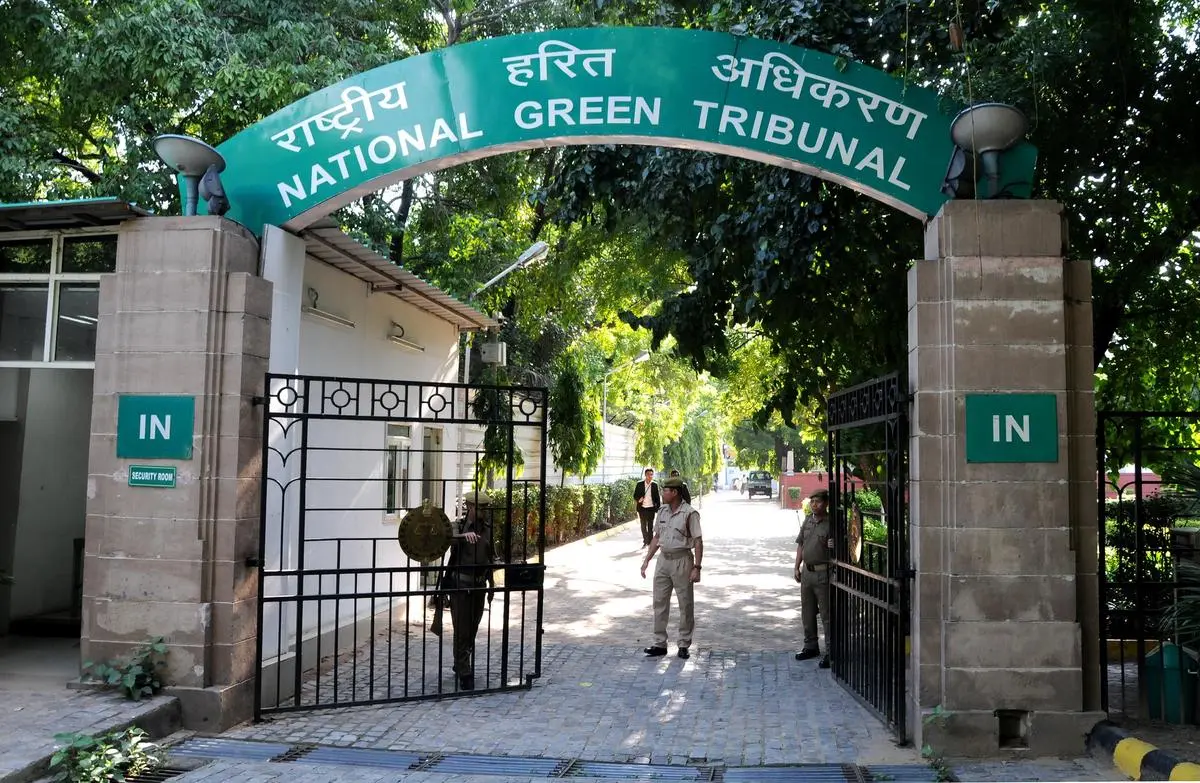
National Green Tribunal office at Faridkot House, in New Delhi.
| Photo Credit:
Shanker Chakravarty
Similarly, in Rajeev Suri of 2022, it explained that “merits review” means scrutiny of the merits of the issues, and not a cursory examination of the decision-making process—again, something that clearly seems to have happened in the present case. In State of Orissa v. Dhaniram Luhar of 2004, the court said reasons are “the heartbeat” of a judgment.
The Pipavav order is vulnerable to every one of these precedents at once. Why, one may ask.
Because the NGT’s order does not address the contradiction between the EIA’s denial of marine-mammal presence and the CSIR-NIO listing of dolphins, turtles and whales in the same study area. It does not address the implication of the proponent’s own thirteen-year non-performance for the credibility of its present projections of expansions in future. It does not address dredging-disposal impacts, the greenbelt question, the Environmental Monitoring Plan, mangrove restoration, livelihoods, or climate.
It remarkably cites only the proponent’s own avian-diversity study to find that there is no adverse biodiversity impact, and treats that citation as the answer. In doing so, the NGT abandoned its primary job of merits-review.
The Supreme Court’s role
On appeal, the court’s May 11 order is short and considerably restrained against the seriousness of what was brought before it.
Paragraph 2 records that the NGT dismissed the appeal at the admission stage “after elaborately relying upon the EIA Report”, where various aspects were “seemingly” examined by experts. It acknowledges the tribunal’s reliance on the EIA without endorsing the adequacy of the scrutiny. Paragraph 3 sets out the twelve issues the appellant says were not considered. Paragraph 4 is the pivot.
The court says it is “not inclined to agree” that the NGT gave no reasons at all, but grants liberty to move a review before the NGT specifically on whether those twelve issues “have been duly considered in the EIA Report”.
But it seems that Chief Justice Kant’s order has framed the issue differently.
Aroskar and Sanghar Zuber are not about whether the EIA report somewhere touches an issue. They are about whether the NGT, sitting in appellate merit review over the clearance, has itself independently engaged with the appellant’s substantive objections.
By directing the review around whether the issues “have been duly considered in the EIA Report”, the Supreme Court has narrowed the question. The NGT may now satisfy itself by pointing to passages of the EIA that mention the listed concerns, and call that consideration. That is not what Sanghar Zuber asks of it. So while the court has reopened a door, the door is narrower than the appeal’s grounds.
One also cannot not mention the intemperate remarks made by Chief Justice Kant against “alleged environmentalists and activists” on that day. During the hearing that day, Chief Justice Kant stated: “Show us even a single project in this country where these alleged environmentalists and activists say we welcome this project… Everything you drag to the court… In this country, this kind of litigation is filed only to stall all development projects. That is the problem”. He continued: “See, you people don’t want ports to be expanded. How is the country going to progress… You went to NGT and unfortunately that creates a lot of doubts on bona fide. You don’t go to any authority pointing out that I am an expert, I find that these are the deficiencies… if at all you are an expert. You are some RTI activist, you are so-and-so activist, an environmentalist, you have so many degrees… Jahan daav lage wahin (Wherever the opportunities are…)”.
The statements generated a strong pushback from citizen groups nationwide. For instance, 71 members of the Constitution Conduct Group, a platform for former civil servants, issued an open letter on May 22 stating that the Chief Justice’s remarks can “weaken environmental and conservation safeguards in the country, and influence lower courts to also adopt similar attitudes”.
Importantly, they pointed to how “most of the expert and statutory bodies set up by the Environment Ministry…consist only of government or retired government officials”, urging the court not to place “blind faith in these appraisal bodies which act as rubber stamps for the government”.
The same concern must apply to the NGT given how its two members dealt with the case in a cavalier manner.
Appointments flaw
What the Supreme Court has done at Pipavav is incremental. It has not stayed the clearance and not held that the NGT order was wholly unreasonable, as is clear to anyone from the record. It has instead chosen to reopen the adequacy-of-consideration question and send it back to the tribunal to reconsider a narrower question. In other words, while the court gave from one hand, it took away from the other.
Whether the NGT now answers the twelve listed objections issue by issue, in reasoned prose, as is expected of a specialised forum like it, or whether it treats the review narrowly and defensively, will determine the real afterlife of this case.
But the larger question, a more concerning one remains open.
Can an environmental tribunal reproduce the project proponent’s documents as its own findings and call its one-para decision a judgment? One can look at the Great Nicobar Island project case where the NGT delegated the difficult ecological questions to a “high powered committee” headed by the very ministry whose clearance was under challenge. Can the tribunal treat such delegation of its job as adjudication?
The Central Information Commission, which sits in appeal over refusals to disclose under the RTI Act, has been operating on precisely this model for years, routinely remanding appeals to the very Ministry whose non-disclosure is under challenge, often without liberty for the appellant to return.
That this model has now percolated upward into a quasi-judicial body seized of environmental clearances is a perverse inversion of the appellate duties.
The issue, finally, lies in who is being appointed to the NGT, keeping in mind the larger ecosystem of questionable appointments across institutions within which those appointments are made. Precedent then holds little significance. Surely, the judicial member on the NGT Bench, former Allahabad High Court judge Justice Dinesh Kumar Singh, who was infamously denied a farewell by the Oudh Bar Association in July 2023 for what it said was “disrespectful and abusive behaviour” towards lawyers would be well versed with the plethora of precedents his bench ought to have followed in the case.
One should also not forget the Supreme Court’s own failure to engage scientifically with the case when it came before it, and the Chief Justice of India’s intemperate remarks from the Bench against those who have given much of their lives in the service of the environment. In that sense, environmental adjudication in India is perhaps drifting in the direction of clearance-by-quotation (the NGT order) and clearance-by-committee (the Great Nicobar case).
Saurav Das is an investigative journalist writing on law, judiciary, crime, and policy.
Also Read | Two lakh people sign petition to stop Great Nicobar project
Also Read | Delhi’s ‘themed forests’ could suffocate its last green lung