


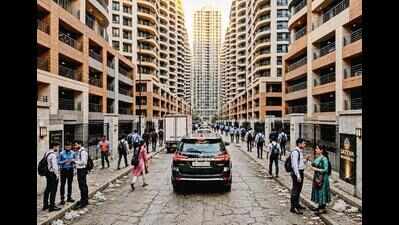
Mumbai: In the 1950s, one side of a typical street in Bandra (W) would have ten plots and 10 houses with about 50 residents and perhaps four cars among them. In the 1990s, with higher floor space index (FSI) — the ratio that defines how much can be built on a plot — this street had 200 apartments, 800 residents and 150 cars. By 2040, thanks to Mumbai’s new Development Control & Promotion Regulation (DCPR-2034), which allowed even higher FSI, the same Bandra street would have 300 apartments with 1,350 people and 450 cars.This was the frightening scenario presented by architect and urban designer Samir D’Monte at a public presentation at Bandra Gymkhana on Saturday. “Now, what happens when every single street in Mumbai undergoes this transformation?” he wondered.With Bandra (W) one of the costliest real estate enclaves in the suburbs, the current redevelopment craze due to the state’s liberal construction policy has led to a proliferation of luxury towers along roads and narrow lanes, which were once lined with bungalows and low-rise buildings. Areas like Turner Road, Perry Road, Carter Road and Pali Hill are witnessing a crop of skyscrapers, 18-20 storeys high.Not many are complaining. Neither the builders nor their architects, and certainly not the residents, who are getting bigger flats in the redeveloped buildings. The govt and BMC too are happy collecting thousands of crores in revenue each year through development charges from builders.On the other hand, old timers in Bandra complain about massive traffic jams on narrow streets filled with pubs and cafes in residential areas, lack of trees and open spaces, no walkable areas for pedestrians, increasing pollution, water shortage and worsening congestion.“With the current FSI allocations, the financial incentives to rebuild are so tremendously high that very few can resist. Every single building is effectively a financial asset worth Rs 400 crore, Rs 500 crore, Rs 700 crore,’’ he said.So, what are Bandra’s streets going to look like? D’Monte showed renderings of these streets with towers having three or four stories of stilt parking built close to each other on narrow roads. “The question I’m asking is: Is this really what we want as the future of our city? So, I think the first effect is that it is going to create streetscapes from hell,” he said.The Bandra-based architect said that one of the first things you find in a vibrant city is that there’s interaction between the building and the street. “The famous urban economist Jane Jacobs called it ‘eyes on the street’. There’s a whole theory of vibrancy in cities; how vibrancy comes into being. And it’s when there’s healthy interaction between the buildings and the street,’’ he said.D’Monte warned that if we have every building having three or four stories of stilt parking, “you are effectively walking through a dead sea of concrete” without any human interaction between street and building.So, is Mumbai’s new DCPR producing architecture that is related to the scale of the human? D’Monte said, “You have streets that are narrow in relation to the height of the building. They are dark, and they end up having garbage; they’re not policed. People will not want to walk on the streets; they would want to drive around in SUVs. This is going to be the effect of our (changed) regulations. Is this kind of a city anybody really wants to live in? Spend crores to live in a box that is looking out onto other boxes, with no light, ventilation or trees?”“And the last point that I’d like to make is the width of footpaths in our city, which are crazily undersized,” he said.“There’s no way that a city of our size should have such tiny footpaths, and footpaths that are so unusable in the sense that they are too high, or broken, or have obstructions. If you go to Vietnam, even a small residential neighbourhood has a 15-ft-wide footpath. And the difference it makes to your experience of the city is just tremendous.”