





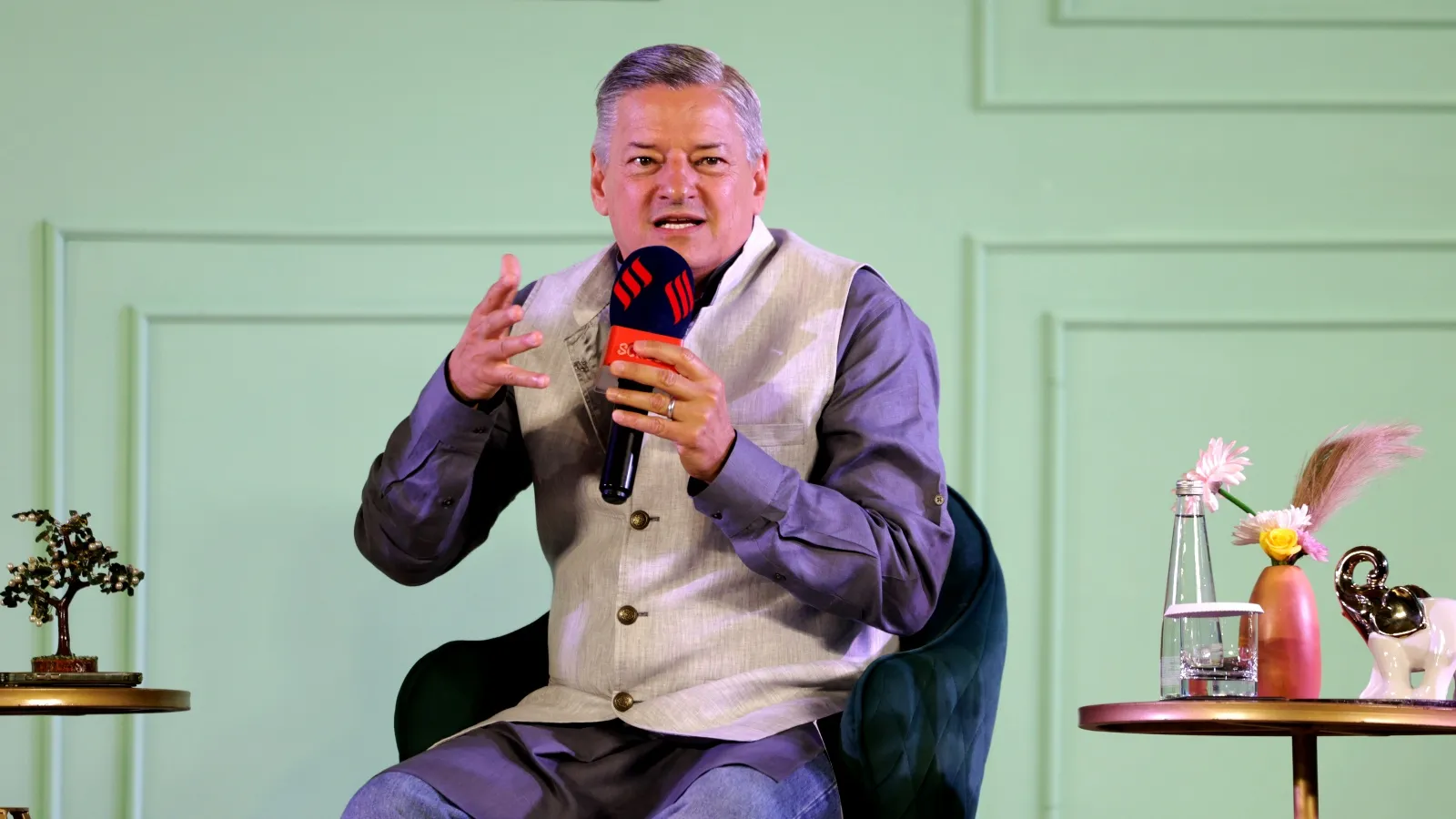
Contrary to popular belief that streaming is in competition with theatres, Netflix co-CEO Ted Sarandos wants viewers to keep watching films on the big screen.
“We don’t see it as a competition at all,” Sarandos said Thursday at the Express Adda in New Delhi. “People on Netflix love movies, (they) love to go to movies and watch them at home. An individual watches an average of seven movies in a month and sees one or two in the theatre. We are not saying one (medium) is better than the other. It is a rich, beautiful ecosystem and I want our viewers to go to the theatres because it strengthens their relationship with movies. That’s where we will benefit.”

The Netflix co-CEO, who was in conversation with Anant Goenka, Executive Director, Indian Express Group, said, “What we compete for is screen time. We want to become the first place you check for something great to watch and the last place you would want to cancel.”
Considered one of the architects of the streaming revolution, Sarandos has played a pivotal role in transforming Netflix into one of the world’s leading entertainment companies. Expanding into all areas of entertainment programming, he led the company’s transition into original content production with the launch of the series House of Cards, Arrested Development, and Orange Is the New Black, among others.
Named one of Time Magazine’s 100 Most Influential People in 2013 and 2025, Sarandos led the platform in investing in diverse voices, reshaping the way audiences discover and experience films and series, and championing bold, innovative and engaging storytelling from around the globe.
Sarandos was in India to mark 10 years of Netflix in the country and for the premiere of one its most ambitious Indian projects yet — Safed Sagar, which spotlights the Indian Air Force’s role in the 1999 Kargil War. Headlined by actors Siddharth and Jimmy Shergill, the series was shot at 16,800 feet, “the highest altitude production we’ve ever been involved in”.
Also Read | 700 failed auditions, mounting debts: Sharib Hashmi says wife kept his acting dream alive
Story continues below this ad
The scale of the show, said Sarandos, speaks to the success Netflix has had in India, “one of the greatest storytelling cultures in the world but dramatically under screened.” “In India, there are fewer movie theatre screens per person than in any country in the world and it is the country with the biggest appetite for movies,” he said, adding, “We can solve that problem. We can tell those stories to audiences that want them and otherwise didn’t have access to them.”
Netflix entered the Indian market with the thriller series, Sacred Games, and has since brought in productions that oscillate between classy and massy. One of their current top shows is the reality series, Lock Upp. Sarandos said he wants to give the audiences “everything they may want to watch”. “We want to be classy and massy,” he said.
India has had some of its biggest national and international recognitions with Netflix productions, including The Elephant Whisperers, which became the first India-produced film to win the Academy Award for Best Documentary Short film in 2023; and Emmy wins for Delhi Crime Season 1 and Vir Das: Landing in 2020 and 2023, respectively, among several other nominations.
“We have had an Indian movie or series in the global Top 10 every week since 2024. We have 3.5 billion hours of watching Indian content on Netflix around the world this year,” Sarandos said.
Story continues below this ad
Although, for Sarandos, who joined Netflix in 2000 and became its co-CEO in 2020, the success of the platform lies more in “informed intuition” rather than just “data”.
“There’s no data in the world that could tell you to make this and don’t make that. Data only tells you what worked before. The audience is always looking to be surprised…that generally doesn’t come in some formula and you definitely can’t reverse engineer into it. We have access to data, yes, but if anybody made big, creative decisions based only on data, that would be a fool’s errand,” he said.
Sarandos is also keen on embracing AI, but with caution. “It is a great opportunity to tell bigger, better stories, but they have to be better; even better if it’s a little bit faster, cheaper,” he said.
To that end, Netflix acquired InterPositive, an AI-powered filmmaking technology, for $587 million in March this year, to integrate its post-production editing process — when post editing, parts of the narrative may feel missing and require the crew to regroup and reshoot.
Story continues below this ad
“As much as 20 per cent of the entire budget is spent doing pickups and reshoots. InterPositive enables a filmmaker using just the data of the film that they made and do that quick pickup shot in AI as almost like a visual effect,” Sarandos said, noting that he has noticed an “aggressive” use of AI by Indian creators.
“Glory is one of the 300 Netflix productions worldwide that used AI tools to help the production along. We do things like pre-visualisation. It gives the director the opportunity to lay out and design a complicated or sometimes a dangerous shot to make sure you can film it faster or safer, which is helpful. We also use it a lot for post-production and VFX.”
Now, Netflix plans to invest more in India, which has been both “unpredictable” and “successful”. “When I look at the rate of acceleration in the last five of the 10 years, it’s unbelievable the opportunity that’s coming to us and to India,” Sarandos said, adding, “India has no shortage of great stories. We have to invest in skilling programs to be able to make sure that the talented crews are here to make projects we’re excited to be thinking about in the next 10 years to come.”


