

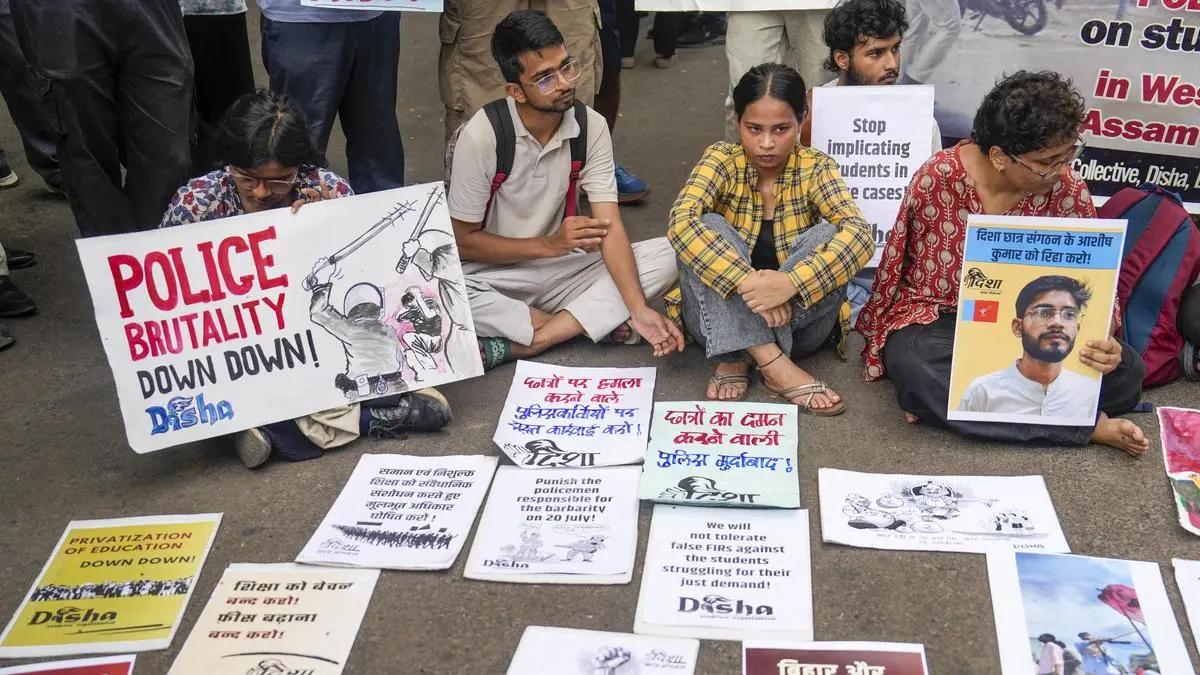
More than a week after the Cockroach Janta Party (CJP) called off its stir against the NEET-UG paper leak, the promised amnesty for protesters remains patchy and contested. Delhi has not withdrawn a single case, West Bengal continues to make arrests under a new anti-goonda law, and the Supreme Court’s July 28 order—allowing existing FIRs to proceed even as it freed detained minors—has left the CJP alleging a “breach of trust”.
Here is where each State stands. This list will be updated in the days to come as and when fresh data become available.
Delhi: 20 FIRs still on the books
Delhi Police registered 20 FIRs at the Parliament Street and Connaught Place police stations over violence on July 20, when protesters trying to move from Jantar Mantar towards Parliament on the opening day of the Monsoon Session were stopped at barricades.
The FIRs invoke the Bharatiya Nyaya Sanhita, the Arms Act, and the Prevention of Damage to Public Property Act; attempt-to-murder charges were added over violence near Rail Bhawan. Police put the toll around 130 injured personnel, including officers up to the rank of Special Commissioner, and about 80 injured protesters.
As of July 29, none of the 20 FIRs had been quashed. They remain under investigation, and the Centre has issued no written confirmation of withdrawal. Delhi Police said they are awaiting formal orders.
Delhi: Surveillance and takedown notices follow the protest
Once the agitation ended, Delhi Police began issuing takedown notices to social media accounts over posts it called abusive or illegal, including content targeting Prime Minister Narendra Modi. The notices followed a review of videos, photographs, and comments posted during and after the protest, with investigators examining whether they breached the law or could disturb public order.
Several content creators whose protest videos had drawn millions of views said Meta and X removed their posts in the same period.
Separately, police sources said facial recognition cameras at four entry and exit points around Jantar Mantar identified 2,873 people with prior criminal records at protest sites between July 20 and 25; more than 980 of them had records including murder, robbery, rape, kidnapping, and narcotics cases. The CJP and Rajya Sabha MP Kapil Sibal have called the exercise surveillance dressed up as investigation.
Bihar: Mass detentions, now formally withdrawn
Police detained 694 people while enforcing the Bihar bandh called by pro-Left students’ unions on July 25. Of these, 339 minors were released; the remaining 355 were booked and produced before courts. The CJP’s own count is narrower and harsher—86 arrests, concentrated in Siwan, Patna, and Chhapra, with attempt-to-murder charges invoked, and roughly 5,000 unnamed persons booked.
On July 27, the State Home Department notified that no adverse legal action would be taken against anyone who had protested before 6 pm on July 26, and that withdrawal of all FIRs, criminal complaints, and show-cause notices would begin immediately, with those arrested to be released.
Assam: 5 cases, 13 arrests, withdrawal ordered
The Assam Home and Political Department’s notification of July 27 recorded five cases connected to the NEET protests as of 6 pm on July 26, resulting in 13 arrests. The department said no police authority in the State would take adverse legal action against those involved, and that withdrawal would begin promptly regardless of the stage each case had reached.
The CJP had named Assam, alongside West Bengal and Bihar, in its July 27 statement on protesters being targeted, detained, or arrested by State agencies.
West Bengal: Arrests continue under a new anti-goonda law
This is the sharpest live front. Violence broke out on July 24 during a Left students’ rally from Sealdah, joined by the CJP, at Dorina Crossing in central Kolkata; journalists and police personnel were assaulted and public property damaged. Seven FIRs were registered, including one suo motu by city police, and 70 people were identified.
Arrests continued after a July 25 agreement to hold back: 14 by July 26, 16 by July 27, with the newly enacted West Bengal Public Safety and Control of Anti-Social Activities Act—the anti-goonda law—invoked. Two of the latest accused, Wakar Azam and Javed Akhtar, were picked up from Karaya and Garden Reach; five already in custody were taken back to Dorina Crossing for a reconstruction.

Security personnel conduct baton charge during a joint protest rally by the Students Federation of India along with Cockroach Janata Party supporters demanding the resignation of Union Education Minister Dharmendra Pradhan over the NEET paper leak issue in Kolkata, West Bengal, on July 24, 2026.
| Photo Credit:
Manvender Vashist Lav/PTI
Police maintain that none of those arrested is a student and describe them as outsiders who infiltrated the protest, a characterisation the CJP disputes. CJP spokesperson Ratna Singh said 10 of the 11 people then arrested in the city were Muslim, and that most of the accused came from Kidderpore, Metiabruz, and Rajabazar.
On July 28, the Chief Metropolitan Magistrate granted bail to the 16, recording that there was, prima facie, no material to show any of the accused had a criminal background. The investigating officer had opposed bail citing past records but, when asked whether any accused had actually been convicted, gave no clear answer.
Six further cases remain open on journalists’ complaints, under investigation under the anti-goonda law, with no separate arrests yet. The State’s assurance covers no coercive action against students, but does not extend to persons with a criminal record—a carve-out wide enough to undercut the promise.
Maharashtra: 20 FIRs in Mumbai, more than 1,000 booked
This is the largest single-city caseload outside Delhi. Police registered 20 FIRs in Mumbai alone, booking more than 1,000 people under Sections 126(2), 189(2), 189(3) and 223 of the Bharatiya Nyaya Sanhita, along with Sections 37(1), 37(3) and 135 of the Maharashtra Police Act. Notices to protesters continued as late as July 27, with officers saying investigations could not stop until formal directions arrived.
On July 28, Chief Minister Devendra Fadnavis, who also holds the Home portfolio, directed the department to begin withdrawal and halt coercive measures—no detentions, no visits to the homes of the accused, a senior officer said. Home Department officials noted that the Chief Minister’s direction does not by itself terminate an FIR; closure reports remain one option alongside withdrawal at the prosecution stage.
Kerala: Roughly 5,000 booked, review ordered
Kerala is worth watching precisely because it is not BJP-governed, and so falls outside the Centre’s assurance entirely. Leader of the Opposition Pinarayi Vijayan wrote to Chief Minister V.D. Satheesan claiming around 5,000 people had been booked across the State; Satheesan has referred the demand for withdrawal to the Home Department.
Police sources say the exact number of cases is not known and that most involve bailable offences of unlawful assembly or gathering in public places. Vijayan’s letter noted that Satheesan had himself joined the Congress agitation in Delhi in support of the students.
Rajasthan: A guarantee claimed, no FIRs registered
The CJP said late on July 27 that it had been guaranteed no authority would proceed against protesters in Rajasthan, and that no FIRs had been registered and none would be. No independent State notification has surfaced to confirm this; it rests on the CJP’s word alone.
The Supreme Court order of July 28
The Supreme Court ordered the release of minors arrested or detained during the protests, while allowing investigations into existing FIRs to proceed. The CJP reads the second half as the more consequential one.
CJP spokesperson Saurav Das said the direction permitting existing FIRs to continue contradicts the government’s assurance, and that the CJP has a “credible apprehension” that the Centre and BJP-ruled States could use the order—issued by a bench led by Chief Justice of India Surya Kant, whose remark comparing some young people to “cockroaches” gave the movement its name—to keep FIRs alive against individual protesters. Das argues that the power to withdraw cases rests with the executive regardless, as Bihar and Assam have shown.
What the movement is doing next
The CJP has launched Saakshi, a portal where protesters can upload video and photographic evidence of police action, and is assembling a nationwide network of lawyers. Sibal has pledged Rs.1 crore towards the legal aid fund. The CJP has also asked, so far without success, for copies of the FIRs that the Delhi Police Commissioner had undertaken on July 25 to hand over.
Disclaimer: FIR numbers and police-station-wise breakups are not in the public domain for most of these cases. This article is the best reconstruction from police briefings, State government notifications, the CJP’s own count, and media reports. Several of these cases are, at the same time, being registered and being withdrawn, sometimes by the same government.
Also Read | The end of immunity?
Also Read | How Gen Z is laughing in the face of brute force