

Last Updated:
For political parties in both states, it remains an issue that can rally public sentiment and sharpen regional identity




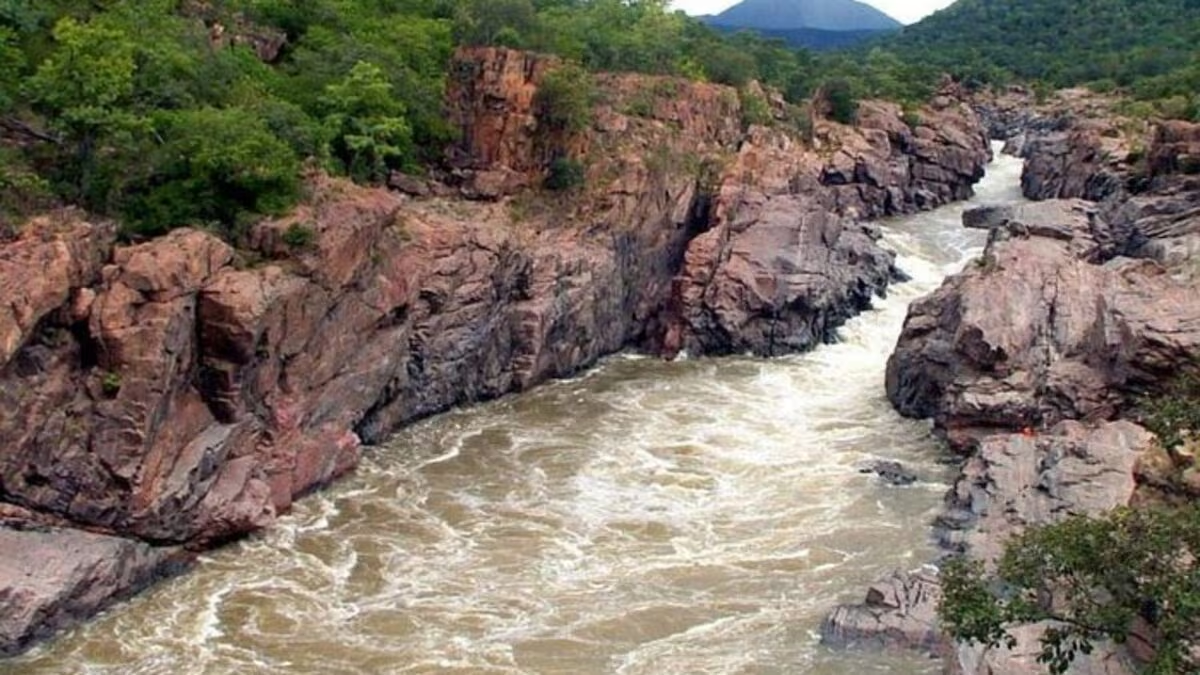
Mekedatu is a proposed balancing reservoir and drinking water project planned by Karnataka across the Cauvery river near the Karnataka-Tamil Nadu border. File image
Nearly three decades after it was first proposed, the Mekedatu balancing reservoir remains one of India’s most politically contentious infrastructure projects. Every few years, it returns as a subject of discussion, triggering a familiar cycle of political statements, counter-statements, legal arguments, and accusations between Karnataka and Tamil Nadu.
Yet, despite successive governments promising to build it and equally determined governments vowing to stop it, the project has remained stuck in a maze of litigation, statutory clearances, and political compulsions.
The latest trigger is a strongly worded letter by Tamil Nadu Chief Minister C Joseph Vijay to Prime Minister Narendra Modi, challenging the Centre’s interpretation of the Supreme Court’s 2018 Cauvery judgment. Vijay’s intervention came a day after the union government told the Rajya Sabha that the apex court’s verdict does not expressly require Karnataka to obtain the consent of Tamil Nadu, Kerala, or Puducherry before constructing a structure across the Cauvery.
Responding to a question raised by PMK MP Anbumani Ramadoss, Union Minister of State for Jal Shakti Raj Bhushan Choudhary said the February 16, 2018 judgment reiterates Clause XVIII of the Cauvery Water Disputes Tribunal (CWDT) award, which allows a state to regulate the use of water within its boundaries so long as it is not inconsistent with the Tribunal’s order. The judgment, he pointed out, does not specifically state that Karnataka must obtain the approval of the lower riparian states before constructing a structure on the river.
Tamil Nadu, however, has taken strong exception to that interpretation.
Calling the Centre’s response “disappointing”, Vijay argued that it ignored the settled legal position governing the rights of lower riparian states. In his letter to the Prime Minister, he maintained that any project on an interstate river with downstream implications cannot be viewed merely through the narrow wording of a single judgment. Instead, he argued, it must be examined within the larger legal framework governing interstate rivers and the rights of downstream states.
Why Karnataka Wants Mekedatu
For Karnataka, the argument has remained remarkably consistent over the years, irrespective of which party has been in power.
The state insists that Mekedatu is not an irrigation project but a multi-purpose balancing reservoir designed primarily to secure Bengaluru’s long-term drinking water needs. Proposed at the confluence of the Cauvery and Arkavathy rivers near Kanakapura in Ramanagara district, around 100 kilometres from Bengaluru, the project is estimated to cost around Rs 9,000 crore.
The reservoir is expected to store nearly 67 tmcft of water, provide more than 4 tmcft of drinking water to Bengaluru and surrounding areas, and generate about 400 MW of hydroelectric power. Karnataka maintains that it is not seeking an additional share of Cauvery waters but merely proposing to store surplus monsoon flows that already fall within its allocated share under the CWDT award and the Supreme Court’s 2018 judgment.
The project has acquired greater political significance as Bengaluru continues to grapple with recurring water shortages, depleting groundwater and rapid urban expansion. The severe drinking water crisis witnessed in parts of the city over the past few years has only strengthened the government’s case that additional storage infrastructure is essential if Bengaluru is to meet its future water requirements.
A Rare Political Consensus in Karnataka
Few issues unite Karnataka’s political class like Mekedatu.
The Congress revived the proposal in 2013 after it had remained dormant for years. It later turned the project into a major political campaign, organising the Namma Neeru, Namma Hakku padyatra in 2022 and accusing the BJP-led union government of delaying approvals despite publicly supporting the project.
Under the leadership of DK Shivakumar, the Congress also made Mekedatu a key campaign promise during both the 2023 Assembly elections and the 2024 Lok Sabha polls, arguing that Bengaluru’s future water security depended on it.
The BJP, too, has consistently backed the project. During his tenure as Chief Minister, Basavaraj Bommai announced budgetary allocations and repeatedly expressed confidence that construction would begin soon.
In an earlier interview with News18, Bommai had said in his budget he had allocated Rs 1,000 crore had been earmarked for the project, and work would commence once the necessary approvals were secured.
Representing the region where the reservoir is proposed, Shivakumar has repeatedly argued that Bengaluru cannot afford to delay Mekedatu any longer and has alleged successive union governments of slowing the approval process.
The political contest in Karnataka has therefore never been about whether the project should be built. Instead, it has centred on which party deserves credit for taking it forward.
Why Tamil Nadu Continues to Oppose It
Tamil Nadu’s concerns go beyond the project’s stated objective of providing drinking water.
Successive governments in Tamil Nadu have argued that any additional storage structure upstream would give Karnataka greater control over the timing and quantity of water released downstream, particularly during years of deficient rainfall. The state fears that such operational control could affect irrigation in the Cauvery delta, making the project unacceptable unless the concerns of downstream states are fully addressed.
That explains why opposition to Mekedatu has remained consistent across political parties in Tamil Nadu. Whether under the AIADMK, the DMK, or now Vijay’s government, the state’s position has remained unchanged—that Karnataka cannot proceed with the project without addressing the concerns of Tamil Nadu and Kerala.
PMK president Anbumani Ramadoss has gone a step further, urging Vijay not to engage in talks with Karnataka over Mekedatu. Instead, he has called for an all-party meeting, a joint delegation to meet the Prime Minister and a renewed legal battle before the Supreme Court.
“We have not acknowledged the dam at all. There is no reason to go to Karnataka to discuss it,” Anbumani said, while alleging that DK Shivakumar’s renewed push for the project is linked to Karnataka’s political calendar.
Why the Centre Finds Itself in a Difficult Position
For the Centre, Mekedatu has always been a political balancing act.
Supporting the project risks provoking Tamil Nadu, where the Cauvery remains one of the most sensitive political issues. Rejecting or indefinitely delaying it invites criticism in Karnataka, where support for Mekedatu cuts across party lines.
As a result, the project has remained caught in a web of environmental clearances, forest approvals, legal challenges, and technical scrutiny. Karnataka submitted its Detailed Project Report to the Centre in 2019, but progress has remained slow as Tamil Nadu has repeatedly opposed the proposal before various statutory and judicial forums.
The Centre’s latest parliamentary reply has now added another dimension to the debate. Karnataka believes it reinforces its legal argument that the Supreme Court never mandated the consent of downstream states. Tamil Nadu, on the other hand, sees it as an attempt to weaken the long-established rights of lower riparian states.
More Than a Dam
Mekedatu is more than just a drinking water project.
For Karnataka, it represents the state’s right to secure Bengaluru’s future water needs. For Tamil Nadu, it symbolises the need to protect the Cauvery and the interests of farmers dependent on downstream flows. For political parties in both states, it remains an issue that can rally public sentiment and sharpen regional identity.
That perhaps explains why the project continues to dominate political discourse despite making little progress on the ground.
Nearly 30 years after it was first conceived, governments have changed, court battles have come and gone, and elections have been fought over it. But the proposed reservoir remains where it has always been—caught between competing legal interpretations, environmental hurdles and political calculations.
This political dilemma has remained unchanged whether the government at the Centre has been led by the Congress or the BJP.
As fresh letters are exchanged and legal positions harden once again, the battle over Mekedatu is no longer just about water. It has become a test of federalism, competing development priorities and the delicate balance between the rights of an upstream state and the concerns of those downstream.
The Centre’s reply in Parliament has been interpreted very differently by the two states.
Karnataka sees it as reinforcing its long-held argument that the Supreme Court never imposed a mandatory requirement to obtain the consent of downstream states before constructing a structure on the river.
Tamil Nadu argues that such a reading ignores broader legal principles governing interstate rivers and the rights of lower riparian states. It maintains that the absence of an explicit provision in one judgment cannot be interpreted as a blanket approval for upstream projects with downstream consequences.
Importantly, the Centre has not granted final approval to the project. Mekedatu still requires multiple clearances, including environmental and forest approvals, apart from scrutiny by the Central Water Commission and other statutory bodies. Tamil Nadu has consistently challenged the proposal at every available forum, ensuring that the approval process remains slow and contentious.
About the Author

Rohini Swamy, Associate Editor at News18, has been a journalist for nearly two decades in the television and digital space. She covers south India for News18’s digital platform. She has previously wor…Read More
Read More