


Meg Mason’s 2020 novel Sorrow and Bliss was an international bestseller and a Women’s Prize for Fiction finalist. Her follow-up, Sophie, Standing There, focuses on a lonely, self-taught sound technician who works literary festivals and falls for an author she will never actually meet. Speaking to indianexpress.com over a video interview, Mason talks about where Sophie’s voice came from, why she still writes for an audience of nobody, and why she would rather see writers go quiet than let AI anywhere near a manuscript.
I was working on something else, a novel that wasn’t going very well. Then one day she just came into mind, encapsulated in that very first sentence of the novel. I let myself pursue it quite nervously. But she was the real thing, and I realized that quite quickly, and then I just let it take off.

I know she came from all the hours I’d spent backstage at literary festivals since my previous novel came out. I felt much more connected to all the staff, the backstage staff running around doing everything they have to do. That caused me to start thinking about what it must be like from their side. I just started to wonder what kind of behaviors the production team might see, and what it would feel like for them.
The novel departs from a traditional writing style, almost as though it’s being told directly to the reader. How did you decide on this storytelling choice?
When I sent the first pages to my editor, I was like, isn’t this silly? But it’s Sophie’s voice, even though it’s in the third person, it’s really her thoughts and her interior monologue, as though she’s telling this story about herself to us. Because she’s self-taught and not part of the establishment, her speech isn’t always correct, she muddles words or gets grammar a little mixed up.
When it went to the copy editor, who usually sends it back with maybe 200-300 little corrections, it came back with 9,300 suggestions of things that were wrong. I was like, oh my gosh, it’s on purpose. I came across a narrative point of view called skaz, very particular to (Anton) Chekhov. It’s narrative that’s meant to sound like the third person but is actually the first person, specific to a character who’s self-educated and attempting to sound cleverer than they are.
Your female characters are never unsympathetic, but they’re not always likeable. How do you approach writing flawed characters?
Unlikeable is an adjective you hear a lot applied to female characters, more so, I think, than male characters. But I think we all have moments of great unlikability. If I wrote myself onto the page, or even if I wrote any of my friends onto the page, they wouldn’t come out as wholly likable, but I like them in their totality. If there was a character who behaved incredibly well all the time, I think we’d be so uninterested, and they wouldn’t even seem real or convincing. With Sophie, I really wanted to make sure that we felt sympathy towards her and understood her all the time.
You move from joy to sorrow very quickly, sometimes within a single sentence. How do you manage that?
I think it comes from real life, from what we do as humans. You can almost begin a sentence describing your greatest terror or depression to someone, or the worst thing that’s ever happened to you, or some bad news you just got, and by the end of the sentence you’ve made an incredibly dark joke, because somehow that’s just how we communicate with each other and how we make life bearable to ourselves and to other people. Even if it stayed constantly humorous, it wouldn’t feel real, there’d be no substance to it. Likewise, if it was just constant misery, I’d be like, why am I doing this to myself? I always read the book lots and lots of times after it’s finished, and I read it out loud to myself. If I start to feel there’s too much of one thing happening, like maybe my interest is wandering because it’s getting too sad, or I’m starting to feel really heavy, then I know that’s probably what the reader will be feeling too, and I’ll try and correct that.
Story continues below this ad
There’s been considerable controversy over the use of AI in writing. What does its growing integration mean for the future of writing as a profession?
I’ve never been tempted to use it myself, and I never would be, because what would become of my career if I turned to ChatGPT to help me with a novel? But more than that, as a reader, I would never, ever want to read a novel that had been even edited technically, even proofread by AI, because it’s lost all its humanity and all its human knowledge and its truth and its graininess and grittiness, even the mistakes in it. I think we can all tell there’s that flattening of language happening, that we’re all beginning to sound the same because the same robot writes the same emails for all the same people. Why would we give away language, which is just the most incredible, beautiful, dynamic, living thing that we have, the thing that we have uniquely as human beings. I just don’t want to give it away to any technology.
You started your career in journalism. How did that background shape your fiction writing voice?
I think journalism is amazing training for any kind of writing, even down to your respect and terror of deadlines. Journalism is so good at teaching you to be concise and to use every single bit of space that you have. Any novel could be seven hundred pages if you let it, but I never want to overstay my welcome. My dream and my goal, everything I focus on, is to make it feel effortless on your side by doing a lot of secret toil myself.
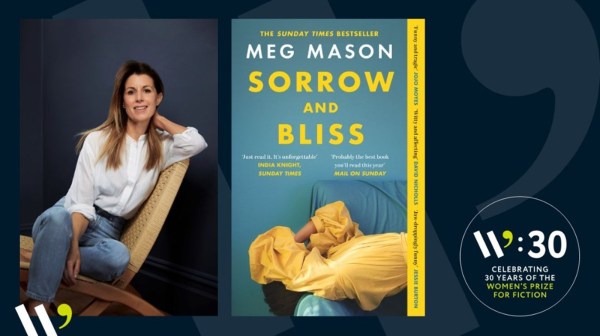 Meg Mason’s Sorrow & Bliss was shortlisted for the Women’s Prize in 2022.
How did the process of writing this novel differ from writing Sorrow and Bliss?
It differed just because I could no longer tell myself that nobody was going to read it, because that’s how I got Sorrow and Bliss written. After everything that happened with that book, which was wonderful and incredible, I knew I had an automatic audience for the next one. The idea of writing started to feel very crowded in the little tiny writing shed where I work, because you feel these readers almost standing over you, waiting for you. It’s not really conducive to the creative process. So it was all about trying to clear any expectation that was on me, or that I’d put on myself. But it was a real battle, something I was contending with daily.
Apart from AI, what do you see as the greatest threat to writing today?
If you love books, and you love reading, and you’ve ever been touched by a book, you know that it’s going to be fine, because story is at the heart of who we are. Whatever the delivery mechanism is, it doesn’t really matter how it’s delivered. The one thing I have noticed that for me is a private tragedy is that people don’t talk in the street as much as they used to, because everybody’s on their phone. The most fertile ground for a writer was out in the street, eavesdropping on buses, walking along and hearing those little snatches of conversation. It’s a very silent place out there now.
Story continues below this ad
Given how technology-averse you are, do you think writers today can succeed without putting themselves out there on social media?
I was on social media until 2018, and I woke up one day and I couldn’t work out why I was on there and what I was hoping to achieve. I noticed how much of my emotional resources were being poured into Instagram, and that I would feel perfectly fine and happy, and then I’d pick up my phone and within two minutes I felt miserable. So that day I just canceled my account. At the same time, I’m hugely grateful to people who are happily on Instagram writing about books and sharing about books, because it’s a brilliant means of discovery, and it creates that reach that we could never hope to get.
Could you name writers who especially influenced this book?
There are the authors that I sort of have loved all my life, like Hilary Mantel and Nancy Mitford, and the New Zealand writer Janet Frame. There’s a reference to Evelyn Waugh in there, because I was rereading Brideshead Revisited in that moment. And Moon Tiger by Penelope Lively I was reading at the time. The only cheat that I performed was to look up a quote about friendship, a Jane Austen quote about friendship, and the result came from Persuasion. I’m not even sure if I’d ever read Persuasion, I would have told you that Emma was my favorite Jane Austen. Then I thought, well, if I’m going to quote from Persuasion, I better read it. And now suddenly it’s my favorite Austen.