



Last Updated:
Unlike previous challengers, Vijay did not position himself as a marginal alternative. He entered with a clear, state-wide pitch to replace, not just challenge, the existing order




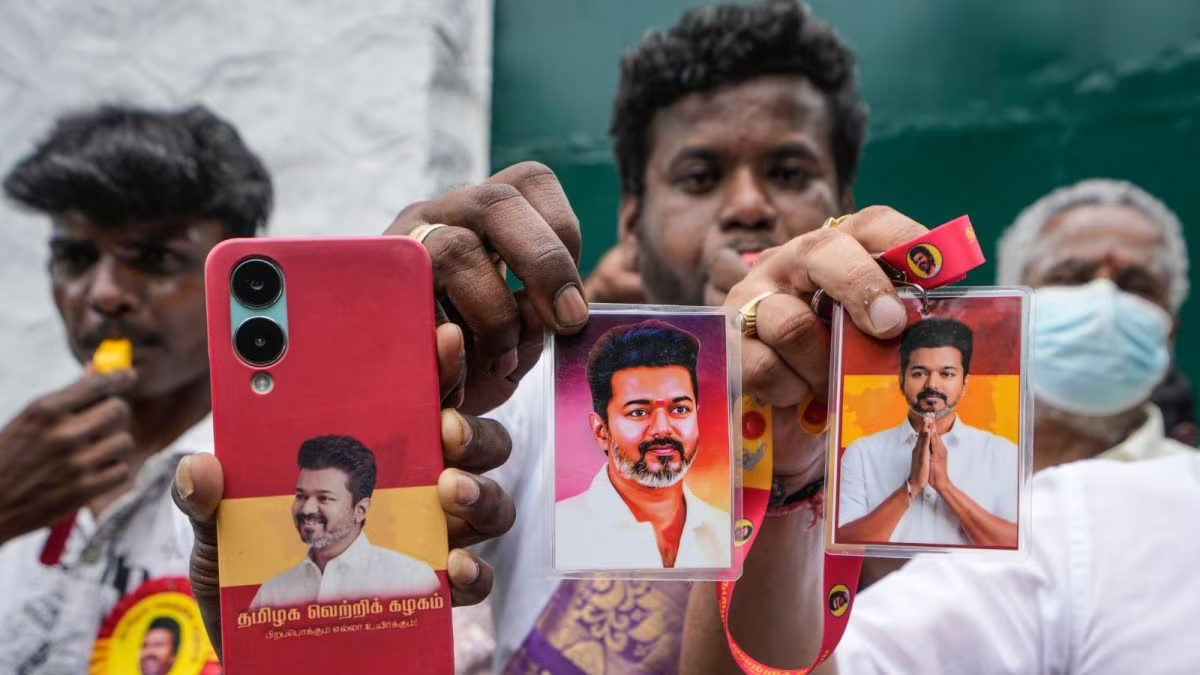
Supporters hold portraits of Tamilaga Vettri Kazhagam (TVK) chief Vijay as his party stuns in the Tamil Nadu polls. (PTI)
For nearly half a century, Tamil Nadu politics followed a script that seemed almost unbreakable: power alternated between two Dravidian giants: the Dravida Munnetra Kazhagam (DMK) and the All India Anna Dravida Munnetra Kazhagam (AIADMK).
That streak, dating back to 1977, may now be snapped.
With actor-turned-politician Joseph Vijay Chandrasekhar and his party Tamilaga Vettri Kazhagam (TVK) surging ahead in the 2026 assembly election, Tamil Nadu is witnessing what many analysts are calling a “49-year jinx” broken.
The 49-Year Pattern
Since the late 1970s, the state’s politics have been defined by a binary contest—DMK vs AIADMK, Karunanidhi vs MGR and later Jayalalithaa.
ALSO READ | From ‘I Am Waiting’ To ‘I Am Coming’: How Vijay Ended Tamil Nadu’s Dravidian Duopoly
No third force, not even strong personalities, managed to disrupt this duopoly in a decisive way. Elections were competitive, but the structure remained intact. That’s what makes 2026 fundamentally different.
What Vijay Has Done Differently
Unlike previous challengers, Vijay did not position himself as a marginal alternative. He entered with a clear, state-wide pitch to replace, not just challenge, the existing order.
His campaign leaned on a direct appeal to first-time and younger voters, anti-incumbency against both Dravidian parties, and a narrative of “system reset” rather than incremental change. The result: TVK didn’t just eat into vote shares; it reconfigured the contest itself, pushing the AIADMK to third place and outpacing DMK in key regions.
Tamil Nadu has seen several high-profile attempts to break the duopoly, but none have been successful at this scale.
ALSO READ | Risky Bet, Big Payoff: Vijay Pulls Off What Rajinikanth, Kamal Haasan, Vijayakanth Couldn’t
Rajinikanth never fully entered electoral politics despite years of speculation, while Kamal Haasan launched a party but struggled to convert popularity into seats. Vijayakanth too built early momentum but couldn’t sustain it.
Each of these efforts showed that celebrity alone wasn’t enough to break Tamil Nadu’s entrenched political order. Vijay’s success, by contrast, lies in combining star power with timing, organisation, and a clear anti-duopoly message.
“I Am Waiting” Moment Pays Off
Vijay’s famous on-screen line, “I am waiting”, has often been referenced in political discussions around him. In 2026, that wait appears to have translated into a decisive electoral moment.
His entry wasn’t rushed. It followed years of speculation, gradual political signalling, and careful timing aligned with visible voter fatigue. This helped him avoid the pitfalls that derailed earlier entrants.
How Did The Pattern Break?
Several factors converged to end the 49-year pattern. Most importantly, voter fatigue with alternation. Voters appeared to move beyond the traditional DMK-AIADMK cycle, seeking a structural change rather than a swing.
The state was also dealing with a leadership vacuum. With towering figures like Karunanidhi and Jayalalithaa no longer in the fray, the emotional and organisational glue of the duopoly weakened.
A large cohort of younger voters, without deep loyalty to Dravidian legacies, proved more open to a new political identity. Also, fans of Vijay banded together to hand him a victory on his debut.
Apart from this, instead of splitting, anti-incumbent sentiment seems to have converged behind a single alternative: TVK.
What sets this apart from previous elections is scale—This isn’t a vote-share dent, it’s a structural disruption. If trends hold, Tamil Nadu may be moving from a two-party system to a new political alignment centred around TVK.
However, breaking a 49-year barrier is one thing and sustaining the new order is another. The key questions ahead include whether TVK can convert momentum into stable governance; will DMK and AIADMK recalibrate or decline further; and does this mark a one-time wave, or a long-term shift?
For decades, Tamil Nadu politics followed a predictable script which has been rewritten in 2026. The 49-year jinx is not just broken but could be replaced by an entirely new political equation.
Read More