




Take a look at the essential events, concepts, terms, quotes, or phenomena every day and brush up your knowledge. Here’s your UPSC Current Affairs knowledge nugget for today on BrahMos missile system.
(Relevance: Defence technology topics such as missiles, air defence systems, fighter jets, and aircraft have been asked in UPSC Prelims. In 2026, the UPSC Prelims included questions on stealth technology and drone swarms, while in 2018, a question was asked on Terminal High Altitude Area Defence. Hence, understanding defence technology from a broader perspective is essential for the exam.)
Indian Defence Secretary Rajesh Kumar Singh said India has signed a deal to sell BrahMos missiles to Vietnam and it is in the final stage for a similar deal with Indonesia. Notably, the Philippines had become the first foreign buyer of the BrahMos missile system from India in 2022.
In this context, let’s know about the BrahMos missile system in detail and also understand important concepts applied in it.
Key Takeaways:
1. BrahMos is built through the collaboration of India and Russia. An agreement was signed, which led to the formation of BrahMos Aerospace, a joint venture between the DRDO and Russia’s NPO Mashinostroyenia (NPOM).
2. BrahMos is an amalgamation of the names of the Brahmaputra and Moskva rivers. The entity was set up with a mandate to design, develop, and manufacture a supersonic, high-precision cruise missile and its variants.
3. India holds a 50.5 per cent share and Russia the other 49.5 per cent share in the joint venture. The first successful test of the missile was conducted on June 12, 2001, from the specially designed land-based launcher at the Integrated Test Range, off the Chandipur coast of Odisha.
Story continues below this ad
4. BrahMos is a two-stage missile with a solid propellant booster engine. The first stage brings the missile to a supersonic speed, greater than the speed of sound, and it then gets separated.
5. The second stage of the liquid ramjet then fires and thrusts the missile to three times the speed of sound in its cruise phase. A liquid ramjet is an air-breathing jet engine that uses liquid fuel, which is injected into the high-speed airstream and ignited to produce thrust.
6. BrahMos is an extremely versatile stand-off range ‘fire-and-forget’ type supersonic cruise missile that has proved its capabilities in land-based, ship-based, air launched and submarine-based versions.
7. The missile has an extremely low radar signature, making it stealthy, and it can follow a variety of paths. As per its website, cruising altitude could be up to 15 km and terminal altitude as low as 10 metres. The missile carries a conventional warhead weighing 200-300 kg.
Story continues below this ad
8. Cruise missiles, like the BrahMos, come under the category known as the “stand-off range weapons”, which are fired from a range sufficient to allow the attacker to evade defensive fire from the adversary. These weapons are in the arsenal of most major militaries in the world.
9. The versions of the BrahMos that are currently being tested at an extended range can hit targets at up to 350 kilometres, as compared to its original range of 290 kilometres.
10. Compared to subsonic cruise missiles, the BrahMos has three times the speed, 2.5 times the flight range and a higher seeker range, leading to higher accuracy and nine times more kinetic energy.
Beyond BrahMos: Understanding the Technologies Behind the Missile
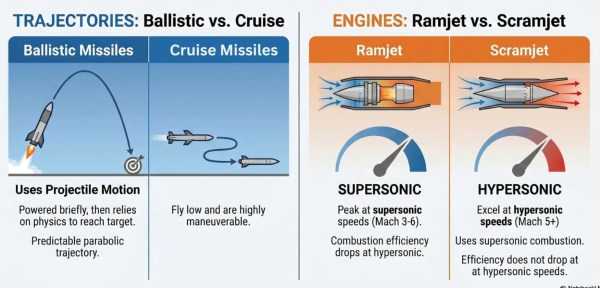
1. Cruise missiles: They are unmanned vehicles powered by jet engines that can be launched from ground, air, or sea platforms. The cruise missiles fly at a low distance from the ground while the ballistic missiles follow a parabolic trajectory. Cruise missiles can fox air defence systems due to their manoeuvrability. Examples of cruise missiles are BrahMos,Tomahawk,Kalibr, AGM-86 ALCM and JASSM.
So, what are ballistic missiles?
Story continues below this ad
Ballistic missiles use projectile motion to deliver warheads to a target. They are powered for a relatively brief time, after which they let the laws of physics take them to their target. These missiles are categorised based on range. Ballistic missiles can carry either nuclear or conventional warheads. Examples of ballistic missiles are Agni I, Agni II, Prithvi I, Prithvi II and Dhanush missiles.
2. Ramjet: In BrahMos second stage liquid ramjet is used. According to ISRO, “Ramjet, Scramjet and Dual Mode Ramjet (DMRJ) are the three concepts of air-breathing engines which are being developed by various space agencies.”
— In ramjet air-breathing jet engines, the vehicle uses the forward motion to compress incoming air for combustion without a rotating compressor. Fuel is injected in the combustion chamber where it mixes with the hot compressed air and ignites. It requires an assisted take-off like a rocket assist to accelerate it to a speed where it begins to produce thrust.
— “Ramjets work most efficiently at supersonic speeds around Mach 3 (three times the speed of sound) and can operate up to speeds of Mach 6. However, the ramjet efficiency starts to drop when the vehicle reaches hypersonic speeds,” as per ISRO.
Then what are Scramjet and DMRJ?
Story continues below this ad
— Scramjet: A Supersonic Combustion Ramjet or Scramjet, is an improved version of ramjet engines as it efficiently operates at hypersonic speeds and allows supersonic combustion. In this, air gets sucked in from the front, fuel burns in the middle and exhaust gas comes out of the back generating thrust.
— Dual-mode ramjet (DMRJ): In a dual-mode ramjet (DMRJ), the jet engine transforms into scramjet over Mach 4-8 range, which means it can efficiently operate both in subsonic and supersonic combustor modes.
BrahMos Missile System — Key Concepts
CONCEPT
Two fundamentally different weapon types
Cruise missiles fly low and are jet-powered throughout flight, making them harder to track. Ballistic missiles arc high on a parabolic path, powered only briefly, then follow projectile motion — easier to detect but capable of carrying nuclear warheads.
CRUISE MISSILE
Jet-powered throughout flight. Low altitude. Manoeuvrable — can fox air defence systems.
BALLISTIC MISSILE
Rocket-powered briefly, then projectile motion. Parabolic arc. Easier to track and intercept.
◆
Cruise missile examples
BrahMos (India-Russia), Tomahawk (USA), Kalibr (Russia), AGM-86 ALCM, JASSM
→
Ballistic missile examples
Agni I & II, Prithvi I & II, Dhanush (India) — can carry nuclear or conventional warheads
★
UPSC 2023 tested this
Agni-V is NOT a cruise missile; BrahMos is NOT a ballistic missile. Both statements in the 2023 prelim question were incorrect — answer: (d)
PROPULSION
Three air-breathing engine concepts
All three — Ramjet, Scramjet, and DMRJ — use atmospheric oxygen for combustion instead of carrying onboard oxidiser. They differ in the speed range they operate efficiently and how air is compressed and burned.
Ramjet
OPTIMAL: MACH 3 · MAX: MACH 6
Uses forward motion to compress air — no rotating compressor. Needs rocket-assisted take-off to reach operational speed. BrahMos uses a liquid ramjet in its second stage. Efficiency drops at hypersonic speeds.
Scramjet (Supersonic Combustion Ramjet)
OPERATES AT: MACH 6+
Improved version of ramjet. Air is sucked in from the front, fuel burns in the middle, exhaust exits the back. Combustion occurs at supersonic speeds — enabling efficient hypersonic flight.
DMRJ (Dual-Mode Ramjet)
RANGE: MACH 4–8
Transitions from ramjet to scramjet mode in the Mach 4–8 range. Operates efficiently in both subsonic and supersonic combustor modes — the most versatile of the three types.
DEPLOYMENT
From one platform to four
BrahMos was first tested in 2001 and has since been inducted across India’s Navy, Army, Air Force and submarine fleet — with a next-generation version in development.
JUNE 12, 2001
First successful test at Integrated Test Range, Chandipur coast, Odisha.
2005 — INDIAN NAVY
Ship-based variant inducted. INS Rajput first to deploy BrahMos. Can fire salvos of up to 8 missiles. Hits sea targets beyond radar horizon.
2007 — INDIAN ARMY
Land-based system operationalised. 4–6 mobile autonomous launchers, each carrying 3 missiles. Deployed along India’s land borders. Range up to 400 km.
MARCH 2013 — SUBMARINE
Submarine-launched version tested off Visakhapatnam. Fired vertically from ~50 m below surface from a submerged platform.
NOVEMBER 2017 — IAF
Air-launched version tested from Sukhoi-30 MKI against sea target in Bay of Bengal. Heaviest missile to arm India’s frontline fighter jet.
IN DEVELOPMENT — BrahMos-NG
Next Generation version underway. Reduced size and weight, enhanced stealth, better ECCM capability, can be launched from a torpedo tube.
Sources: Indian Express · BrahMos Aerospace · ISRO
BEYOND THE NUGGET: Variants of BrahMos
Following the first successful launch at the Chandipur test range, the BrahMos was inducted into the Navy in 2005, into the Indian Army in 2007 and the first successful flight with IAF’s Sukhoi-30 MKI fighter in 2017. While land, air, sea and submarine are broader classifications of the missile, numerous versions with extended ranges and evolving sensing capabilities have been tested and deployed over the last 24 years.
1. Ship-based variant: The naval version can be fired vertically or inclined, and from both moving and static naval platforms. From ships, the BrahMos can be launched as a single unit or in a salvo of upto eight, separated by two-and-a-half-second-long intervals. These salvos can hit and destroy a group of frigates having modern missile defence systems. BrahMos is a ‘prime strike weapon’ for such targets and significantly increases the capability of engaging naval surface targets at long ranges.
Story continues below this ad
The Indian Navy began inducting BrahMos on its frontline warships from 2005, and it can hit sea-based targets beyond the radar horizon. Indian Navy’s guided missile destroyer INS Rajput was the first ship to deploy a BrahMos and it has since been deployed on other warships.
2. The land-based system: The land-based BrahMos Complex has four to six mobile autonomous launchers. Each launcher has three missiles on board that can be fired almost simultaneously on three different targets and in different configurations. Multiple units of BrahMos systems have been deployed along India’s land borders.
— The land attack version of the BrahMos, with a capability of cruising at 2.8 Mach speed. Following upgrades, it can hit targets at a range of upto 400 kilometres with precision. The development of advanced versions of a range above 1,000 kilometres and speed upto 5 Mach is said to be in store. The ground systems of BrahMos come with an air-conditioned cabin with Nuclear, Biological and Chemical (NBC) protection. The land attack version of the BrahMos was operationalised in the Indian Army in 2007.
3. Air-launched version: The BrahMos Air Launched Cruise Missile (ALCM) is the heaviest missile to arm India’s frontline fighter jet, the Sukhoi-30 MKI. In November 2017, BrahMos was successfully flight-tested for the first time from the IAF frontline fighter aircraft against a sea-based target in the Bay of Bengal and has since been successfully tested multiple times. In tests conducted in 2019, BrahMos ALCM validated its land attack and anti-ship capability from large, stand-off ranges by day or night and in all weather conditions.
Story continues below this ad
4. Submarine-launched version: This version can be launched from around 50 meters below the surface of the water. The canister-stored missile is launched vertically from the pressure hull of a submarine and uses different settings for underwater and out-of-the-water flights. This version was first successfully tested in March 2013 from a submerged platform off the coast of Visakhapatnam.
5. Futuristic BrahMos-NG: Development is underway for a futuristic version of the BrahMos, known as the BrahMos-NG (Next Generation), primarily for air and naval applications. This version will have reduced dimensions and weight, next generation stealth features, greater effectiveness against Electronic counter-countermeasure (ECCM), higher versatility for underwater combat and launch capability from a torpedo tube.
Post Read Questions
(1) Consider the following statements: (UPSC CSE, 2023)
1. Ballistic missiles are jet-propelled at subsonic speeds throughout their flights, while cruise missiles are rocket-powered only in the initial phase of flight.
2. Agni-V is a medium-range supersonic cruise missile, while BrahMos is a solid-fuelled intercontinental ballistic missile.
Which of the statements given above is/are correct?
(a) 1 only
(b) 2 only
(c) Both 1 and 2
(d) Neither 1 nor 2
(2) Consider the following statements:
Story continues below this ad
1. A Scramjet engine uses atmospheric oxygen for combustion and operates efficiently at hypersonic speeds.
2. Ramjet air-breathing jet engines work at a subsonic speed.
Which of the statements given above is/are correct?
(a) 1 only
(b) 2 only
(c) Both 1 and 2
(d) Neither 1 nor 2
(Answer: Statement 2 is incorrect because Ramjet works at a supersonic speed.)
| Answer Key |
|---|
| 1. (d) 2. (a) |
(Sources: ‘India has signed deal with Vietnam for supply of BrahMos’: Defence Secretary Rajesh Kumar Singh, What makes scramjet engines crucial for hypersonic missiles?, BrahMos missiles
🚨 Click Here to read the UPSC Essentials magazine for May 2026. Share your views and suggestions in the comment box or at manas.srivastava@indianexpress.com🚨
Subscribe to our UPSC newsletter. Stay updated with the latest UPSC articles by joining our Telegram channel – Indian Express UPSC Hub, and follow us on Instagram and X.