









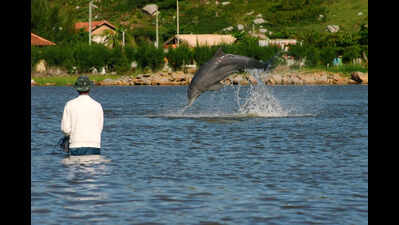
T’puram: Kerala University (KU) has signed a memorandum of agreement with Oregon State University, USA, towards implementing a multi-institutional collaborative project that studies the evolution of the relationship between humans and dolphins.Titled ‘The Ecology and Evolution of Cultural and Cooperative Behavior Among Dolphins and Humans’, the project is supported by National Geographic Society and The Wildlife Intelligence Project.“The evolution of cooperation is one of the most debated topics in science. While the discussion focuses on human-wildlife conflicts, there are a few instances of dolphin- human cooperation in fishing. Such examples are found in the Ashtamudi estuary in Kerala, Ayeyarwady River in Myanmar and the Tramandai inlet in Brazil. This collaborative research project studies dolphin-fisher interactions in these regions and examines how net-casting fishers and dolphins work together to catch fish, benefiting both humans and wild dolphins,” the university said in a statement.This unique human-wildlife interaction raises key questions about how cooperative behaviours evolve in the wild and why this interaction is rare across species. With a focus on these three locations, the research team will test if the same behaviour has evolved there. Further, if the nature of all human-dolphin interactions is cooperative, the research will also identify whether specific ecological conditions have contributed to the evolution of this cooperation. This project will also train KU researchers to establish long-term monitoring of each human-dolphin system and will work to raise global awareness of the rare and declining cooperation between wild animals and humans.Through this project, KU’s department of aquatic biology and fisheries will receive the support of nearly Rs 1.2 crore and the project is scheduled till March 2028. The project, through high-end instruments such as hydrophones and drones, direct photo-documentation of dolphins and their interactions, and interactions with fishers, understands how dolphins and fishers interact and whether the same populations of dolphins exhibit this cooperative behaviour.The project is internationally led by Dr Mauricio Canter, head of the laboratory for animal behavioral interaction research, Oregon State University, and in India by Prof A Biju Kumar, head of dept of aquatic biology fisheries and Kufos vice-chancellor, and Dr Dipani Sutaria, project scientist.Prof Kumar said, “This collaboration is highly relevant to India as Ashtamudi Lake is among the very few places in the world where humans and wild dolphins demonstrate cooperative interactions that benefit both species. Documenting these interactions offers a unique opportunity to understand the evolutionary mechanisms of cooperation in the wild, while simultaneously strengthening India’s global research profile, building local research capacity, and promoting sustainable fishing and conservation practices.”