The first day of Parliament’s Monsoon Session usually begins with security drills, political calculations and the familiar churn of protests and counter-protests. But on July 20, as Parliament prepared to witness another day of political confrontation inside, a different kind of unrest was gathering outside.
By around 11 am, the sound of slogans began to rise near Vijay Chowk. At first, it was difficult to tell where the noise was coming from. Then the message arrived: a massive student march led by the CJP had moved from Jantar Mantar towards Parliament.
Within minutes, the area around Rail Bhavan had changed.
What followed was a tense, hours-long standoff that stretched from Rail Bhavan and the Agriculture Ministry to Rafi Marg, Raisina Road, Kartavya Path, Vayu Seva Bhavan and Seva Teerth Metro Station. Students pushed against barricades, police tried to hold the security perimeter, mobile internet services were suspended and thousands kept moving through the streets.
This is what July 20 looked like from the ground.
A MORNING THAT BEGAN LIKE ANY OTHER PARLIAMENT DAY
The morning had begun at Vijay Chowk, where preparations for the first day of the Monsoon Session were underway. Around 8 am, the focus was on live reporting from the Parliament complex – the likely disruptions, the Opposition’s strategy and the government’s plans for the day.
Security was tighter than usual. Delhi Police, the CRPF and other paramilitary personnel were deployed across the area. On the first day of a Parliament session, such arrangements are not unusual.
But there was no indication that within a few hours, the same stretch of central Delhi would become the centre of one of the biggest student demonstrations of the day.
Around 11 am, the noise began.
The slogans grew louder. Security officials began discussing where the sound was coming from. Then a fellow reporter arrived at Vijay Chowk in a hurry with the news: the CJP-led student march had already begun moving towards Parliament.
At the same time, reports of Opposition protests inside Parliament were emerging.
But outside, a much larger confrontation was taking shape.
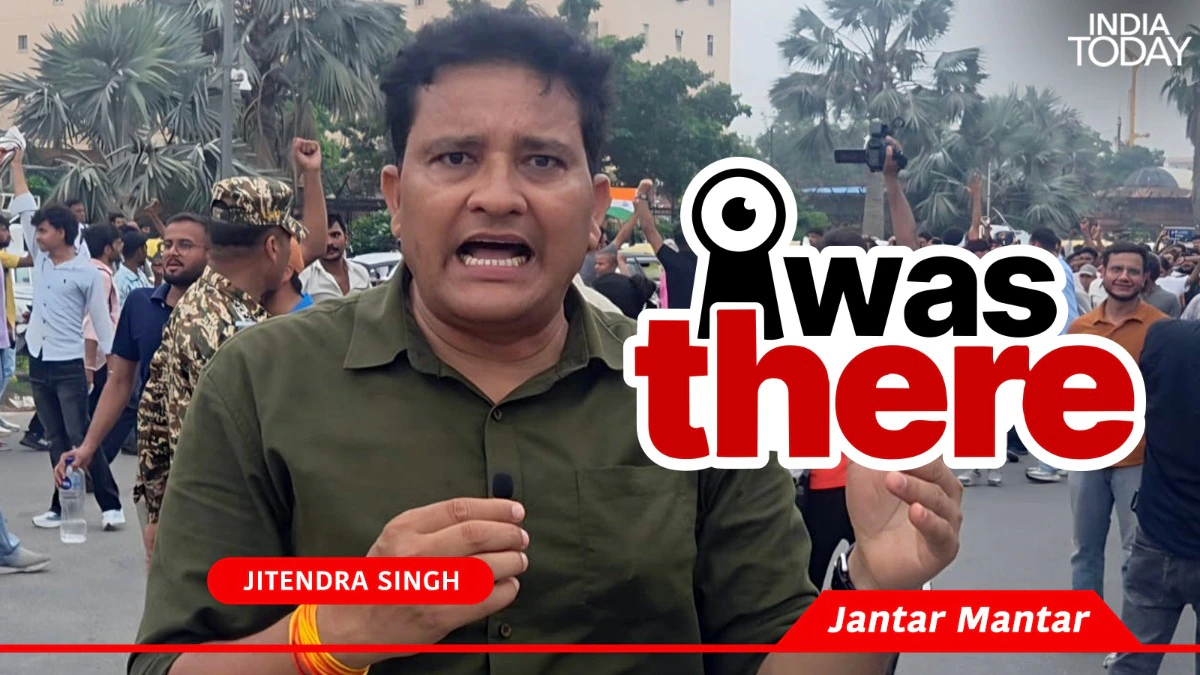
I left the Parliament complex and moved towards Rail Bhavan. By the time I reached the area, the scene had changed completely. Hundreds of protesters had reached Rail Bhavan, the Agriculture Ministry, the Parliament entry points, Rafi Marg and the Raisina Road crossing.
Within minutes, the main entrances of Rail Bhavan and the Agriculture Ministry were shut. The security cordon around the new Parliament building was strengthened.
The slogans were loud and clear.
“Dharmendra Pradhan resign.”
“Stop paper leaks.”
“Justice for students.”
“Compensation for students who died by suicide.”
The crowd was angry. But it was not uniform.
There were young protesters whose faces showed visible frustration and anger. There were also many students who were marching peacefully, trying to make their voices heard by the government.
WHEN THE INTERNET WENT SILENT
A senior police officer soon arrived and took charge of the security arrangements. Journalists were recording videos, sending updates and trying to keep track of the rapidly changing situation.
Then came another development: mobile internet services across the area had been suspended.
At first, it seemed like a network problem. It soon became clear that the services had been temporarily suspended for security reasons.
For journalists on the ground, the shutdown created an immediate problem. Reports were being prepared, but there was no reliable way to send them.
We began looking for places around Rail Bhavan where even a weak internet signal could be found. After several attempts, a spot finally provided connectivity. From there, the first recorded videos, photographs and updates were sent to the office.
But the impact on the protesters was far greater.
People could not contact one another. Many did not know where their leaders were or what the next move was supposed to be.
“Has the march left?”
“Which route should we take to Parliament?”
“Where are the leaders?”
These questions kept coming up.
Later, it emerged that a large group of protesters had already moved towards Parliament ahead of the leaders. Several prominent faces of the movement, including Abhijeet Dipke, were not with that group at the time.
With the internet suspended, the information did not reach the rest of the protesters.
The result was a fragmented crowd.
Some were still waiting around Jantar Mantar for the next announcement. Thousands had already moved towards Parliament.
A CITY TURNED INTO A SECURITY CORDON
We decided to move towards Parliament Marg.
But the roads of Delhi looked less like ordinary streets and more like a maze of security barriers.
There were barricades everywhere. Additional police teams had been deployed. Several routes were closed.
At times, it was difficult to understand which road could actually lead towards Parliament. Between the crowds and the security cordons, the route had to be changed several times.
Eventually, we reached the spot where thousands of protesters had gathered.
Large iron barricades stood between the crowd and the security forces. On the other side were Delhi Police and paramilitary personnel, fully prepared for the possibility of the crowd moving forward.
The protesters kept trying.
Some attempted to move the barricades. Others argued with the police.
The tension grew by the minute.
Police announcements began over loudspeakers. The crowd was told that Section 163 of the Bharatiya Nagarik Suraksha Sanhita was in force in the area and that gathering there was not permitted.
Repeated appeals were made to the protesters to move back.
The slogans did not stop.
A section of the crowd remained peaceful and wanted only to sit and protest. But some young protesters were visibly aggressive, trying to move the barricades and arguing with police personnel.
Then the police began pushing the crowd back.
At some places, a spray was used that caused severe irritation in the eyes. Several protesters were seen rubbing their eyes and moving away. Limited force was later used, and lathis were also used at some points.
The crowd, however, refused to retreat.
THE BARRICADE BREAKS
Then, in a moment that changed the movement of the crowd, several protesters pushed against a barricade together.
The pressure continued.
The barricade finally gave way.
As it broke, thousands of protesters moved forward rapidly. Police personnel moved alongside the crowd, trying to prevent the situation from spiralling completely out of control.
For hours, the confrontation continued.
From Rail Bhavan to Rafi Marg, Raisina Road and Kartavya Path, and further towards Vayu Seva Bhavan and Seva Teerth Metro Station, the pattern remained the same.
The police tried to push the crowd back.
The protesters tried to move forward.
At several metro stations, entry gates were also shut to prevent more people from reaching the area.
The objective of the security agencies was clear: the crowd could not be allowed to reach the security perimeter of Parliament.
But the protest did not simply disappear after every police action.
The protesters regrouped.
Some moved towards the parks near India Gate. The crowd continued to grow there as well. Police teams tried to disperse the protesters, leading to pushing and clashes at several places.
Some protesters and police personnel suffered minor injuries.
THE PEOPLE WATCHING FROM INSIDE
The employees working in and around Rail Bhavan were among those most affected by the situation.
Many watched the events from inside their buildings as the crowd moved through the surrounding roads. The administration repeatedly advised people to remain away from the building boundaries for security reasons.
The protest had turned the area around some of the most heavily guarded government buildings in the country into a moving confrontation between thousands of students and security forces.
By around 3.30 pm, the situation began to ease gradually.
Police teams started removing protesters from Rafi Marg and Raisina Road in phases. The crowd moved towards Connaught Place, Janpath and other surrounding areas, where police continued to manage the situation for some time.
MORE THAN A PROTEST OVER ONE EXAM
By the end of the day, one thing had become increasingly clear.
The movement was no longer limited to a single examination or the demand for the resignation of one minister.
The students I spoke to were angry for different reasons.
Some were frustrated by irregularities in recruitment examinations. Some were angry over unemployment. Others had spent years preparing for competitive exams and felt that the system had failed to provide transparency despite their hard work.
For them, education was not merely about obtaining a degree.
It was about a job.
A future.
A sense of dignity.
The anger on the streets had multiple causes, but it had found a common language.
5,000 PERSONNEL, THOUSANDS OF PROTESTERS
Security agencies had prepared extensively for the first day of Parliament’s Monsoon Session.
Around 5,000 Delhi Police and paramilitary personnel were deployed across the area.
Even with that level of preparation, protesters reaching the entry areas around Parliament and Rail Bhavan posed a major challenge to the security arrangements.
In the days that followed, the government reviewed the events and further strengthened security arrangements.
But on July 20, the question was not only whether the crowd could reach Parliament.
The larger question was what had brought thousands of young people to the streets in the first place.
A QUESTION THAT REMAINED AFTER THE CROWD LEFT
As evening fell and I watched the recordings from the day while returning to the office, one question kept returning.
Was this only a one-day protest?
Or was it a larger political and social warning?
Outside Parliament that day, there were not just slogans.
There were thousands of young people carrying different forms of frustration.
Some held placards.
Some had tears in their eyes after the police action.
Some were trying to recover from the effects of the spray.
Others were simply looking at the security cordons and wondering what would happen next.
As a journalist, I did not see only a protest that day.
I saw what happens when dialogue weakens and the streets begin to speak.
On the first day of Parliament’s Monsoon Session, the student march was not merely a challenge for security agencies. It was also a visible sign of the growing unease among young people over education, recruitment examinations, employment and transparency.
July 20 is no longer just a date in the diary.
It is now part of the memory of a day when, outside Parliament, one of the loudest voices of democracy came from the streets.
And from Rail Bhavan to Seva Teerth Metro Station, every step of that long march seemed to write a new line in the story.
– Ends