










The author is CEO of PaisabazaarFor many salaried individuals, a new financial year begins with bigger paychecks and bonuses. With higher income, the immediate instinct may be to invest in a new mutual fund scheme, increase SIP contributions or explore other investment avenues; but, it also presents a great opportunity to review and rebalance your current investment portfolio. After all, your risk tolerance, financial goals and tax strategies may have changed over the past year. So, it would be prudent to ensure your portfolio is still where you want it to be.
Why Do Portfolios Need a Periodic Review?
When building an investment portfolio, investors decide on an asset allocation. Let’s say, a portfolio comprising 70% equity and 30% debt investments. This allocation should be a well-thought out decision that an investor should make after considering his age, financial goals, income, risk tolerance, etc. Now, an asset class usually generates varying returns over a span of time. This varying performance across the asset classes causes the asset mix to deviate from its original or starting allocation. So, what started out as a 70:30 portfolio might shift to 80:20 in favour of higher equity exposure to meet financial goals.In other words, the asset mix could differ from one’s risk and return objectives and affect the achievement of investment goals. This is where you need to rebalance your investment portfolio. Portfolio rebalancing is simply an exercise for investors to ensure their investment portfolios remain aligned with their financial goals and risk appetite. It helps investors:
- Align their investment portfolios with their financial goals and risk appetite.
- Prevent a single high-performing stock or sector from dominating the entire portfolio.
- Trim overvalued assets and reinvest in areas that are expected to see notable growth.
How Should You Rebalance Your Investment Portfolio?
Investors can rebalance their investment portfolio by following the following process:Review your financial goals & risk appetiteLike the stock market, life is also always in a state of constant flux. Therefore, reviewing your current situation, such as your financial goals is necessary to calibrate investment allocations and ensure your financial roadmap keeps pace with unexpected life changes or market shifts. You also need to reassess your ability to tolerate risks as this might have changed over time. For instance, a young investor with no dependents and financial liabilities may be more comfortable investing a larger portion of his income in equities than someone who’s approaching a major financial goal or retirement.
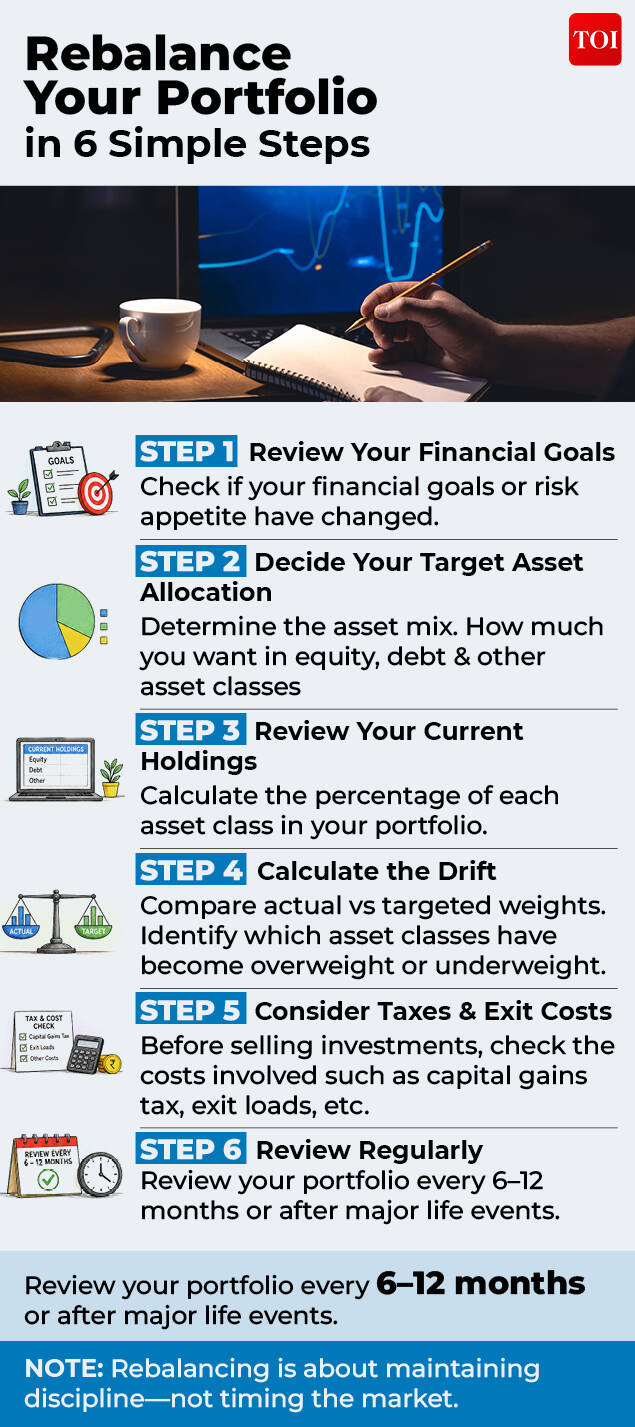
Rebalancing portfolio – 6 simple steps
Know your target allocationOnce you have reviewed and revised your financial goals, determine the target allocation as without this you wouldn’t know what you are rebalancing towards. Your target allocation should reflect your current situation. Therefore, when determining what percentage to have in stocks, gold, real estate and other asset classes, consider your remaining service years, income, financial goals, risk appetite and other influencing factors.Compare current allocation with target allocationNow that you have determined your optimal target allocation, it’s time to look at your current asset allocation. For this, calculate the current value of each asset class (such as equity, debt, gold, real estate, etc.) and note each category as a percentage of your total investment portfolio. Next, compare your current asset allocation with your target allocations to see where you need to add or remove assets to restore your portfolio to your target levels.Decide what to add, trim or leave aloneIf the asset mix in your portfolio matches your target asset allocation, then you don’t need any planning. However, if an asset allocation deviates beyond a predetermined limit, such as five percentage points, you would need to make necessary changes.
- Add new funds or top up existing ones where the allocation is low.
- Stop new investments where the allocation is high. In such overweight asset classes, you may also redeem a small portion, if necessary.
- Switch but only when necessary. Replacing one investment with another can be considered only when your portfolio has drifted significantly from your target allocation or when an existing fund no longer meets your investment objectives due to consistent underperformance or a change in its strategy.
- Pay attention to the impact that various holdings have on your style-box positioning and sector weightings. Your stock portfolio doesn’t need to be an exact clone of the broad market, but you should at least be aware of whether your portfolio is skewing heavily to one style or sector.
Look beyond individual fund performanceA common mistake investors make is replacing mutual funds solely because they underperformed over a short period. Every investment category experiences cycles of outperformance and underperformance. Instead of reacting to recent returns, evaluate whether each fund continues to serve a clear purpose within your portfolio.Avoid owning multiple funds with similar portfolios merely because they have delivered strong recent returns. Excessive overlap reduces the benefits of diversification without necessarily improving outcomes.Review fund’s performanceA common mistake investors make is replacing mutual funds solely because they underperformed over a short period. Every investment category experiences cycles of outperformance and underperformance. Instead of reacting to recent returns, evaluate whether a fund has consistently created value over a full market cycle while adhering to its stated investment strategy.Compare its performance with its benchmark and peers over a longer run, but don’t rely solely on returns. Consider factors such as consistency across different market environments, risk-adjusted performance, downside protection during market corrections, portfolio quality and whether the fund manager has remained disciplined in executing the investment strategy. If a fund has persistently underperformed its benchmark and peers across multiple market cycles without any clear justification, it may indicate a structural issue and warrant a replacement during the rebalancing process.Consider taxes and exit costsRebalancing often involves selling investments, which may attract capital gains tax depending on the holding period and applicable tax rules. These costs should be evaluated before making changes. In some cases, using fresh investments to restore the desired asset allocation may prove more efficient than selling existing holdings immediately.
How Often Should You Rebalance Your Investment Portfolio?
There is no fixed rule for how often you should rebalance your investment portfolio. If you have been investing for let’s say 6 months or 18 months, it may not make sense to rebalance because right now your portfolio must experience one phase of the market cycle to see how it performs under current market conditions. For those holding their portfolios for more than 2 years, a portfolio review every 12 months is usually recommended.
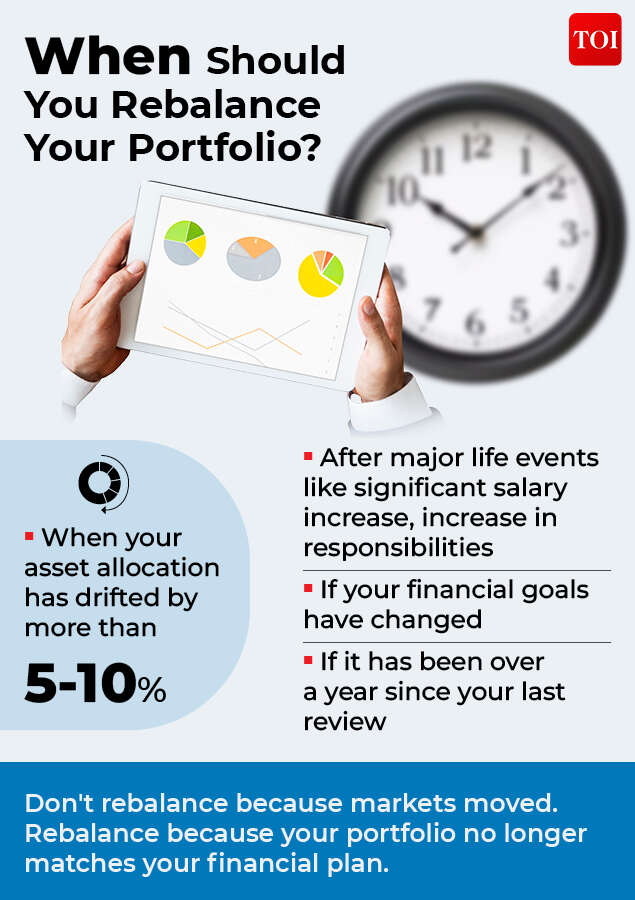
When should you rebalance your portfolio?
Over the long-term, portfolios usually need a periodic relook from both allocation and performance perspectives. With time, as life-stages, risk appetite and goals change, your portfolio may need certain adjustments. For instance, with certain life-goals like your child’s higher education coming closer, you may need to move the parked funds for the goals from equity to fixed income instruments for capital protection and avoid market volatility when you need to redeem.Similarly, when your asset allocation drifts more than 5%-10% points from your target or preferred asset allocation or when a single sector or stock pushes your entire portfolio outside your risk tolerance.Common Rebalancing Mistakes to AvoidHere are some of the common mistakes that investors should avoid when rebalancing their investment portfolios:Rebalancing too frequently: Rebalancing your portfolio too frequently, i.e., every week or month, can lead to unnecessary transaction costs, exit loads and tax implications without providing real benefits. Thus, give your investments some space to grow before you intervene.
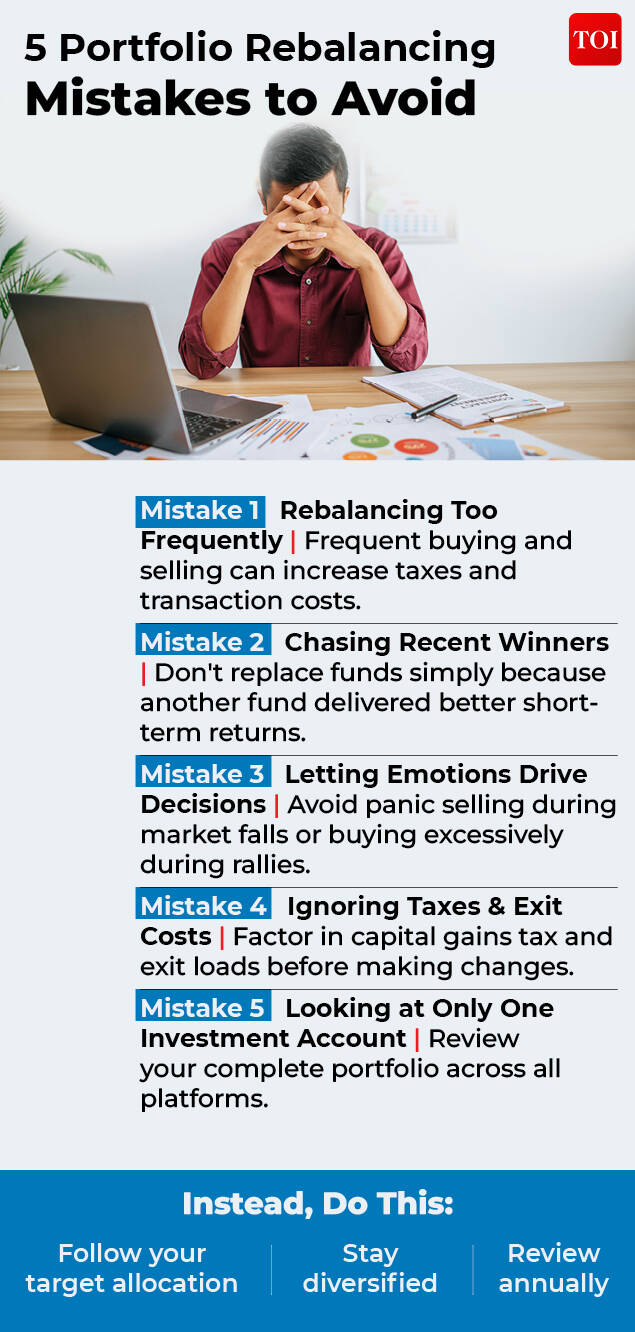
Rebalancing portfolio: 5 Mistakes to avoid
Making decisions emotionally: Selling your best holdings is one of the hardest decisions you can take when rebalancing. When equities are at an all-time high, selling them might feel wrong. When they are falling, buying more might feel terrifying. Financial discipline and a clear, long-term plan should remain the guiding principle through market cycles.Ignoring the whole picture: Many investors rebalance just one account while forgetting about others. Your investment portfolio includes everything across every investment account and platform. Therefore, always look at the bigger and complete picture before making investment decisions.Not reviewing your portfolio: Rebalancing your portfolio is a recurring exercise because with time, you experience growth in your income, shifts in your goals and changes in risk tolerance. To ensure your portfolio aligns with these changes, one should revisit their investment portfolios every few years.