




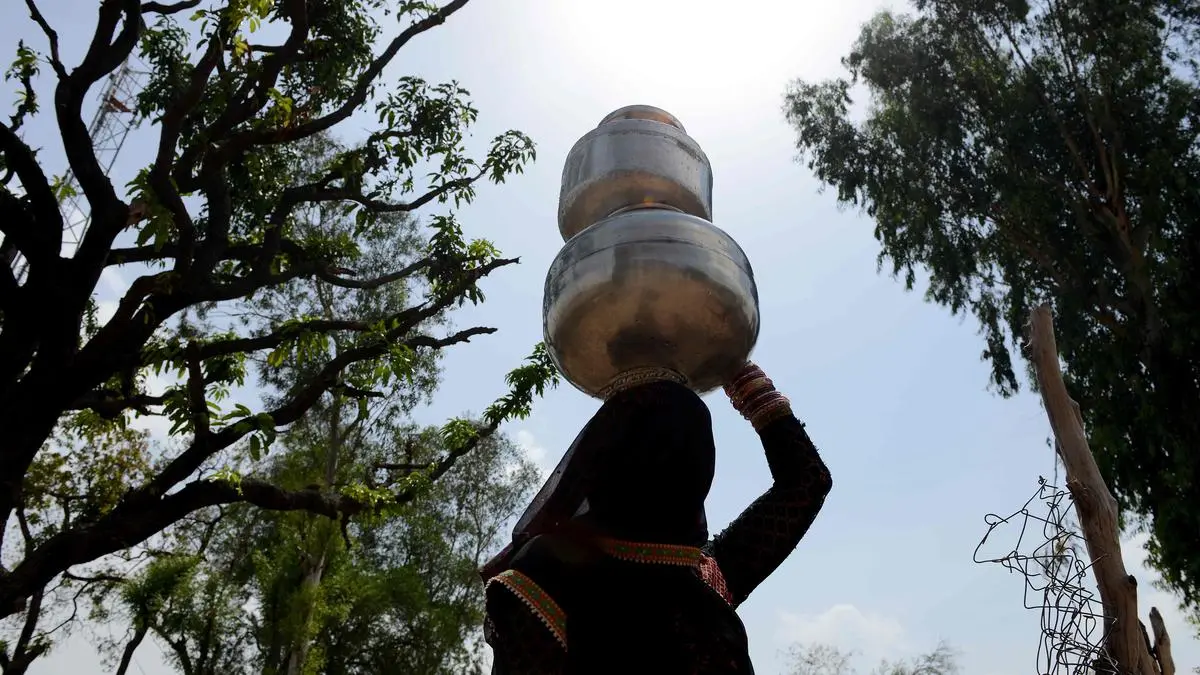
Every summer morning in Barua village, Satna district, Kamlawati Yadav is up before her family. By 6 am she is already walking, one water container balanced on her head, a second carried by hand, covering the half kilometre to a neighbouring household’s private borewell. Her village has both a well and a government-installed hand pump. The well runs dry before April ends and stays that way until the rains return in August or September. The hand pump produces the same result.
So, Kamlawati walks. She will walk again in the evening, covering the same ground twice each day to bring her family of five a total of 72 litres. “Getting water is the first thing I do,” she had told journalist Jigyasa Mishra, who reported from Barua in 2022. “We have to get things done with four buckets of water per day.” Those four buckets deliver roughly 29 litres per person each day, nearly half the 55-litre minimum that India’s own Ministry of Housing and Urban Affairs (MoHUA) recommends for rural households.
Kamlawati’s walk, exhausting as it is, does not carry caste. For Kamlesh Kumari, 36, from an underprivileged household in Bundelkhand’s Hamirpur district, the walk to the water source comes with a second burden. “I can’t remember how many days I stood waiting for hours for water only to return empty-handed because upper-caste men would arrive and cut the line,” she said to the reporter Sadhika Tiwari in 2022. “I still remember how small and humiliated I would feel on my walk back home.”
Two women. Two documented testimonies. One water crisis with two completely different depths of suffering, divided along a line that India has carried since before the republic existed.
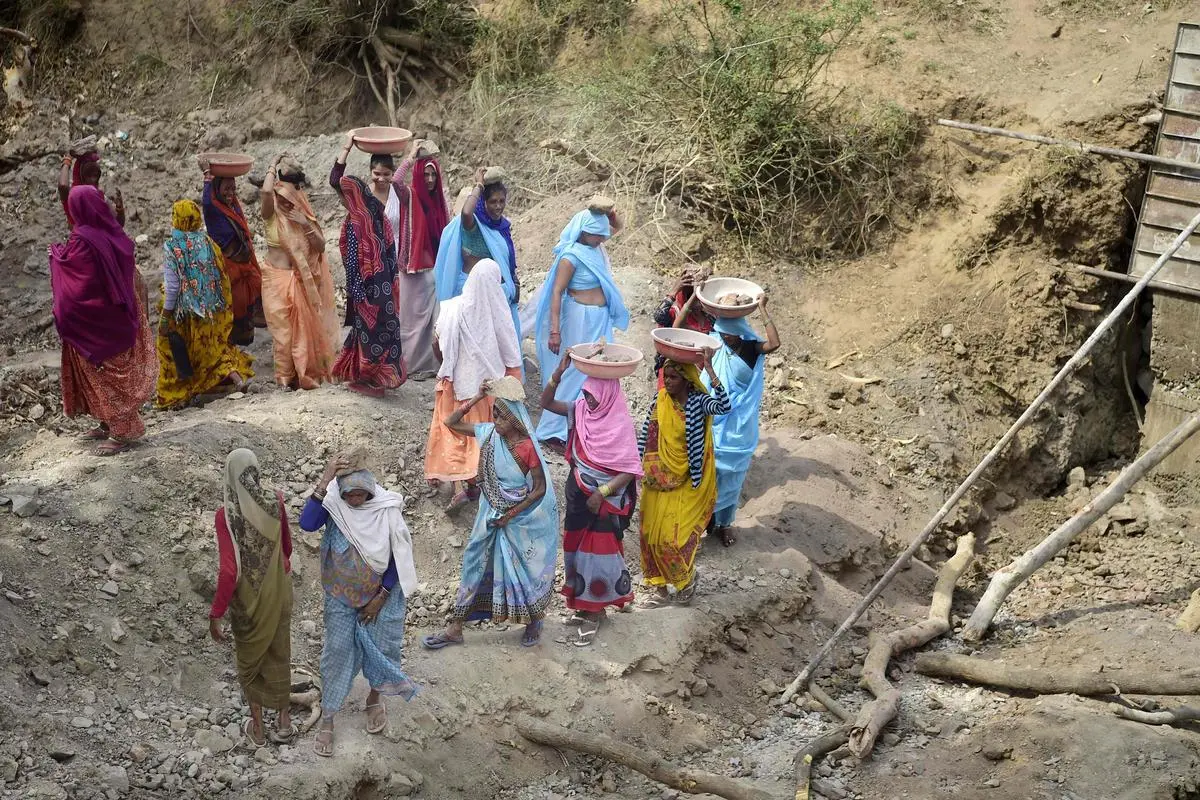
Such cases are far too numerous across India’s drought-prone and socially marginalised regions. From the parched districts of Bundelkhand and Tikamgarh in Madhya Pradesh to the drought-affected stretches of Vidarbha in Maharashtra, and parts of rural Odisha, women continue to bear the disproportionate burden of water scarcity. In many places, the crisis is shaped not only by ecological stress, but also by entrenched inequalities of caste, class, and gender.
The scale of the crisis
India holds nearly 18 per cent of the world’s population but commands access to only about 4 per cent of global freshwater resources. Over 600 million Indians face high to extreme water stress, according to NITI Aayog’s Composite Water Management Index (CWMI). As many as 2,00,000 people die every year from inadequate access to safe drinking water. India is the largest user of groundwater in the world, consuming over 25 per cent of the global total, and 70 per cent of that groundwater is now contaminated with fluoride, arsenic, nitrate, or uranium.
Per capita water availability currently stands at 1,486 cubic metres, already below the international water stress threshold of 1,700 cubic metres. It is projected to fall to 1,140 cubic metres by 2050, well into severe scarcity territory. By 2030, NITI Aayog estimates that demand will be double the available supply.
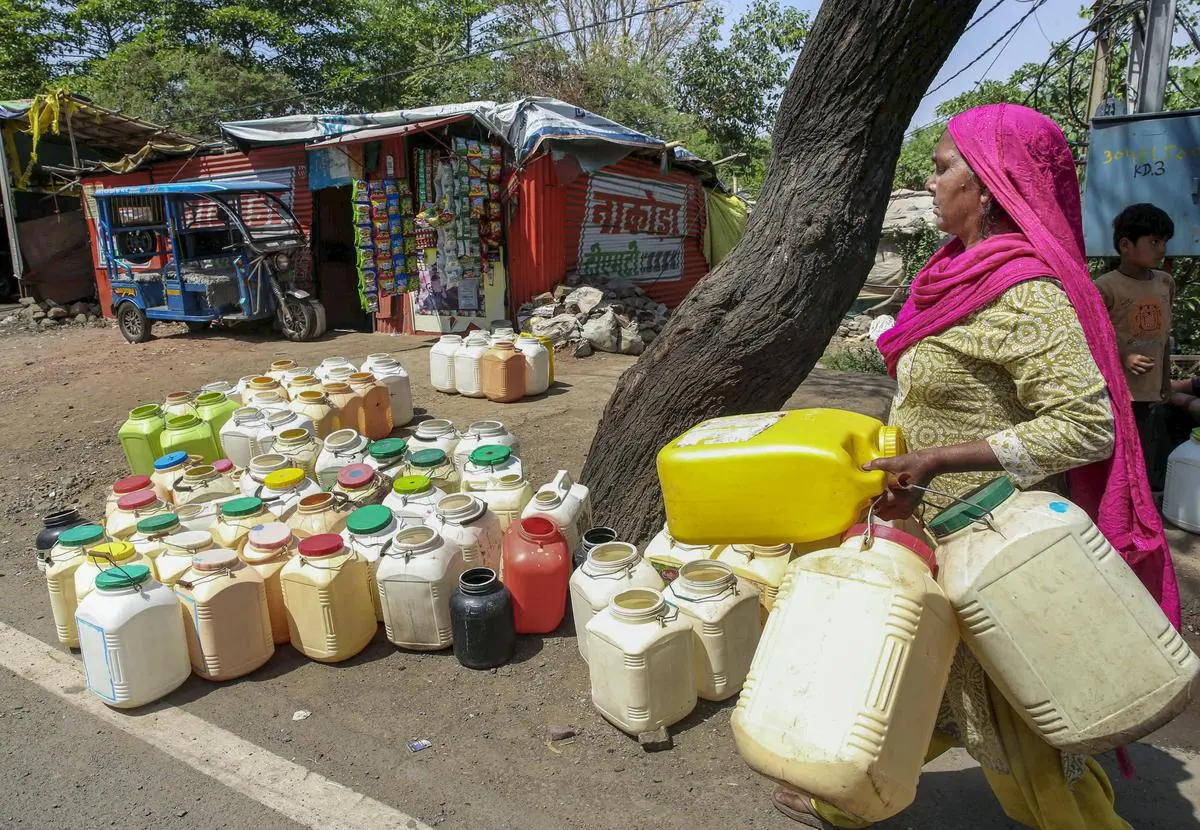
A resident adding her containers to those of others waiting for a drinking water tanker amid water shortages, in Bhopal, on April 13, 2026. When women line up at the community water tank with pitchers and buckets, upper-caste women fill their vessels first. Dalit women wait until they are done.
| Photo Credit:
PTI
The government’s Jal Jeevan Mission, launched in 2019, has on paper connected 81.7 per cent of rural households to piped water. Between 2006 and 2016, 60 per cent of Bundelkhand’s wells recorded a four-metre fall in groundwater. Groundwater extraction in Mahoba, Chitrakoot, Lalitpur, and Hamirpur districts has consistently run above 70 per cent of annual recharge. Lalitpur, Chitrakoot, and Mahoba districts have seen no improvement in groundwater depletion after rains because of ongoing mining and hard rock terrain, said Gunjan Mishra, an environmentalist based in Chitrakoot. The pipes arrive. The water often does not.
The wells that have always known caste
Almost a century before Kamlesh Kumari stood humiliated at the water queue in Hamirpur, Babasaheb Ambedkar led 3,000 Dalits to the public tank at Mahad, Maharashtra, in 1927 to drink water they were constitutionally owed but socially forbidden from touching. They were attacked. The tank was ritually purified afterwards to remove the pollution of Dalit presence. Nearly a hundred years later, the violence has changed its form. Now, it does not arrive as a mob but is a queue that reorganises itself the moment upper-caste men walk in.
Field research documented in Adhiyara village, Banda district, records what that reorganisation looks like in practice. When women line up at the community water tank with pitchers and buckets, upper-caste women fill their vessels first. Dalit women wait until they are done. This is a current field observation, not a historical one. And it repeats across hundreds of villages in Uttar Pradesh, Rajasthan, and Madhya Pradesh.
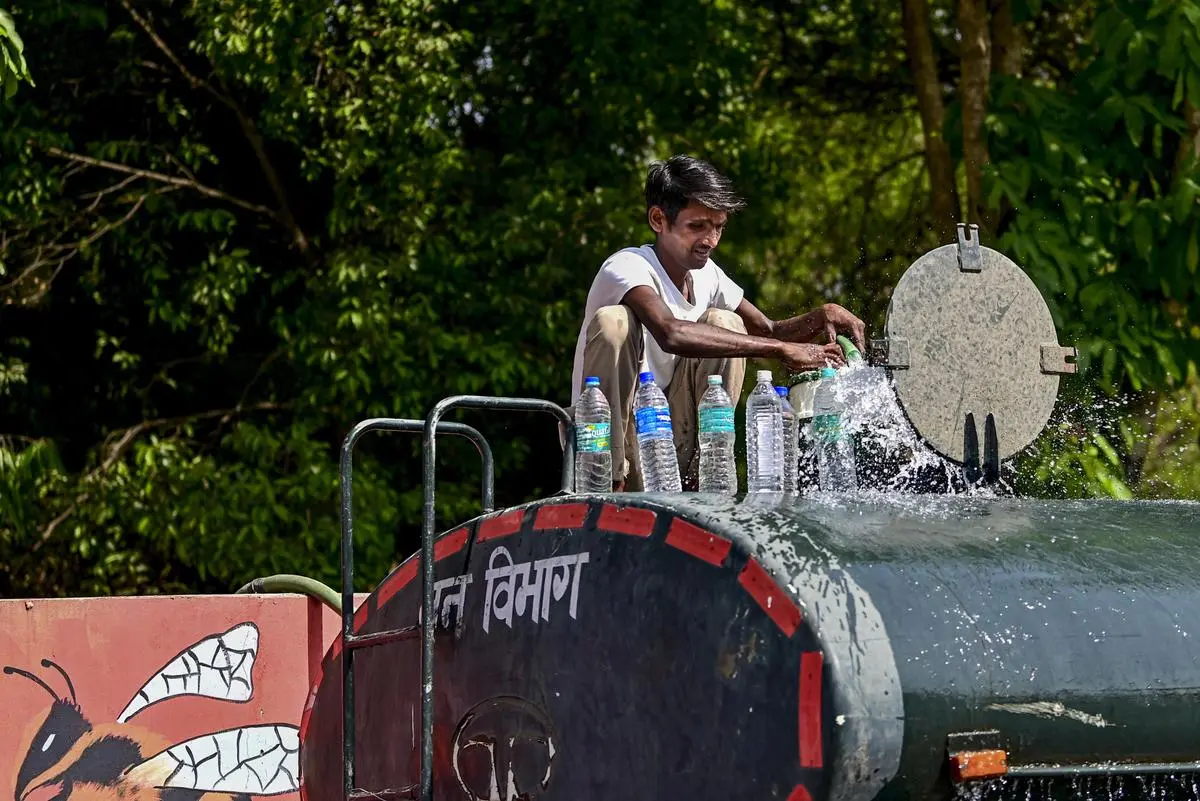
A man filling water bottles on top of a water tanker, in Prayagraj, Uttar Pradesh, on April 17, 2026. By 2030, NITI Aayog estimates that demand for water will be double the available supply.
| Photo Credit:
PTI
A 2022 study published in the journal Water confirms the structural pattern. Dalits, who make up 16 per cent of India’s population, have historically been and continue to be denied access to common water sources across rural India. Caste-based water discrimination between cities and villages traces directly to piped water availability: where pipes reach, private control over water sources weakens. Where they do not, upper-caste control over wells and tanks holds. Caste is not incidental to India’s water crisis. It is structural to it.
Kamlesh Kumari knew this before any study confirmed it. Her humiliation at the water queue, her silent walk home with empty vessels, is the lived experience that the data describes.
A dam for whom?
The government offers a solution at scale. The Ken-Betwa river interlinking project, with its foundation stone laid by Prime Minister Narendra Modi on December 25, 2024, proposes a 77-metre dam on the Ken River in Panna, Madhya Pradesh, linked to the Betwa via a 221-km canal. The stated benefits are significant. The Rs.44,605 crore project promises drinking water to 62 lakh people and irrigation in 10.62 lakh hectares (ha) across Madhya Pradesh and Uttar Pradesh, in a region that averages only 80 to 90 cm of rain annually.
At the foundation stone ceremony in Khajuraho, Modi declared the project would “open new doors of prosperity in Bundelkhand”, describing it as his “responsibility to free the drought-affected” people of the region. Madhya Pradesh Chief Minister Mohan Yadav, sharing the stage, called Modi the “Bhagirath of Bundelkhand”—invoking the mythological king said to have brought the Ganga to earth. The ceremony was held on December 25, timed to the birth centenary of former Prime Minister Atal Bihari Vajpayee, whose government first proposed river interlinking as a national solution.
The people in whose name the project is built have a different account.
The project submerges 9,000 ha of rural and forested land, including 4,141 ha inside the core zone of the Panna Tiger Reserve. It displaces an estimated 5,000 families in Chhatarpur and 1,400 in Panna. Bhanu Pratap, a resident of Palkoha village in Bijawar tehsil whose land falls inside the submergence zone, received Rs.15,00,000 for three acres in compensation. Other families fared worse. Reports from Panna document rehabilitation amounts as low as Rs.16 and Rs.200, sums that cannot buy a sack of grain, let alone a life.
| Indicator | Data | Source |
| Indians facing high to extreme water stress | 600 million | NITI Aayog CWMI |
| Annual deaths from inadequate safe water | 2,00,000 | NITI Aayog CWMI |
| Per capita water availability (2021) | 1,486 cubic metres | National Commission on Integrated Water Resources Development |
| Projected per capita water by 2050 | 1,140 cubic metres | NITI Aayog |
| Contaminated groundwater share | 70 per cent | Central Ground Water Board report 2024 |
| Kamlawati’s daily water per person | 29 litres (min. recommended: 55) | The Third Pole/MoHUA |
| Women affected by acute water shortage in Bundelkhand | Up to 70 per cent | Abhiyan NGO, Chitrakoot |
The project’s scientific premise is also contested. When the Ken and Betwa basins are adjacent to each other and share similar rainfall patterns, experiencing droughts and floods simultaneously, the concept of transferring surplus water from one to the other becomes scientifically questionable, said Ravi Chopra, founder of the People’s Science Institute. The hydrological data used to justify the project has not been shared transparently and appears dated, argued Himanshu Thakkar of the South Asia Network on Dams, Rivers and People. The government’s own Central Ground Water Board added an ironic footnote: its 2024 assessment found 10 of 14 Bundelkhand districts to have safe groundwater levels, meaning extraction runs below 70 per cent of annual recharge. Proven, cheaper groundwater recharge interventions remain partially implemented while the Rs.44,605 crore dam has advanced.
By April 2026, protests across Chhatarpur and Panna intensified sharply, with tribal women staging pyre protests against displacement. India’s large infrastructure has a long record of subsidising the lifestyles of the powerful with the lands of the powerless. A huge percentage of those displaced by large dam projects in India have been tribal people and Dalits, groups that together constitute less than a quarter of the population but bear the majority of displacement costs. The Adivasis of Panna did not create Bundelkhand’s water crisis. They now pay for it with their villages.
The right to water
India’s Supreme Court has been clear on the right to water for three decades. In Subhash Kumar v. State of Bihar (1991), it held that the right to life under Article 21 includes the right to pollution-free water. In A.P. Pollution Control Board II v. Prof. M.V. Nayudu (2000), it held that the state carries a constitutional duty to provide clean drinking water. Ambedkar built the right to water into the constitutional framework. The court has affirmed it repeatedly.
The gap between these rulings and Kamlawati Yadav’s 6 am walk in Barua village is not accidental. The absence of a codified national water rights law means that marginalised communities cannot effectively claim water access through legal means without significant time, money, and legal support. A Dalit woman excluded from the village tank cannot file a writ petition as easily as an upper-caste landlord can sink a deeper borewell. The constitutional right to water remains aspirational for those who need it most.
Jal Saheli (friends of water) volunteers constructing a check dam in Agrotha village, Tikamgarh, Madhya Pradesh, on June 9, 2022.
| Photo Credit:
Sanjay Kanojia/AFP
There is a counter-model running quietly in Bundelkhand. Since 2011, Parmarth Samaj Sevi Sansthan has trained women who once walked miles for water to become water conservation managers in their own communities. Today, 1,530 Jal Sahelis work across 321 villages, reviving rainwater harvesting systems, shifting agricultural water use, and holding local panchayats accountable for what gets installed and what actually flows. They did not wait for the state. Pushpa Vishwakarma, 40, who set up the Jal Saheli group in her village in Lalitpur, put it plainly in a report: “Trekking long distances to fetch drinking water was a routine. Farming, household chores and then fetching water were taking a toll on our health and family life.” She did not wait for the Rs.44,605 crore canal. She built a check dam.
This is what water justice looks like when it is genuine. Not as a foundation stone laid before television cameras, but as a woman who reads the water table, teaches about it to her neighbour, and then demands that the panchayat officer file his report honestly.
In 2022, when journalist Jigyasa Mishra visited Barua village in Satna district, Kamlawati Yadav woke up at 6 am and walked half a kilometre to a private borewell, one container on her head, one in her hand, carrying 29 litres home for a family of five. It is now 2026. Whether her village has since received a Jal Jeevan Mission (JJM) tap, whether that tap produces water when she turns it on, whether she still walks—we do not know.
What is known is that the State of India’s Environment 2026 report has confirmed that freshwater change is among the seven planetary boundaries now globally breached, and that the government’s own 2024 Functionality Assessment Survey found only about three-quarters of JJM-connected households actually receiving regular, safe, and adequate water. That gap, between what the dashboard records and what reaches the vessel, is precisely the gap this article has tried to describe. India’s water crisis is ultimately a question of whom the republic considers worth delivering to. Ambedkar asked it first at Mahad in 1927. Kamlesh Kumari asked it again at a water queue in Hamirpur. The rivers have been asking it for much longer.
Ankit Mishra is an ICSSR Fellow at Govind Ballabh Pant Social Science Institute, Prayagraj, specialising in political ecology, environmental politics, climate governance, and public policy. He regularly writes on environmental governance, public policy issues and democratic policy challenges. Samanta Sahu is an associate professor of Political Science at Govind Ballabh Pant Social Science Institute, Prayagraj. His work specialises in water governance, public policy issues, and resource management and development.
Also Read | Ken-Betwa’s first flood may arrive before the dam fills
Also Read | How Jal Jeevan Mission has failed drought-prone Bundelkhand