




Across the fertile plains of Punjab and Haryana, the once-abundant groundwater that powered the ‘Green Revolution’ is rapidly vanishing. Decades of intensive paddy-wheat cultivation, unchecked tube-well extraction, inefficient canal systems, industrial pollution, and climate pressures have pushed the water table into a steep decline in many areas.
Farmers are drilling deeper, spending lakhs of rupees on submersible pumps, watching kinnow and other orchards wither, and facing saline or contaminated water that threatens both crops and human health. While some pockets see paradoxical rises in water levels due to canal seepage, the water is often too brackish for use.
Ground reality from key districts paints a picture of mounting desperation, broken promises, and urgent calls for crop diversification, canal revival, and recharge measures.
DHOL PROTESTS IN FAZILKA
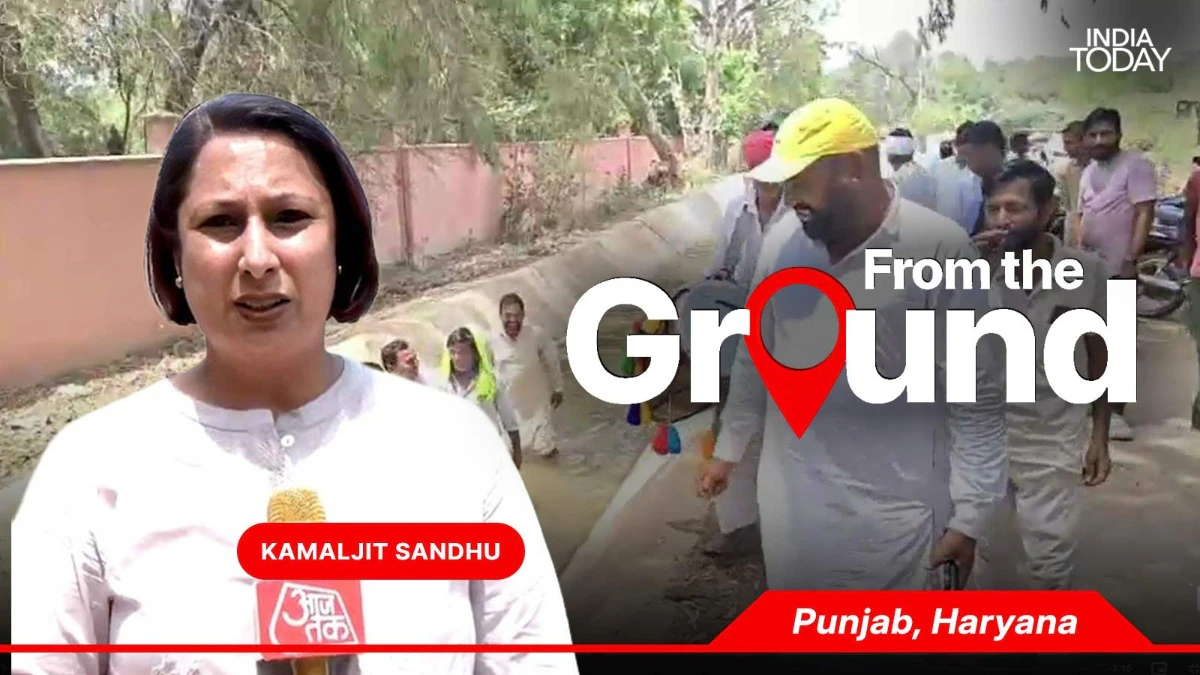
In Punjab‘s Fazilka district, the crisis has boiled over into open protests. Farmers in villages like Bohar and Kalar Khera, along the Kalar Khera canal, are furious that tail-end (taluka) areas receive little to no canal water despite government claims of reaching every field.
Farmers beat drums (dhols) in a traditional “siapa” (lament) against the administration, raising slogans against the government. Kinnow orchards — a key cash crop — are on the brink of ruin due to water scarcity.
“We have submitted many memorandums to the administration and irrigation department, but no concrete action has been taken,” said affected farmers. They warned of intensifying the struggle if tail-end villages are not given their full share of water.
DEEPER BOREWELLS, SKYROCKETING COSTS
In Punjab’s Mansa, the water table’s relentless drop has forced farmers to abandon traditional engines and monoblock motors. Submersible pumps are now lowered 200–300 feet deep using specialised techniques.
Farmer Amrik Singh from Makhha village, with 20 years of experience, described the shift saying, “Earlier, a full-tube-well boring cost Rs 30,000–40,000. Now, installing a submersible motor costs Rs 1–2 lakh. Factories are wasting water on a large scale, but farmers bear the brunt.”
He stressed that crops cannot grow without water, urging accountability beyond just agriculture.
Sangrur stands out as a stark example of the crisis gripping many parts of Punjab. Decades of large-scale paddy cultivation have accelerated groundwater depletion in the district, as confirmed by experts and reports.
Farmer Manpreet Singh reflected on a drastic change he has witnessed over the past decades. “Once, we used to draw water from wells with plenty available. Now, everything depends on submersible pumps. Every year, the level drops further, forcing us to add new delivery pipes at our own expense. Costs keep rising,” he said.
He also noted the lack of viable alternatives under the current system. Farmers grow wheat and paddy because of assured markets and MSP, though some, like Manpreet, have experimented with maize for fodder.
His deepest worry is for the next generation: “If the water table keeps falling, what will our children inherit?”
BASMATI: PREMIUM EXPORT DRIVING CRISIS
Punjab’s world-renowned Basmati rice, famous for its aroma, long grains, and high market value (with record exports contributing significantly to India’s basmati trade), has become one of the biggest contributors to the state’s deepening groundwater crisis.
While it offers strong economic returns to farmers – often cited as a reason for its continued cultivation despite alternatives – it is highly water-intensive, consuming approximately 4,000–5,000 litres of water per kilogram produced, with a heavy dependence on groundwater irrigation in the region.
The latest official assessment carried out under the CGWB National Compilation on Dynamic Ground Water Resources of India, 2025 suggests that Punjab has 111 over-exploited blocks commonly called “dark zones.”
Stage of groundwater extraction in Punjab: 156.36% – the highest in India, meaning the state extracts far more groundwater than is annually recharged, which means that farmers every summer are facing a worsening crisis.
EXPERTS ECHO CONCERNS
Gurmant Singh of the Confederation of Food and Agro Industries pointed to heat stress reducing yields per hectare and the need for common ground between producers and consumers, advocating millets for nutrition and sustainability.
Another agricultural expert from Amritsar, Paramjit Singh, urged shifting from paddy-wheat to canal-reliant patterns, praising some state government initiatives.
Agricultural expert Davinder Sharma pointed out that paddy’s high water use (3,000-5,000 litres per kg of rice) is compounded by ethanol production demands (up to 10,000 litres per litre of ethanol, per India Today reports), calling for stronger canal systems, warabandi (rotational allocation of water for irrigation) enforcement, and balanced burden-sharing instead of targeting only farmers.
PUNJAB’S WATER TABLE FALLING
In Charkhi Dadri, the groundwater crisis is among the most severe, with the water table reportedly falling by 10–15 feet each year, raising fears that the once-fertile region could gradually turn arid. In Umrawas village of Badhra tehsil, farmer Radheshyam recalled that groundwater was available at a depth of around 100 feet just a few years ago, and installing a tube-well cost approximately Rs 1 lakh.
Today, however, water is often unavailable even at depths of 350–400 feet, while drilling a borewell can cost up to Rs 10 lakh—far beyond the reach of most small farmers. Even after making such investments, many borewells run dry quickly, pushing farmers deeper into debt and financial distress.
Omprakash, from Kari village, said canal water once supported diverse crops like gram, wheat, and mustard; now gram is gone, costs have doubled, and profits halved.
Harpal Singh Bhandwa, a district-level office bearer of the Bharatiya Kisan Union (BKU) in Haryana, warned of saline, “poisonous” water turning soil hard and causing cancer, joint pain, and stomach ailments, effectively draining family incomes into hospitals. He demanded better canal management and diggis (ponds).
Agriculture and groundwater expert Chandrabhan Sheoran identified over-extraction, deforestation, and canal failures as root causes. Possible solutions include farm-level water conservation (recharging bores, soaking pits), de-silting ponds, linking them to canals, and shifting to drip/micro-irrigation.
CONTRASTING REALITIES: ROHTAK AND SONIPAT
In Haryana’s Rohtak, the water table has paradoxically risen (now 5–25 feet in places like Sampla, Maham) due to canal irrigation and the 1995 floods, but the water is largely saline – unfit for drinking or irrigation. Officials like Dalbir Singh from the Groundwater Cell point to the shift from sweet water (30–40 feet in 1985) amid rising paddy cultivation.
Farmer leaders like Prit Singh and Rampal Suhag agree that the quality crisis forces continued canal dependence. In nearby Sonipat, however, villages near Kundli, Rai, Murthal, Ganuar, and Kharkhoda face acute drinking water shortages and contamination from factory effluents.
Residents are forced to line up at handpumps near canals, sometimes after travelling 15 km. Livestock rearing has declined in the area. Officials like Dalbir Dalal, from the Public Health Department, and Dr Satyawan, an Assistant Soil Conservation Officer, acknowledged efforts to refill water houses and warned of paddy’s role in depletion, urging crop changes.
THE ROAD AHEAD
Haryana’s Development and Panchayat Minister, Krishan Lal Panwar, has announced measures to address groundwater scarcity concerns, including identification of 39 “dark zones”, plans for tube-wells near canals to balance levels, de-silting and beautification of 2,200-9,000 silt-affected ponds, and improved rural sanitation with more tractors
Yet, farmers and experts demand more: guaranteed MSP for millets and less water-intensive crops, robust canal networks with timely warabandi, strict industrial effluent treatment, widespread recharge structures, and research into low-water varieties while protecting Basmati GI tags and exports.
The groundwater table’s decline is not just an agricultural issue, it threatens food security, public health, and rural economies in India’s breadbasket. Without urgent and collective action by governments, scientists, and farmers, the “siapa” of today may foreshadow far greater losses tomorrow.
– Ends