









With an outlay of over Rs 1.27 lakh crore India has launched the second phase of its ambitious semiconductor programme. Globally, a semiconductor supercycle is underway. If artificial intelligence is reshaping businesses world over, semiconductors are the building blocks for this shift.“In boardrooms across the semiconductor industry, the conversation has shifted. For years, leaders asked when the cycle would turn. Today, they’re asking how fast they can build. The real demand for AI suggests that the semiconductor supercycle may be underway,” KPMG said in its 2026 Global Semiconductor Outlook report.According to McKinsey, the semiconductor industry is now one of the world’s most profitable sectors. In fact, McKinsey estimates that the semiconductor industry could reach $1.6 trillion in revenue by 2030!One has to only look at the new records that US and South Korean stock markets have scaled driven by AI-led semiconductor demand. As semiconductors define the next big growth phase globally, where does India stand?Semiconductors sit underneath almost everything today: electronics, EVs, telecom, AI, data centres, defence, manufacturing.So having a self-reliant semiconductor ecosystem is an absolute necessity in the current globally uncertain economic and geopolitical environment.“If a country of India’s size stays dependent on outside supply chains for something this fundamental, that’s a real vulnerability, both economically and strategically,” Saurabh Agarwal, Partner, EY India tells TOI.What is India’s semiconductor plan? Can it compete against established players like the US, Taiwan, and South Korea?
India’s big semiconductor push
Through its mission, India is aiming to build an integrated semiconductor and AI ecosystem that spans chip design, fabrication, advanced packaging, research, talent, and computer infrastructure.India’s semiconductor push can be seen in two phases: Semicon 1 which had an outlay of Rs 76,000 crore, and the recently approved Semicon 2.0 which has a Cabinet nod of Rs 1,27,500 crore.So far, 12 semiconductor projects with investment commitments of over Rs 1.64 lakh crore have been approved; three facilities are already in commercial production.
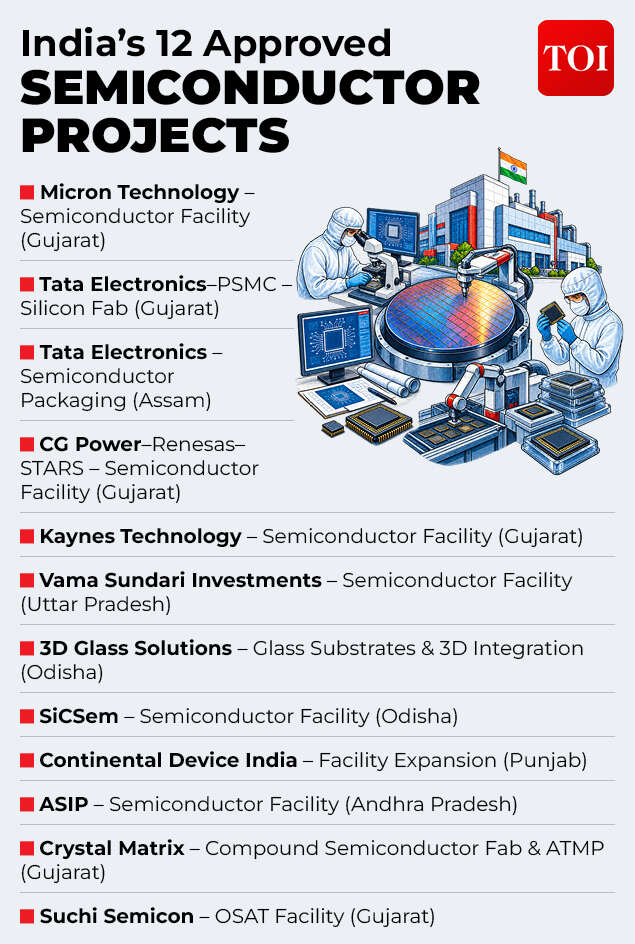
India’s 12 Approved Semiconductor Projects
Meanwhile, semiconductor design capabilities are being expanded through skilling programmes, startup support and global partnerships.Semicon 1.0 provided fiscal support of up to 50% for silicon fabrication plants, compound semiconductor units, semiconductor assembly and testing facilities, and chip design.India Semiconductor Mission 2.0 prioritises domestic production of semiconductor equipment and materials, development of an end-to-end Indian semiconductor intellectual property stack.Industry estimates place the Indian semiconductor market at around $38 billion in 2023, rising to approximately $45-50 billion during 2024-25. The market is projected to expand further to $100-110 billion by 2030.The government hopes that India can develop the capability to design and manufacture chips catering to nearly 70-75% of its domestic demand by 2029.Building on this base, Semicon 2.0 aims to accelerate advanced chip manufacturing, with a defined roadmap for achieving 3-nanometre and 2-nanometre technology nodes.Semicon 2.0 focuses on six pillars: chip design, semiconductor equipment and materials, fabrication facilities, advanced packaging (ATMP/OSAT), research and development, and talent development.With this India is looking to position itself as a global semiconductor hub with an aim to strengthen the entire semiconductor value chain, attract more chipmakers, support indigenous intellectual property, advance semiconductor technologies.
India entering a game-changing phase?
Experts see Semicon 2.0 as a potential gamechanger for India. Saurabh Agarwal, Partner of EY India says that while the first phase was about getting manufacturing capability off the ground, the second one is broader: design, fabs, packaging, materials, equipment, R&D and talent, all at once.“Done well, it can lift domestic value addition in electronics, pull in large investments, create serious engineering and manufacturing jobs, strengthen India’s place in global supply chains, and push homegrown IP forward,” he says.
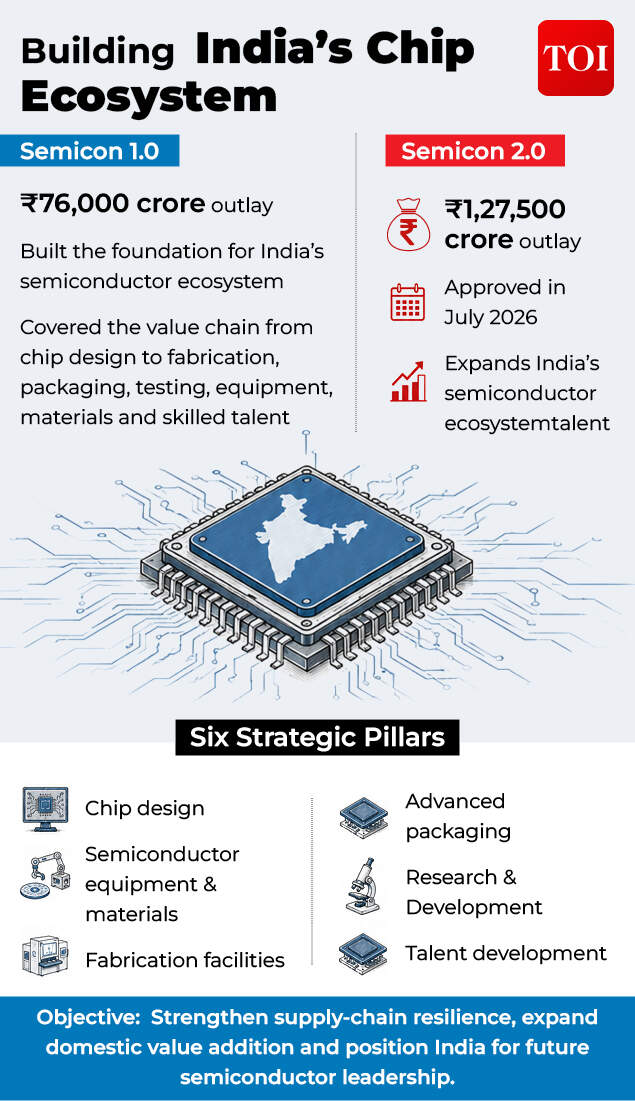
Building India’s Chip Ecosystem
The bigger shift is this: India stops being just a buyer of semiconductor technology and starts becoming a maker of it. Over the next ten years, semiconductors could do for India what software did over the last thirty, becoming a whole new engine of growth and self-reliance, Agarwal says.Experts also see the mission as a way to create high-skilled jobs in semicon industry and indirect employment across supply chains and supporting industries.“For electronics manufacturing, the initiative can help India move beyond assembly and increase domestic value addition by developing local component and semiconductor capabilities,” says Grant Thornton Bharat’s Krishan Arora.“From a technological self-reliance perspective, Semicon India 2.0 can reduce dependence on imported chips, strengthen supply-chain resilience, and build domestic expertise in semiconductor design, manufacturing, and advanced packaging,” he adds.But as Shivani Parashar says, ultimately, the success will depend not just on the number of projects India attracts, but on how much technology, IP, jobs and value India can build within the country.Saurabh Agarwal of EY India cautions that the next stage is harder. It’s about going deeper, not just wider.“Fabs get the attention, but the real test is whether we build out the rest: equipment, specialty materials, gases and chemicals, research infrastructure, and skilled people,” he says.
US, Taiwan, China, South Korea for chips: What about India?
Experts believe India is uniquely positioned. Asked whether India would be able to match what China, South Korea have managed to achieve in their semiconductor journey, experts say India can create a differentiated semiconductor ecosystem.“India’s strongest competitive edge lies not in immediately matching Taiwan, South Korea, or China in advanced chip fabrication, but in building a differentiated semiconductor ecosystem,” says Krishan Arora, Partner and Leader Investment Advisory, Grant Thornton Bharat.The country combines a large pool of chip design talent, strong engineering capabilities, growing government support, rising domestic demand, and increasing interest from global companies seeking to diversify supply chains beyond traditional manufacturing hubs.“India’s biggest advantage in the semiconductor industry is its large pool of skilled engineers and strong R&D talent. Many of the world’s leading chip companies already run design and research centers in India, giving the country deep expertise in chip design and innovation. This strong talent base puts India in a unique position to build a competitive semiconductor ecosystem for the future,” he tells TOI.
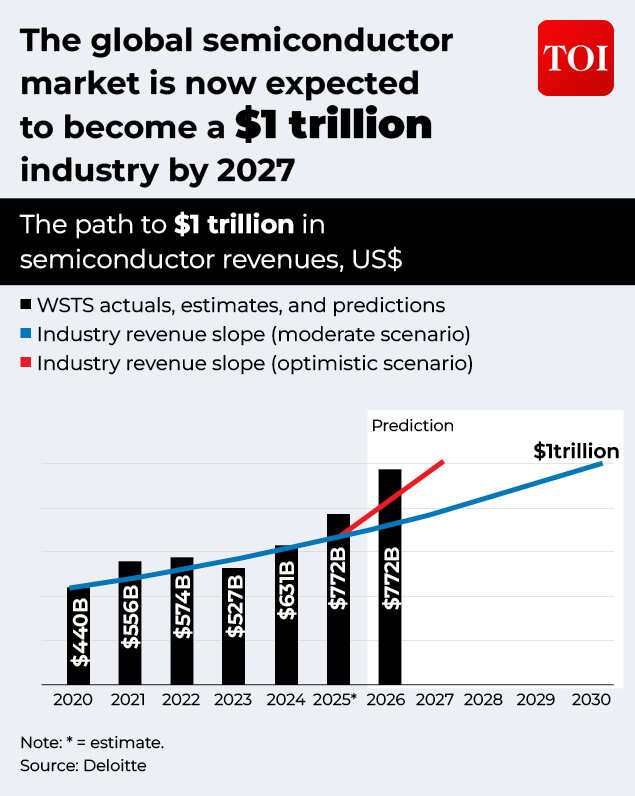
Global Semiconductor market projections
But Shivani Parashar notes that India’s semiconductor ecosystem is still heavily service oriented rather than product led. The challenge is not just having the engineering capability to design chips, but identifying large global markets and building products around them.“Commercialization remains one of the biggest gaps. The missing piece is converting India’s engineering talent into globally successful semiconductor businesses,” she says.Saurabh Agarwal believes India should pick the parts of the value chain where it can genuinely be world class.He says that India already has some real advantages: one of the deepest semiconductor design talent pools anywhere, a domestic electronics market that’s growing fast, strong policy backing, solid engineering capability, and a geopolitical position that global supply chains trust.“That combination can make India a serious player in design, advanced packaging, compound semiconductors, specialty materials, equipment, and eventually mature node fabrication too. The goal isn’t to beat the existing leaders at their own game, it’s to become a partner the global ecosystem can’t do without,” he tells TOI.
Road ahead
The semiconductor sector is characterised by long development cycles, high capital requirements and sustained investment in research and development. Achieving India’s semiconductor goals will therefore require a long-term strategy that addresses existing challenges while steadily building domestic capabilities. Experts note that capital outlay would be important.“From a policy perspective, consistency, speed and access to patient capital will be critical. Semiconductor projects have long development cycles and require significant investment, making predictable incentives, faster clearances and reliable infrastructure essential,” says Shivani Parashar of Counterpoint Research.
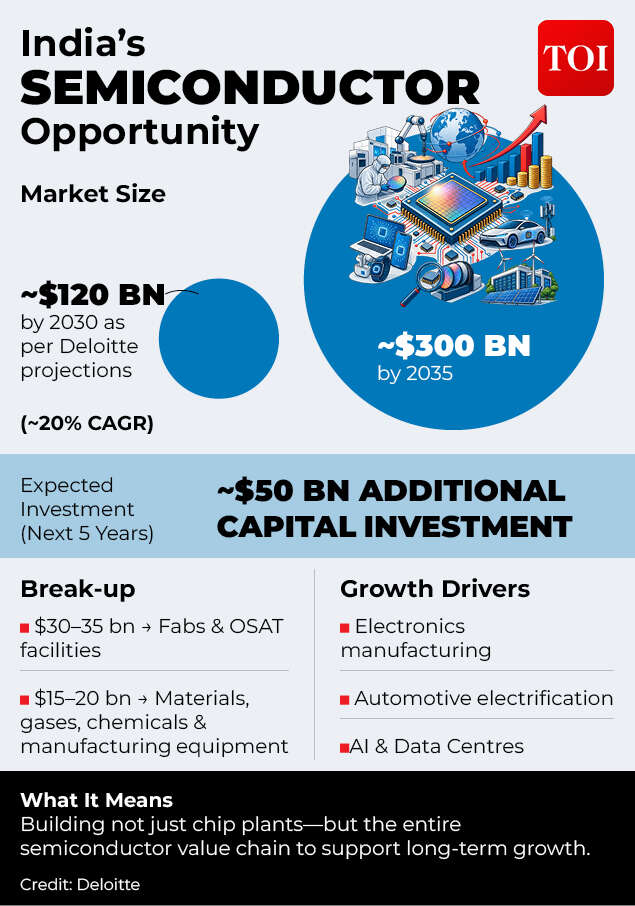
India’s Semiconductor opportunity: The numbers
“India also needs a stronger venture capital ecosystem capable of supporting 7-10 year development cycles, multiple tape-outs and deep-tech commercialization, without which many startups may struggle to move beyond first silicon,” she adds.She also believes that incentives should increasingly reward outcomes such as IP creation, product commercialization, production volumes, and revenue generation, rather than design activity alone.“The goal should be to move from being a design destination to becoming a creator and owner of globally competitive semiconductor products and intellectual property,” she concludes.According to Saurabh Agarwal, policy needs to move from handing out project specific incentives to actually building an ecosystem, backing R&D, forming global tech partnerships, and creating demand for what we design and make here.As the EY expert says: A few years ago, semiconductors in India were mostly a talking point. That’s changed. We now have real projects on the ground.But that’s just a starting point to a long road.With its semiconductor mission, India has taken definitive steps to establish itself as a credible player in the global semiconductor ecosystem. But execution holds key and policies will need to continuously evolve for India to make a mark in the long-run.